Main course · Korea, table grill
Galbi
Galbi, Korean for "ribs", is beef short ribs cut thin across the bones or butterflied into long ribbons, marinated in soy and pear or salted, and grilled over charcoal, usually at the table. Rich in fat and connective tissue, the rib grills well only when thin enough for heat to cross it in minutes.
At a glance
- Origin
- Korea; Suwon galbi from the mid-20th century
- Cut
- Beef short ribs: flanken (LA galbi) or butterflied (wang-galbi)
- Seasoning
- Soy-pear marinade, or salt (Suwon style)
- Serves
- 4
- Time
- 45 min active; marinate 4–24 h
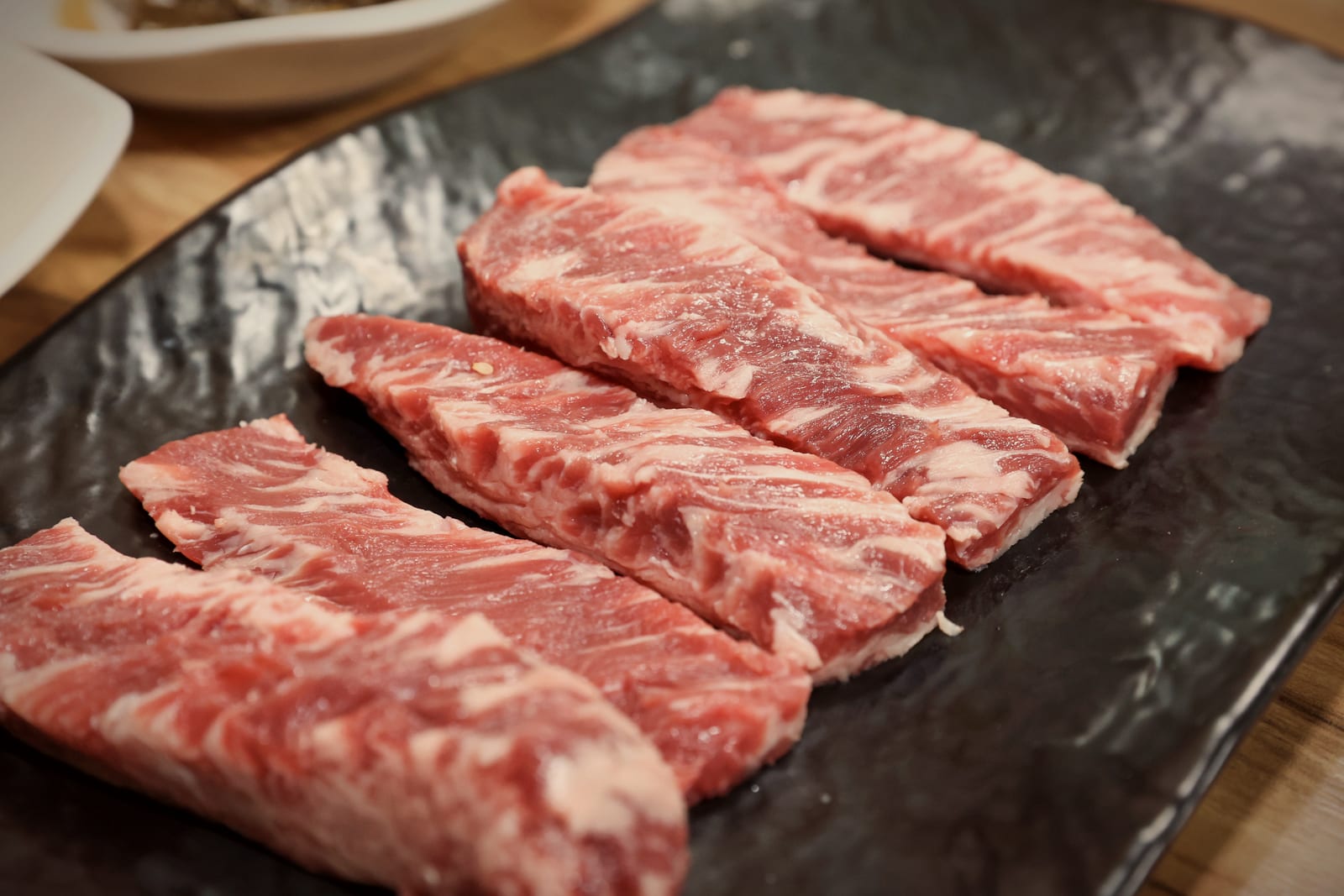
LA galbi and wang-galbi
Galbi means rib, and on its own usually refers to grilled beef ribs (so-galbi, "beef galbi"; pork ribs are dwaeji-galbi). The meat is taken from the short ribs, the rib section of the chuck and plate, rich in fat and connective tissue, which grills well only when cut thin or opened out so that heat crosses it in minutes.
Two cuts dominate. LA galbi is cut across the bones (flanken style) into strips about 1 cm / ½ in thick, each showing three or four small bone ovals. Wang-galbi ("king ribs") keeps one long bone per piece, and the meat attached to it is butterflied — cut in a spiral or accordion into a long, thin ribbon that remains joined to the bone. In the restaurant, the ribbon is laid on the grill, turned, and cut into bite-sized pieces with scissors.
Suwon's ribs and the LA question
Grilled ribs have a long history in Korean cooking, alongside bulgogi and its court ancestor neobiani, but galbi as a restaurant dish grew in the 20th century. The city of Suwon, south of Seoul, which had one of the country's largest cattle markets, became known after the 1940s for its large, salt-seasoned ribs, and "Suwon galbi" is now a recognized regional style.
The origin of the name "LA galbi" is disputed. One explanation is that the cut was popularized by Korean butchers in Los Angeles from the 1970s, who used American flanken-cut short ribs that were cheaper and easier to cut than the Korean style; another is that "LA" comes from "lateral", describing the cut across the bones. Both are repeated, and neither is firmly documented.
Ingredients
| Ingredient | Amount | Note |
|---|---|---|
| Beef short ribs, flanken (LA) cut | 1.5 kg / 3.3 lb | 1 cm / ½ in thick; or butterflied single ribs |
| Soy sauce | 120 ml / ½ cup | |
| Sugar | 50 g / ¼ cup | or part honey |
| Korean pear (or Asian pear) | 1, about 300 g / 10½ oz | grated with its juice |
| Onion | 1, about 150 g / 5 oz | grated |
| Garlic | 8 cloves, about 30 g / 1 oz | minced |
| Fresh ginger | 10 g / ⅓ oz | grated |
| Rice wine (cheongju or mirin) | 60 ml / ¼ cup | |
| Toasted sesame oil | 2 tbsp / 30 ml | |
| Spring onions, sesame seeds, black pepper | 3 onions; 1 tbsp / 8 g; ½ tsp | |
| Water | 120 ml / ½ cup | to rinse and to loosen the marinade |
| Lettuce, perilla leaves, ssamjang, rice | to serve |
Method
- Soak the ribs in cold water for 30–60 minutes, changing the water once, to draw out blood and remove bone fragments from the saw. Drain and pat dry.
- For wang-galbi, butterfly each single rib: with the bone on the board, cut the meat about 1 cm / ½ in thick parallel to the board, almost to the end, unfold it, and repeat until it forms a long, even ribbon still attached to the bone. Score the surface lightly.
- Mix the soy sauce, sugar, pear, onion, garlic, ginger, rice wine, sesame oil, water and pepper. Coat the ribs and refrigerate 4–24 hours; flanken strips need less time than thick butterflied ribs.
- Light a charcoal grill and let it burn down to glowing coals; a gas grill should be very hot. Lift the ribs from the marinade and let excess drip off.
- Grill flanken strips 2–4 minutes per side, until caramelized at the edges and cooked to medium; the sugar burns quickly, so move pieces away from flare-ups.
- For butterflied ribs, grill the meat side first, turn when browned, then cut the ribbon off the bone into pieces with scissors, and finish them in a minute. The bone, with meat clinging to it, is grilled last and eaten by hand.
- Sprinkle with spring onion and sesame and serve at once.
Salt in Suwon, a braise in galbi-jjim
Suwon galbi seasons large butterflied ribs mainly with salt, often with garlic and sesame oil, instead of the dark soy marinade, so that the beef flavour dominates. Galbi-jjim is a festive braise of short ribs with soy, radish, chestnuts and jujubes; galbitang is a clear soup of beef ribs. Tteokgalbi, associated with Damyang and Gwangju in the south-west, is rib meat minced, shaped back onto or around the bone and grilled. In Japan, the related word karubi names fatty rib meat in yakiniku.
At the table grill, then cold noodles
Galbi is usually eaten at the table grill, wrapped in lettuce and perilla leaves with ssamjang, raw garlic and green chili, and followed by cold noodles (naengmyeon) or rice with soybean-paste stew. Common mistakes: cutting the ribs too thick, so the outside burns before the inside is tender; skipping the soak, which leaves bone dust and a metallic taste; grilling over flame, which chars the sugar; and marinating thin flanken strips for days, which makes the meat mushy.
Frequently asked questions
What is LA galbi?
Beef short ribs cut across the bones into thin strips about 1 cm thick (flanken style), marinated and grilled. Why it is called LA is disputed: Los Angeles or 'lateral'.
What is the difference between galbi and bulgogi?
Galbi is made from short ribs, on the bone; bulgogi from thin boneless slices of tender cuts such as sirloin. Both can share a soy-pear marinade.
What is Suwon galbi?
A style from the city of Suwon, south of Seoul, using large butterflied beef ribs seasoned mainly with salt rather than soy sauce.
How long should galbi marinate?
About 4–24 hours in the refrigerator: shorter for thin flanken strips, longer for thick butterflied ribs.
Sources
3
- Korea Institute for Animal Products Quality Evaluation (KAPE). Beef cuts and grading. www.ekape.or.kr
- Pettid, Michael J. Korean Cuisine: An Illustrated History. London: Reaktion Books, 2008.
- Maangchi; Chattman, Lauren. Maangchi's Real Korean Cooking: Authentic Dishes for the Home Cook. Boston: Rux Martin / Houghton Mifflin Harcourt, 2015.
Related