Cut · Flank, long-grained
Flank steak
Flank steak is the rectus abdominis, a flat, lean muscle from the belly with long, coarse fibres running its full length. Seared hot to 52–55 °C / 126–131 °F and sliced thin across the grain, it is tender and full of beef flavour; cut with the grain, it is chewy at any temperature.
Key takeaways
- 73.1 % of each whole piece ended up usable: number 4 of the 7 cuts we have measured.
- Per kilo bought it gives about 660 g of portions (66 % of the weight).
- 12.8 % is fat trimmed off. Measured on 38 pieces, 162.5 kg in total.
Measured by Steakpedia · Steakpedia Field Kitchen
At a glance
- Primal
- Flank
- Muscles
- Rectus abdominis
- Weight
- 700 g–1.2 kg (1.5–2.6 lb)
- Grain
- Long, coarse, along the piece
- Best cooked
- Hot and fast to medium-rare, sliced thin across the grain
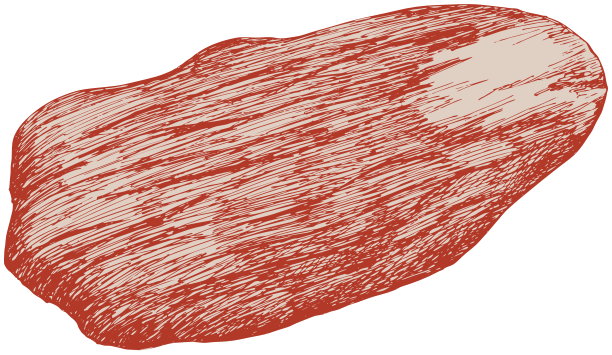 Flank steak
One flat muscle, a coarse grain
The flank steak is the rectus abdominis, the flat muscle that runs along the lower belly from the ribs to the hip. It is about 2–3 cm thick, weighs 700 g to 1.2 kg (1.5–2.6 lb), and has an unmistakable grain: long, coarse fibres running the length of the piece. It is lean, with a thin membrane on each side that butchers remove.
It is often confused with three neighbours. The flap (bavette d'aloyau, US sirloin flap) lies next to it, is thicker and looser, and is sold under some of the same names. The skirt is the diaphragm, further forward and inside the ribcage. And in Argentina the flank steak is only one part of the vacío, the whole abdominal wall cooked slowly in one piece; the steak cut from it is called bife de vacío. Nor is it the matambre, a thin sheet of muscle that lies over the ribs under the hide.
Flank is one of the cuts whose price rose fastest in the 2000s, as fajitas, Vietnamese phở (where thin raw slices are cooked by the broth) and Korean barbecue moved it from mince to steak.
On the belly wall, with no bone
On the belly wall, below the loin and behind the plate. It is one of the few steaks with no neighbouring bone and is removed as a single flat muscle, one per side. The flap sits beside it towards the hip, under the bottom sirloin; the plate and skirt lie forward of it under the ribs.
How it is separated depends on the country. American and Australian specifications (IMPS 193, HAM 2210) list it as a steak in its own right, trimmed of membrane and fat. Argentine butchery keeps the belly wall together as vacío, with its fat and membrane, and the rectus abdominis inside it goes to the grill with the rest unless it is lifted out. French butchery distinguishes the bavette de flanchet (the flank) from the bavette d'aloyau (the flap).
Bavette, London broil, nạm: the flank's other names
Flank is sold as flank steak in the United States, Canada and Australia (IMPS 193, HAM 2210); as bavette in British butcher's shops; as bavette de flanchet in France; as fraldinha in Brazil, a name also used for the flap; as falda in Mexico, where it is braised and shredded; as nạm in Vietnam; and as bife de vacío in Argentina. London broil is not a cut but a preparation, usually of flank. The table in the vacío article shows which of these names mean the flank, the flap or the whole belly wall; the one in skirt steak sorts out the diaphragm cuts that are often mistaken for it.
Cooking it: hot, fast, sliced thin
Two rules: never past medium-rare, and always sliced thin across the grain. Grilled or pan-seared hot for 3–5 minutes a side to 52–55 °C / 126–131 °F at the core, rested, then cut at a low angle against the fibres, it is tender; cut with the grain it is chewy at any temperature. It takes marinades well because its open grain absorbs them, which is why it is the cut of fajitas and London broil.
In Vietnam the flank is sliced paper-thin and dropped raw into boiling phở broth, or simmered whole in the broth and sliced as nạm. Braised, it falls apart into long strands, the basis of Cuban ropa vieja. In Argentina, when it is cooked as part of the whole vacío, it follows the slow method of that cut over low embers.
Where a kilo of flank goes
Across 38 batches of flank broken down by the Steakpedia Field Kitchen between July and October 2026, 162.5 kg of Angus flank in total, 66% of the weight bought became steaks once the membrane, fat and ragged ends were removed. Another 7% was meat good for fajitas, stir-fries or mince, so 73.1% was eaten; the rest was fat and membrane.
The spread between batches was wide, from 40% to 89% of steaks, which is what thin ends and membranes do to a flat muscle: a flank of even thickness from end to end gives far more than one that tapers sharply.
Fig. 1
Where one kilo of flank steak goes
Share of the whole piece by weight, %. 38 pieces measured.
Portions 66 %Other usable meat 7.1 %Fat 12.8 %Silverskin, sinew, loss 14.1 %
| Part | Share | Per kg bought | Used for |
|---|---|---|---|
| Steaks | 66% | ≈ 660 g | Grilled whole and sliced across the grain, fajitas, steak salad |
| Other usable meat | 7.1% | ≈ 70 g | Thin ends and trim: stir-fries, fajitas, mince |
| Fat | 12.8% | ≈ 130 g | Rendered or discarded |
| Membrane, sinew, loss | ≈ 14% | ≈ 140 g | Discarded |
Even from end to end
A good flank is even in thickness from end to end, deep red, with fine white fat between the fibres rather than thick seams, and the membranes already removed. Pieces that thin out sharply at one end cook unevenly; they can be folded or the thin end cut off and cooked first.
Labels vary. In Britain and France bavette may mean either the flank or the flap; in Brazil fraldinha is used for both; in Argentina a butcher asked for vacío will sell the whole wall, and the flank steak alone should be requested as bife de vacío or by its English name. Pre-marinated flank, common in American supermarkets, hides the colour of the meat and is best avoided when quality matters.
Fig. 2
Usable meat, cut by cut
Usable share of each whole piece after trimming, %. n = pieces measured.
Names around the world
18
The same muscle, named by language and by trade system.
| English | Flank |
| Tiếng Việt | Nạm bò |
| Español | Flank · bife de vacío (Argentina) |
| 한국어 | 플랭크 |
| 日本語 | フランク |
| Français | Bavette de flanchet |
| Italiano | Fianco |
| Русский | Фланк |
| 中文 | 腹腩排 |
All the cuts' names, country by country →
Trade and national systems
| System | Name | Reference |
|---|---|---|
| United States | Flank steak · London broil (as a preparation) | IMPS 193 |
| United Kingdom | Flank · bavette (often also the flap) | AHDB |
| Australia / NZ | Flank steak | HAM 2210 |
| Argentina | Vacío region; the flank steak proper is sold as bife de vacío. Matambre is a different muscle (cutaneous trunci, over the ribs). | IPCVA |
| Brazil | Fraldinha (often also the flap) | Portaria 5/88 |
| France | Bavette de flanchet | Larousse |
| Mexico | Falda (braised and shredded) | |
| Vietnam | Nạm (in phở) | |
| Japan | ともばら · フランク | JMGA |
Field data
Numbers measured in a working kitchen, piece by piece, not taken from a table. Another kitchen, another trimming specification, another number. How field data is collected.
Field data
Flank
Steakpedia Field Kitchen3 Jul 2026 – 21 Oct 2026
Frequently asked questions
Is skirt steak the same as flank steak?
No. Skirt is the diaphragm, thinner, fattier and looser in grain; flank is a belly muscle, thicker and leaner. Both are cooked fast and sliced across the grain.
Vacío vs flank: what is the difference?
Flank steak is one muscle, the rectus abdominis. Vacío is the Argentine cut of the whole abdominal wall, which includes it, with fat and membrane, cooked slowly for one to two hours.
How do you keep flank steak tender?
Cook it hot and fast to no more than medium-rare, rest it for a few minutes, and slice it thin across the grain at a low angle.
What is flank steak called in phở?
In Vietnamese phở the flank is nạm, simmered in the broth and sliced, while raw thin slices of lean beef added at the table are tái.
Is there another name for flank steak?
Bavette in Britain, bavette de flanchet in France, fraldinha in Brazil, falda in Mexico, nạm in Vietnam, bife de vacío in Argentina. In the United States it is sometimes labelled London broil, though that is really a way of cooking it.
Is flank steak a good cut of beef?
Yes, for fast cooking and slicing: it is lean, beefy and even in thickness. It is not a steak to eat whole like a ribeye; served in thin slices across the grain it is tender.
Is flank steak a cheap cut?
Cheaper than the loin steaks, but no longer a budget cut: fajitas, stir-fries and Korean barbecue raised its price. Flap meat is often cheaper; outside skirt usually costs more.
Can I use skirt instead of flank?
Yes, in fajitas, stir-fries and steak salads. Skirt is thinner and fattier, so it needs less time (2–3 minutes a side) and is juicier; flank gives neater slices.
Is flank or skirt less fatty?
Flank. It is one of the leanest steaks; across 38 batches measured, 12.8% of a flank's weight was fat trimmed off before portioning. Skirt, especially outside skirt, carries more fat between its fibres.
How much steak does a flank give?
About 660 g of steak per kilo bought, plus about 70 g of meat for stir-fries, fajitas or mince: across 38 batches measured, 66% of the weight became steaks and 73.1% was usable.
Sources
7
- USDA Agricultural Marketing Service. Institutional Meat Purchase Specifications: Fresh Beef Series 100. Washington, DC, 2014. www.ams.usda.gov/sites/default/files/media/IMPS_100_Fresh_Beef%5B1%5D.pdf
- AUS-MEAT Limited. Handbook of Australian Meat, 7th ed. (International Red Meat Manual). Brisbane, 2005. www.ausmeat.com.au
- Instituto de Promoción de la Carne Vacuna Argentina (IPCVA). Cortes de carne vacuna argentina — nomenclatura y usos. Buenos Aires. www.ipcva.com.ar
- Brasil, Ministério da Agricultura, SIPA. Portaria nº 5, de 8 de novembro de 1988 — Padronização de cortes de carne bovina.
- Larousse Gastronomique, rev. ed. London: Hamlyn, 2009.
- McGee, Harold. On Food and Cooking: The Science and Lore of the Kitchen, rev. ed. New York: Scribner, 2004.
- Steakpedia Field Kitchen. Butchery records, July–October 2026: 279 sheets, 1,604.6 kg of meat processed, weighed piece by piece on a calibrated scale and logged per cut. Open data, CC BY 4.0. steakpedia.com/field-data
Related