Main course · River Plate embers
Asado
Asado is the Argentine and Uruguayan way of grilling beef, offal and sausages slowly over hardwood embers, seasoned only with coarse salt. The heat comes from coals shovelled under the grill, not from flame, and the meat comes in turns: chorizo and offal first, then the large cuts.
At a glance
- Origin
- Argentina, Uruguay, southern Brazil, Paraguay
- Fire
- Hardwood embers or lump charcoal, no flame
- Quantity
- About 500 g / 1.1 lb raw meat per adult
- Time
- 2–3 h from lighting to the last cut
- Seasoning
- Coarse salt only
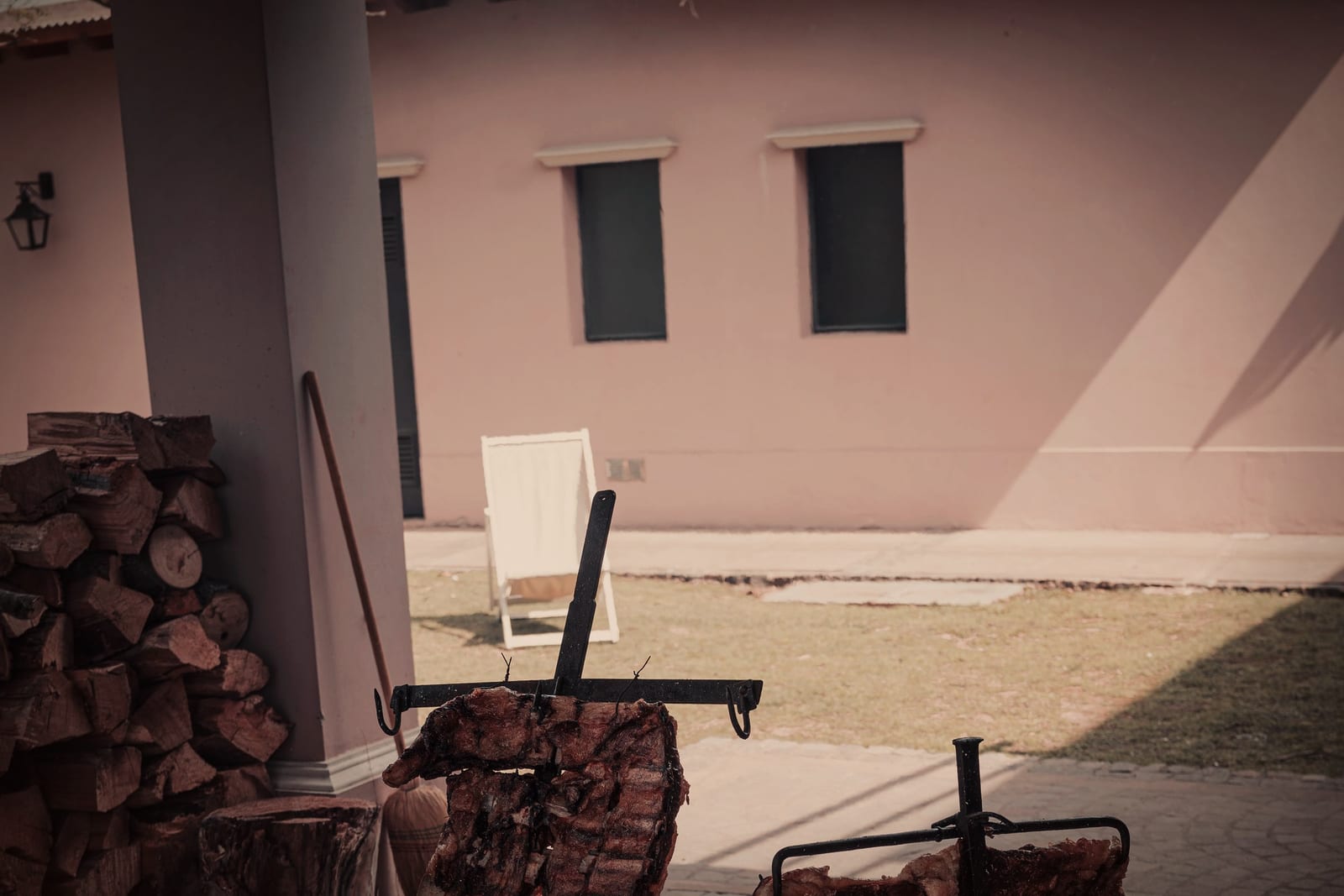
A technique and a gathering
In the Río de la Plata, asado names both the technique and the gathering. The technique is slow grilling over embers: the wood or charcoal burns down in a corner, and the cook (asador) shovels glowing coals under the grill, adjusting the heat by the amount of embers rather than by flame. The meat is seasoned only with coarse salt; sauces such as chimichurri and salsa criolla are served at the table.
A full asado is served in courses: sausages and offal come off first, eaten as starters while the large cuts, which need more time, finish cooking. Argentina has one of the highest beef consumptions per person in the world, and the asado is its central social meal.
From the gauchos' iron cross
The asado comes from the gauchos of the pampas, the horsemen of the 18th and 19th centuries who lived among wild and semi-wild cattle and roasted meat on iron spits over open fires. The older method, asado al asador or a la cruz, splays whole animals or large sides on iron crosses tilted towards the fire; asado con cuero cooks the meat in its hide.
The flat grill (parrilla) over embers became standard with urban life in the late 19th and 20th centuries, along with Argentina's beef cuts — asado de tira, vacío, entraña, matambre — that differ from those of Europe or North America. Francis Mallmann's Seven Fires describes the parrilla among the traditional Argentine fires.
Coals underneath, flame to one side
Hardwood is preferred: in Argentina quebracho and algarrobo burn slowly and give long-lasting embers; lump charcoal is the common alternative. The fire is kept to one side and fed continuously; only coals go under the meat. A simple test is the hand: held at grill height, a medium fire for large cuts allows about 8–10 seconds before the heat forces it away.
Fat dripping onto the coals must not flare. Many parrillas are tilted, with channels that carry the fat away, and the grill bars are V-shaped for the same reason. Burning flame blackens the surface without cooking the inside.
Ingredients
| Item | Amount (for 8) | Note |
|---|---|---|
| Chorizo (fresh pork-beef sausage) | 8 pieces, about 1 kg / 2.2 lb | first off the grill |
| Morcilla (blood sausage) | 4–8 pieces, about 600 g / 1.3 lb | low heat; it bursts |
| Mollejas (sweetbreads) | 500 g / 1.1 lb | blanched or raw, finished with lemon |
| Chinchulines (small intestine) | 500 g / 1.1 lb | cleaned, cooked until crisp |
| Provoleta (provolone cheese) | 1 round, 1.5 cm / ½ in thick | optional |
| Asado de tira (cross-cut short ribs) | 1.5 kg / 3.3 lb | bone side down first |
| Vacío (flank with its fat) | 1.5–2 kg / 3.3–4.4 lb | fat side down first |
| Entraña (outside skirt) | 1 kg / 2.2 lb | fast, high heat |
| Coarse salt (sal parrillera) | about 2% of the meat weight | no pepper, no marinade |
| Hardwood or lump charcoal | 8–10 kg / 18–22 lb | for 2–3 hours of fire |
Method
- Light the wood or charcoal about 45 minutes before cooking and let it burn down to embers. Clean and heat the grill.
- Spread a thin layer of embers under the grill. Put the large, slow cuts on first: vacío fat side down and asado de tira bone side down, salted with coarse salt; matambre or picanha (tapa de cuadril) also fat side down.
- After about 30 minutes, add the chorizos and morcillas at the edge, over gentle heat; cook chorizos 20–30 minutes, morcillas 15–20 minutes. Serve them first, in bread (choripán) or on a board.
- Grill the offal: sweetbreads 40–60 minutes until golden and firm, finished with lemon; chinchulines until crisp. Serve as a second course with the provoleta, grilled 5–10 minutes until bubbling.
- Turn the large cuts once, when juice appears on the top surface and the underside is brown: short ribs after 40–60 minutes, vacío after about 1 hour. Total cooking is roughly 1–1.5 hours for short ribs and 1.5–2 hours for vacío.
- Grill the entraña last, over hotter coals, 5–8 minutes per side. Lean, thick cuts such as ribeye (ojo de bife) are also cooked last and fast.
- Rest each cut briefly, slice it against the grain on a board, and bring it to the table in rounds, with chimichurri, salsa criolla and salads.
When to salt, and which cuts
Salting differs: some asadores salt at the start, others at turning, and some use salmuera, a saltwater brine brushed on during cooking. In Uruguay the asado is often fired with wood only and includes pulpón and costilla; Brazil's churrasco uses skewers and picanha with a fat cap. Other common cuts are flank (bife de vacío in some regions), skirt, colita de cuadril (tri-tip) and bife de chorizo (striploin). Whole lamb or kid al asador is common in Patagonia and the north-west.
In turns, with Malbec or Tannat
The asado is served in turns rather than all at once, with mixed salads (lettuce, tomato and onion), bread and red wine, usually Malbec in Argentina and Tannat in Uruguay. Custom has the guests applaud the asador at the end. Common mistakes: cooking over flame, too much heat at the start, turning the meat repeatedly, piercing it with a fork, and salting thin cuts long in advance.
Frequently asked questions
What is the order of an Argentine asado?
Sausages (chorizo and morcilla) first, then offal such as sweetbreads and chinchulines with provoleta, and finally the large cuts: short ribs, vacío, entraña, matambre.
How much meat per person for an asado?
About 500 g (1.1 lb) of raw meat per adult, including sausages and offal; more if bone-in cuts dominate.
Is an asado cooked with charcoal or wood?
Both: hardwood embers are traditional, lump charcoal is common. Only embers go under the meat, never flame.
What is the difference between asado and barbecue?
Asado uses embers on an open grill, coarse salt only and no sauce while cooking; American barbecue usually means smoking with indirect heat and rubs or sauces.
Sources
4
- Mallmann, Francis; Kaminsky, Peter. Seven Fires: Grilling the Argentine Way. New York: Artisan, 2009.
- Instituto de Promoción de la Carne Vacuna Argentina (IPCVA). Cortes de carne vacuna argentina — nomenclatura y usos. Buenos Aires. www.ipcva.com.ar
- McGee, Harold. On Food and Cooking: The Science and Lore of the Kitchen, rev. ed. New York: Scribner, 2004.
- OECD/FAO. OECD-FAO Agricultural Outlook 2024–2033, "Meat" (per-capita consumption tables). Paris, 2024. www.oecd.org/en/publications/oecd-fao-agricultural-outlook-2024-2033_4c5d2cfb-en.html
Related