Cut · Short loin, one muscle
Striploin
The striploin is the boneless loin muscle behind the ribs: one firm grain and a strip of fat along one edge. Leaner than the ribeye, it is best rare to medium-rare, and no steak carries more names — New York strip, sirloin, bife de chorizo, contre-filet.
Key takeaways
- 78.2 % of each whole piece ended up usable: number 3 of the 7 cuts we have measured.
- Per kilo bought it gives about 772 g of portions (77.2 % of the weight).
- 7.8 % is fat trimmed off. Measured on 11 pieces, 56 kg in total.
Measured by Steakpedia · Steakpedia Field Kitchen
At a glance
- Primal
- Short loin (13th rib to the hip)
- Muscles
- Longissimus lumborum; gluteus medius at the hip end
- Weight
- Whole 4–6 kg · steaks 250–500 g
- Best cooked
- Rare to medium-rare, 50–55 °C / 122–131 °F
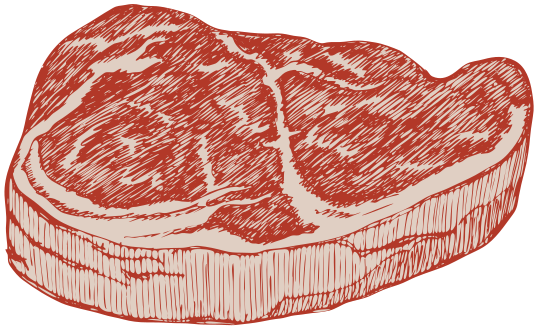 Strip steak
One muscle, one grain, one strip of fat
The striploin is the continuation of the same long back muscle that forms the eye of the ribeye, the longissimus, once it passes the thirteenth rib. Past that point the marbled cap disappears and the muscle becomes a single, even cylinder with a layer of external fat along its back. That is why a striploin steak looks tidy and uniform: one muscle, one grain, one strip of fat.
The name problem is real. In the United Kingdom and Australia this cut is sold as sirloin; in the United States “sirloin” is a different, cheaper cut further back, and the striploin is the New York strip. Australians also call a boneless striploin steak a porterhouse, which in the United States is a bone-in steak with a large piece of tenderloin attached. In Argentina it is the bife de chorizo, one of the most ordered steaks in the country, and has nothing to do with sausage. In Spain the same muscle is the lomo bajo.
Left on the bone with the tenderloin on the other side of the vertebra, the striploin becomes a T-bone or porterhouse. Boneless, it is sold whole (4–6 kg) or as steaks of 250–500 g.
From the last rib to the hip
The short loin runs from the last rib to the front of the hip bone. Steaks from the rib end have a rounder eye and may show a small vein of connective tissue; steaks from the hip end are wider and a second muscle, the gluteus medius, begins to appear, which butchers call the “vein end”. Most restaurants prefer the centre cut, where the muscle is even and the grain runs straight.
In the American primal map the striploin is one half of the short loin; the other half is the tenderloin. It is sold boneless as IMPS 180 and cut into strip steaks as IMPS 1180; bone-in, the steak is a Kansas City strip. In the Australian system it arrives boneless as a striploin (HAM 2140), with the fat cover trimmed to a specified depth. In the Argentine map, cut bone-in, it is the bife angosto.
Strip, sirloin or porterhouse: one steak, many names
No steak changes name as often between countries, and two of its names mean a different steak elsewhere. Ordering a “sirloin” in London or Sydney gets you this cut; in New York it gets you a cheaper steak from the hip. A “porterhouse” in Australia is a boneless striploin; in the United States it is a large bone-in steak with the tenderloin attached.
Fig. 1
Where one kilo of striploin goes
Share of the whole piece by weight, %. 11 pieces measured.
Portions 77.2 %Other usable meat 1 %Fat 7.8 %Silverskin, sinew, loss 14 %
| Name | Where | What you get |
|---|---|---|
| New York strip · strip steak | United States, Canada | Boneless striploin steak |
| Kansas City strip | United States | Bone-in striploin steak |
| Sirloin | UK, Ireland, Australia, NZ, South Africa | Striploin |
| Sirloin · top sirloin | United States | A different cut: the rump (gluteus medius) |
| Porterhouse | Australia, NZ | Boneless striploin steak |
| Porterhouse | United States | Bone-in: striploin + a large piece of tenderloin |
| Bife de chorizo | Argentina, Uruguay | Boneless striploin steak, cut thick |
| Lomo bajo | Spain | Striploin |
| Faux-filet · contre-filet | France | Striploin |
| サーロイン sāroin | Japan | Striploin |
| 채끝 chaekkeut | South Korea | Striploin |
| 西冷 xīlěng | Hong Kong, Singapore, China | Striploin (menus) |
How many steaks in a whole striploin
Across 11 boneless striploins broken down by the Steakpedia Field Kitchen between July and October 2026, 56 kg in total, the average piece weighed 5.1 kg and 77.2% of its weight became steaks: about 10 steaks of 400 g, 13 of 300 g or 16 of 250 g. The rest was 7.8% fat, 1.1% usable trim and losses from squaring off the tail and the vein end. The sample is smaller than for the ribeye (61 pieces), so the figure is an indication, not a standard.
Fig. 2
Usable meat, cut by cut
Usable share of each whole piece after trimming, %. n = pieces measured.
| Part | % | Per kg | Used for |
|---|---|---|---|
| Steaks | 77.2% | ≈ 772 g | Strip steaks |
| Other usable meat | 1% | ≈ 10 g | Trim for burgers, mince, stock |
| Fat | 7.8% | ≈ 78 g | Rendered or discarded |
| Silverskin, sinew, loss | 14% | ≈ 140 g | Discarded |
Cooking it: rare, the fat edge rendered
The striploin has less internal fat than a ribeye and a firmer bite, so it rewards less cooking: rare to medium-rare (50–55 °C / 122–131 °F core) is where its texture is best. Its fat strip wants rendering; scoring it, or standing the steak on that edge in the pan for a minute, browns it and keeps the steak from curling as the strip contracts.
It takes well to a hard sear over high heat, to reverse searing when thick, and to the parrilla: the bife de chorizo is cooked over wood embers, fat side first, salted with coarse salt and served with the fat crisp. In French kitchens the faux-filet is pan-fried in butter and finished with a pan reduction. In Japan, sāroin is the name used for the highly marbled loin of Wagyu, served as steak or sliced thin for sukiyaki.
Because the grain runs along the length of the muscle, a striploin steak is sliced across that grain after resting, in strips of about 1 cm.
Choosing one: even, with 5–10 mm of fat
A good striploin steak has an even thickness from the fat edge to the far side and a fat strip of 5–10 mm; much more is waste, much less leaves the steak without protection on the grill. Marbling is graded on the ribeye, not here, so the same carcass grade can give a striploin with visibly less fat than its ribeye; it is worth looking at the steak itself.
Ask for centre-cut steaks if uniformity matters; vein-end steaks are cheaper but carry the connective tissue between the two muscles. Bought whole, a striploin is one of the simplest primals to portion: the fat is trimmed, the thin tail end and the vein end are squared off, and the rest is cut into steaks of equal thickness, usually 2.5–4 cm. Striploin also takes well to dry-ageing, and is often aged whole on the bone as part of the short loin.
Names around the world
20
The same muscle, named by language and by trade system.
| English | Striploin · New York strip · sirloin (UK, Australia) |
| Tiếng Việt | Thăn ngoại (striploin) |
| Español | Bife de chorizo (Argentina) · lomo bajo (España) · New York (México) |
| 한국어 | 채끝 (chaekkeut) |
| 日本語 | サーロイン (sāroin) |
| Français | Faux-filet · contre-filet |
| Italiano | Controfiletto |
| Русский | Стриплойн |
| 中文 | 西冷 (xīlěng) · 外脊 (wàijǐ) |
| Português | Contrafilé |
All the cuts' names, country by country →
Trade and national systems
| System | Name | Reference |
|---|---|---|
| United States | Strip steak · New York strip · Kansas City strip (bone-in) · top loin | IMPS 180 / 1180 |
| United Kingdom | Sirloin steak (note: not the US sirloin) | AHDB |
| Australia / NZ | Striploin · porterhouse (Australian usage) · sirloin | HAM 2140 |
| Argentina | Bife de chorizo · bife angosto (bone-in) | IPCVA |
| Brazil | Contrafilé | Portaria 5/88 |
| France | Faux-filet · contre-filet | Larousse |
| Japan | サーロイン (sāroin) | JMGA |
| South Korea | 채끝 (chaekkeut) | KAPE |
| China · Hong Kong · Singapore | 外脊 wàijǐ (trade) · 西冷 xīlěng (menus, from “sirloin”) | |
| Spain | Lomo bajo · often sold as entrecot |
Field data
Numbers measured in a working kitchen, piece by piece, not taken from a table. Another kitchen, another trimming specification, another number. How field data is collected.
Field data
Striploin
Steakpedia Field Kitchen1 Jul 2026 – 20 Oct 2026
Frequently asked questions
Is sirloin the same as striploin?
It depends on the country. In the UK and Australia “sirloin” is the striploin. In the United States sirloin is a different cut from the hip, behind the short loin, and the striploin is called New York strip.
What is bife de chorizo?
The Argentine name for the boneless striploin steak, usually cut thick and grilled over embers. Despite the name, it has nothing to do with chorizo sausage.
Striploin vs ribeye: which is leaner?
The striploin. Both come from the same muscle, but the ribeye keeps a marbled cap and a seam of fat; the striploin is a single, firmer muscle with its fat on the outside.
What is a Kansas City strip?
A strip steak cut with the bone still on: the striploin side of a T-bone, with the tenderloin removed. A bone-in steak from the rib end, where the tenderloin barely reaches, is also sold as a club steak.
Why is it called New York strip?
The name is usually traced to New York restaurants of the 19th century, Delmonico's among them, which made the boneless loin steak famous. The same steak bone-in is the Kansas City strip, after the Midwest meat trade.
Is New York strip a good steak?
Yes: it is the firmest and beefiest of the premium steaks, tender but with more bite than a ribeye or a tenderloin, and the easiest to cook evenly because it is one muscle of even thickness.
Is a porterhouse the same as a striploin?
In Australia and New Zealand, yes: “porterhouse” is the boneless striploin steak. In the United States a porterhouse is a bone-in steak from the short loin with a large piece of tenderloin, a larger T-bone.
How many steaks are in a whole striploin?
About 10 steaks of 400 g, 13 of 300 g or 16 of 250 g from an average 5.1 kg boneless striploin, measured across 11 pieces; 77.2% of the weight became steaks.
New York strip vs filet mignon?
The strip has more flavour, a fat edge and a firmer bite; the filet mignon is softer, leaner and milder. Measured per kilo bought, a striploin gives about 772 g of steaks and a whole tenderloin about 570 g.
Sources
7
- USDA Agricultural Marketing Service. Institutional Meat Purchase Specifications: Fresh Beef Series 100. Washington, DC, 2014. www.ams.usda.gov/sites/default/files/media/IMPS_100_Fresh_Beef%5B1%5D.pdf
- AUS-MEAT Limited. Handbook of Australian Meat, 7th ed. (International Red Meat Manual). Brisbane, 2005. www.ausmeat.com.au
- Agriculture and Horticulture Development Board (UK). Beef Meat Purchasing Guide. Kenilworth, 2016. ahdb.org.uk
- Instituto de Promoción de la Carne Vacuna Argentina (IPCVA). Cortes de carne vacuna argentina — nomenclatura y usos. Buenos Aires. www.ipcva.com.ar
- Larousse Gastronomique, rev. ed. London: Hamlyn, 2009.
- McGee, Harold. On Food and Cooking: The Science and Lore of the Kitchen, rev. ed. New York: Scribner, 2004.
- Steakpedia Field Kitchen. Butchery records, July–October 2026: 279 sheets, 1,604.6 kg of meat processed, weighed piece by piece on a calibrated scale and logged per cut. Open data, CC BY 4.0. steakpedia.com/field-data
Related