Cut · Rib, the long bone
Tomahawk
The tomahawk is a bone-in ribeye with the rib bone left 12–20 cm long and scraped clean, shaped like a short-handled axe. At 5 cm or more, it is cooked slowly first and seared at the end.
At a glance
- Primal
- Rib (ribs 6–12), bone-in
- Muscles
- Longissimus dorsi, spinalis dorsi, complexus — the ribeye
- Weight
- 1–1.5 kg (2.2–3.3 lb), 5–6 cm thick
- Bone
- 12–20 cm of frenched rib
- Best cooked
- Reverse sear, pulled at 52–55 °C / 126–131 °F
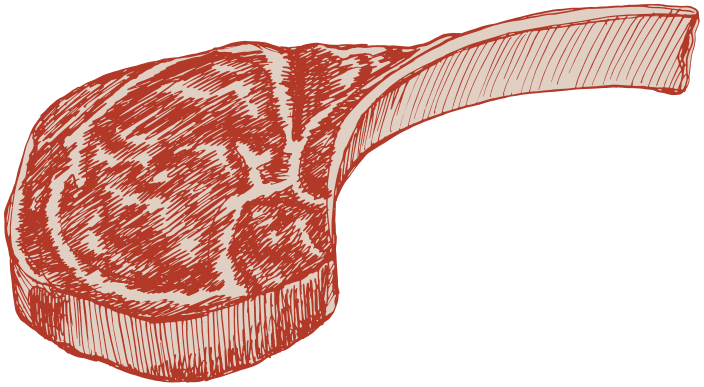 Tomahawk
A rib steak with the bone left long
A tomahawk is not a separate muscle. It is a rib steak, the bone-in version of the ribeye, cut one rib thick with the full length of the rib bone left attached. The meat on the bone is the longissimus eye, the spinalis cap and the fat seam between them, exactly as in any ribeye.
The bone is frenched: the meat, fat and membrane between the ribs are scraped away so that 12–20 cm of clean bone stand out from the steak. A shorter frenched bone of about 5–10 cm is usually sold in the United States as a cowboy steak. A tomahawk is typically 5–6 cm thick and weighs 1–1.5 kg, of which the bone accounts for a substantial part.
Tomahawk, cowboy, côte de bœuf: one rib, many names
All of these are steaks from the same rib with the same meat; what changes is how much bone is left on and how it is cleaned.
| Name | Where | The bone |
|---|---|---|
| Tomahawk | Worldwide | Full rib, frenched, 12–20 cm or more |
| Cowboy steak | United States | Frenched, cut to about 5–10 cm |
| Bone-in ribeye · rib steak | US, UK, Australia | Short, not frenched |
| Côte de bœuf | France, UK | Thick bone-in rib steak, short bone |
| Chuletón | Spain | Thick bone-in rib steak, short bone |
| Bife ancho con hueso | Argentina | Bone-in rib steak; with the long bone, tomahawk |
| トマホーク tomahōku | Japan | Tomahawk |
| 토마호크 tomahokeu | South Korea | Tomahawk |
Ribs six to twelve, bones left full length
The tomahawk is cut from the rib primal (ribs 6–12), from a rib set that has been left with the rib bones at their full length rather than cut short at the chine. Because the long bone is part of the plate, the butcher has to keep the rib ends that are otherwise used for short ribs. In IMPS terms it is a variant of item 1103, the bone-in rib steak; the Australian HAM and the Argentine IPCVA maps describe the same piece as a rib eye or bife ancho on the long bone.
How much of a rib becomes tomahawks
Across 14 bone-in rib sets frenched into tomahawks by the Steakpedia Field Kitchen between July and October 2026, 79.4 kg in total, 71.1% of the weight became tomahawks. Frenching costs weight: the meat, fat and membrane scraped from between the bones are mostly not usable as steak, one reason a tomahawk costs more per gram of meat than a boneless ribeye.
In round numbers, a 5.7 kg rib set gives about 4 kg of tomahawks: four of 1 kg or three of about 1.3 kg. A tomahawk of 1–1.2 kg is a main course for two, or for three with sides, because a good part of its weight is bone.
| Part | Share | Per kg bought | Used for |
|---|---|---|---|
| Tomahawks | 71.1% | ≈ 710 g | Tomahawk steaks, weighed with the bone |
| Other usable meat | 1.1% | ≈ 10 g | Trim: mince |
| Fat | 9.3% | ≈ 95 g | Rendered or discarded |
| Bone ends, membrane, loss | ≈ 18.5% | ≈ 185 g | Stock or discarded |
Cooking it: slow first, sear last
At 5 cm or more, a tomahawk cannot be cooked like a thin steak. The usual method is a reverse sear: a slow start in a low oven, over indirect coals or in a water bath, until the core reaches about 45–48 °C / 113–118 °F, then a hard sear over high heat. It is pulled at 52–55 °C / 126–131 °F for medium-rare, rested 10–15 minutes and carved off the bone into slices.
The bone conducts heat poorly and shields the meat next to it, which cooks more slowly than the outer edge; the thermometer goes into the thickest part, away from the bone. Over an open fire the bone is often wrapped in foil to keep it from charring. The same rules as the ribeye apply: its fat wants enough heat to soften.
Look at the eye, not the bone
Price per kilo includes the bone, so a tomahawk costs more per gram of meat than a boneless ribeye of the same grade. Look at the eye rather than the bone: marbling, a well-formed cap and an even thickness across the steak. A clean, pale bone shows careful frenching. Tomahawks are also cut from dry-aged or Wagyu rib sets; the grade and ageing of the rib decide the eating quality, not the length of the bone. One tomahawk is usually shared by two or three people; for a comparable bone-in steak with two muscles, see the T-bone.
Names around the world
18
The same muscle, named by language and by trade system.
| English | Tomahawk |
| Tiếng Việt | Tomahawk |
| Español | Tomahawk |
| 한국어 | 토마호크 |
| 日本語 | トマホーク |
| Français | Tomahawk |
| Italiano | Tomahawk |
| Русский | Рибай |
| 中文 | 肋眼 |
| Português | Tomahawk |
All the cuts' names, country by country →
Trade and national systems
| System | Name | Reference |
|---|---|---|
| United States | Tomahawk · long-bone rib steak · cowboy steak (shorter frenched bone) | IMPS 1103 |
| United Kingdom | Tomahawk · long-bone rib | AHDB |
| Australia / NZ | Tomahawk · rib eye on the bone, long bone | HAM |
| Argentina | Tomahawk · bife ancho con hueso largo | IPCVA |
| France | Côte de bœuf (short bone) · tomahawk | Larousse |
| Spain | Chuletón (short bone) · tomahawk | |
| Japan | トマホーク (tomahōku) | |
| South Korea | 토마호크 (tomahokeu) |
Frequently asked questions
Tomahawk vs ribeye: what is the difference?
Only the bone. A tomahawk is a bone-in ribeye with the long rib bone left on and cleaned. The meat, marbling and cooking are the same.
Tomahawk vs cowboy steak?
Both are frenched bone-in rib steaks. The cowboy steak keeps a short bone, about 5–10 cm; the tomahawk keeps the full rib, 12–20 cm or more.
How long does a tomahawk take to cook?
With a reverse sear, roughly 45–75 minutes of slow cooking to reach 45–48 °C / 113–118 °F in the core, then a few minutes of searing and 10–15 minutes of rest. Time depends on thickness; a thermometer decides.
What cut of steak is a tomahawk?
A bone-in ribeye (rib steak) from ribs 6–12, cut one bone thick, with the whole rib bone left on and scraped clean. In Australia the same meat without the bone is the scotch fillet.
Why is a tomahawk steak so expensive?
It is sold by weight with the bone, so part of what you pay for is bone; it comes from the rib, one of the dearest primals; frenching takes butcher's time; and leaving the rib long means giving up the short ribs. Per gram of meat it costs more than a boneless ribeye of the same grade.
How much does a tomahawk weigh and how many people does it feed?
Usually 1–1.5 kg with the bone and 5–6 cm thick. One of 1–1.2 kg feeds two, or three with sides, because a good part of the weight is bone.
How many tomahawks are in a rib?
One per rib bone, so at most seven per side from ribs 6–12. By weight, about 71% of a bone-in rib set becomes tomahawks (measured across 14 sets), so a 5.7 kg set gives about four of 1 kg.
What is the best way to cook a tomahawk steak?
A reverse sear: cook it slowly over indirect heat or in a low oven until the core reaches 45–48 °C / 113–118 °F, sear it hard over high heat, pull at 52–55 °C / 126–131 °F for medium-rare and rest 10–15 minutes before carving it off the bone.
Why is it called a tomahawk?
For its shape: the long, clean rib bone looks like the handle of a small axe, with the steak as the blade. The meat is the same as in any bone-in ribeye.
Sources
4
- USDA Agricultural Marketing Service. Institutional Meat Purchase Specifications: Fresh Beef Series 100. Washington, DC, 2014. www.ams.usda.gov/sites/default/files/media/IMPS_100_Fresh_Beef%5B1%5D.pdf
- AUS-MEAT Limited. Handbook of Australian Meat, 7th ed. (International Red Meat Manual). Brisbane, 2005. www.ausmeat.com.au
- Instituto de Promoción de la Carne Vacuna Argentina (IPCVA). Cortes de carne vacuna argentina — nomenclatura y usos. Buenos Aires. www.ipcva.com.ar
- McGee, Harold. On Food and Cooking: The Science and Lore of the Kitchen, rev. ed. New York: Scribner, 2004.
Related