Cooking · Low oven, sear last
Reverse sear
The reverse sear cooks a thick steak slowly in a low oven, at 90–135 °C / 200–275 °F, until it is a few degrees short of its target, then finishes it in a smoking-hot pan or over embers. The inside turns one even pink from edge to edge; the dried surface takes a dark crust in under a minute, with almost no carryover.
At a glance
- Best for
- Steaks 4 cm / 1½ in and thicker
- Oven
- 90–135 °C / 200–275 °F
- Leave the oven at
- 8–11 °C / 15–20 °F below target
- Final sear
- 45–90 s per side
- Carryover
- Almost none
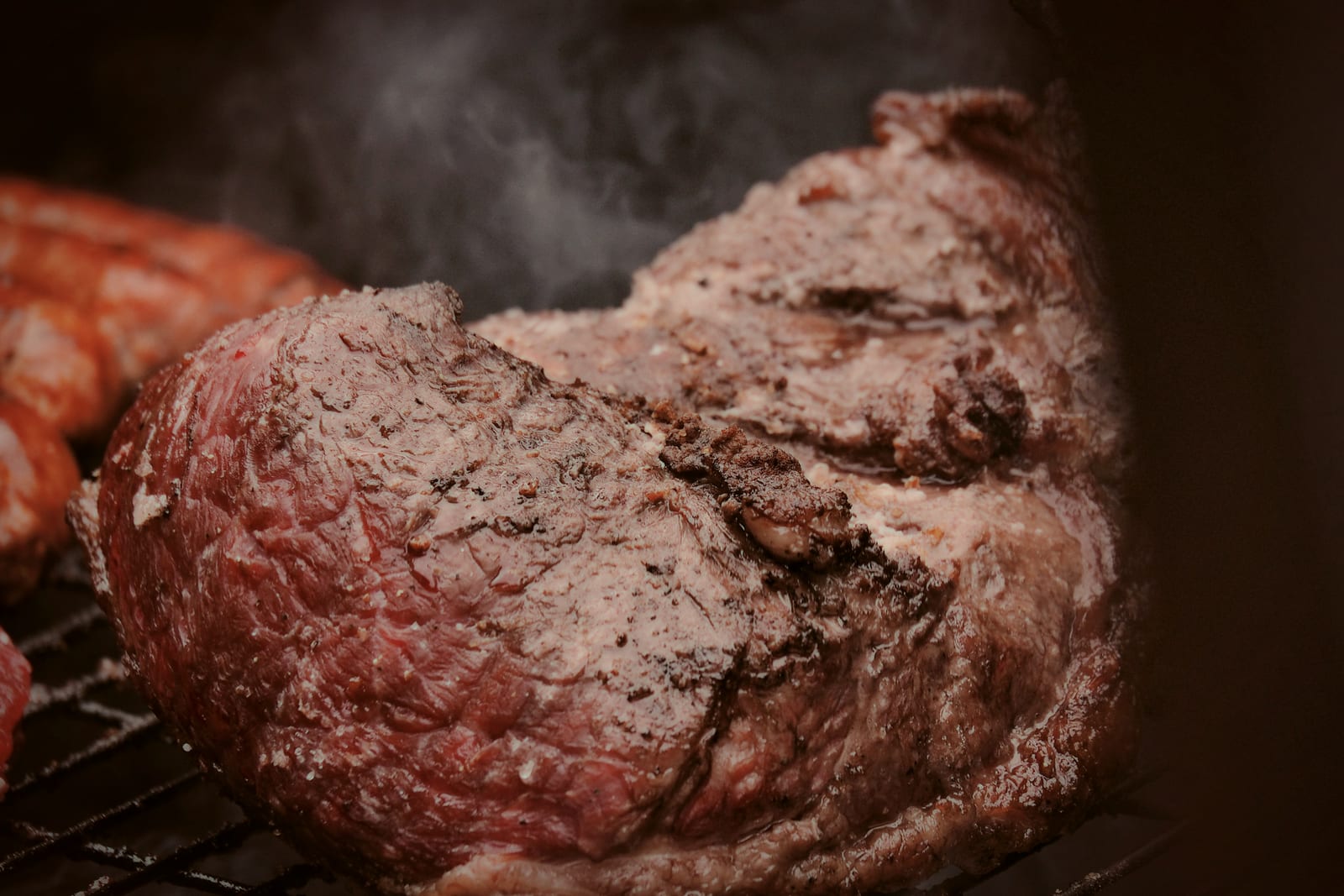
Sear last, not first
The reverse sear inverts the classic order of searing first and finishing in the oven. The steak is cooked gently until its centre is within a few degrees of the final temperature, then given a short, intense sear for the crust. The technique was popularised in the 2000s by American food writers, notably J. Kenji López-Alt, and draws on the same logic as sous vide followed by a sear, without the water bath.
It is designed for thick steaks: ribeye, striploin or tenderloin of 4 cm / 1½ in or more, bone-in cuts such as tomahawk and côte de bœuf, and thick rump or picanha steaks. For thin steaks it brings no advantage: they overcook during the sear.
Why a dry surface browns faster
When a thick steak is seared over high heat from the start, heat moves inward slowly, and by the time the centre is medium-rare the outer centimetre has passed 65 °C / 149 °F and turned grey. Cooking it in a low oven reduces the temperature difference between surface and centre, so almost the whole steak reaches the target at the same time.
The slow stage also dries the surface: in the dry air of an oven, the outside loses moisture, so when the steak reaches the pan it starts browning almost immediately and the sear can be very short. Because the steak arrives at the sear warm throughout and leaves it after only a minute or two of high heat, there is little stored heat in the outer layers and carryover is minimal; the steak can be served almost at once. Some cooks also note that a slow rise through 40–50 °C / 104–122 °F gives the muscle enzymes a brief period of activity that may slightly improve tenderness, though the effect over an hour is small.
Step by step
- Salt the steak, ideally the day before, and leave it uncovered on a rack over a tray in the refrigerator.
- Heat the oven to 90–135 °C / 200–275 °F; the lower the temperature, the more even and the slower the result.
- Put the steak, on its rack and tray, in the oven with a probe thermometer in the centre of the thickest part.
- Take it out when the centre is 8–11 °C / 15–20 °F below the final target: about 43–46 °C / 110–115 °F for medium-rare.
- While it waits, heat a cast-iron pan with a little high-smoke-point oil until it smokes, or bring a grill to maximum heat. The steak can wait 5–10 minutes at this point.
- Sear 45–90 seconds per side and the edges, adding butter in the last 30 seconds if wanted, until the crust is deep brown.
- Serve after a brief rest of 1–2 minutes; a long rest is not needed.
Temperatures and times
Oven times vary with the oven, the starting temperature of the meat and the shape of the steak, so they are only a guide. The thermometer decides when the steak leaves the oven.
| Target | Leave the oven at | Final after sear |
|---|---|---|
| Rare | 40–43 °C 104–109 °F | 49–52 °C 120–126 °F |
| Medium-rare | 43–46 °C 110–115 °F | 53–56 °C 127–133 °F |
| Medium | 49–52 °C 120–126 °F | 58–61 °C 136–142 °F |
Approximate oven times at 120 °C / 250 °F
| Thickness | Time to medium-rare stage |
|---|---|
| 4 cm / 1½ in | 30–40 min |
| 5 cm / 2 in | 40–55 min |
| 6–7 cm / 2½–2¾ in (tomahawk) | 55–75 min |
Where it goes wrong
Taking the steak out of the oven too late, then adding a full sear: the sear raises the centre a few degrees, and a steak pulled at the final temperature ends up a level past it. Searing too long in a pan that is not hot enough, which undoes the even interior. Covering the steak with foil while it waits, which steams the dried surface. Using the method on thin steaks. And relying on oven times instead of a probe: two steaks of the same weight can differ by twenty minutes.
Frequently asked questions
What is a reverse sear?
A method in which a thick steak is first cooked slowly in a low oven, to just below the target temperature, and then seared briefly at high heat for the crust.
What temperature should the oven be for a reverse sear?
90–135 °C / 200–275 °F. Lower temperatures give a more even result but take longer.
When do you take the steak out of the oven?
8–11 °C / 15–20 °F below the final target; for medium-rare, about 43–46 °C / 110–115 °F at the centre.
Do you need to rest a reverse-seared steak?
Only briefly, 1–2 minutes. The steak is cooked evenly and carries little stored heat, so carryover is minimal.
Sources
3
- Myhrvold, Nathan; Young, Chris; Bilet, Maxime. Modernist Cuisine: The Art and Science of Cooking. Bellevue: The Cooking Lab, 2011.
- McGee, Harold. On Food and Cooking: The Science and Lore of the Kitchen, rev. ed. New York: Scribner, 2004.
- López-Alt, J. Kenji. The Food Lab: Better Home Cooking Through Science. New York: W. W. Norton, 2015.
Related