Cooking · Water bath, exact heat
Sous vide steak
Sous vide steak is cooked sealed in a bag in a water bath held at the exact final temperature, 54–56 °C / 129–133 °F for medium-rare, until the centre reaches it, then seared briefly for the crust. The meat cannot get hotter than the water, so it comes out one doneness from edge to edge; it can be over-held by time, never overcooked by heat.
At a glance
- Medium-rare bath
- 54–56 °C / 129–133 °F
- 2.5 cm / 1 in steak
- 1–4 h
- Safety limit
- Under 54.4 °C / 130 °F: max 4 h
- Finish
- Sear 45–60 s per side
- Key reference
- Baldwin (2012)
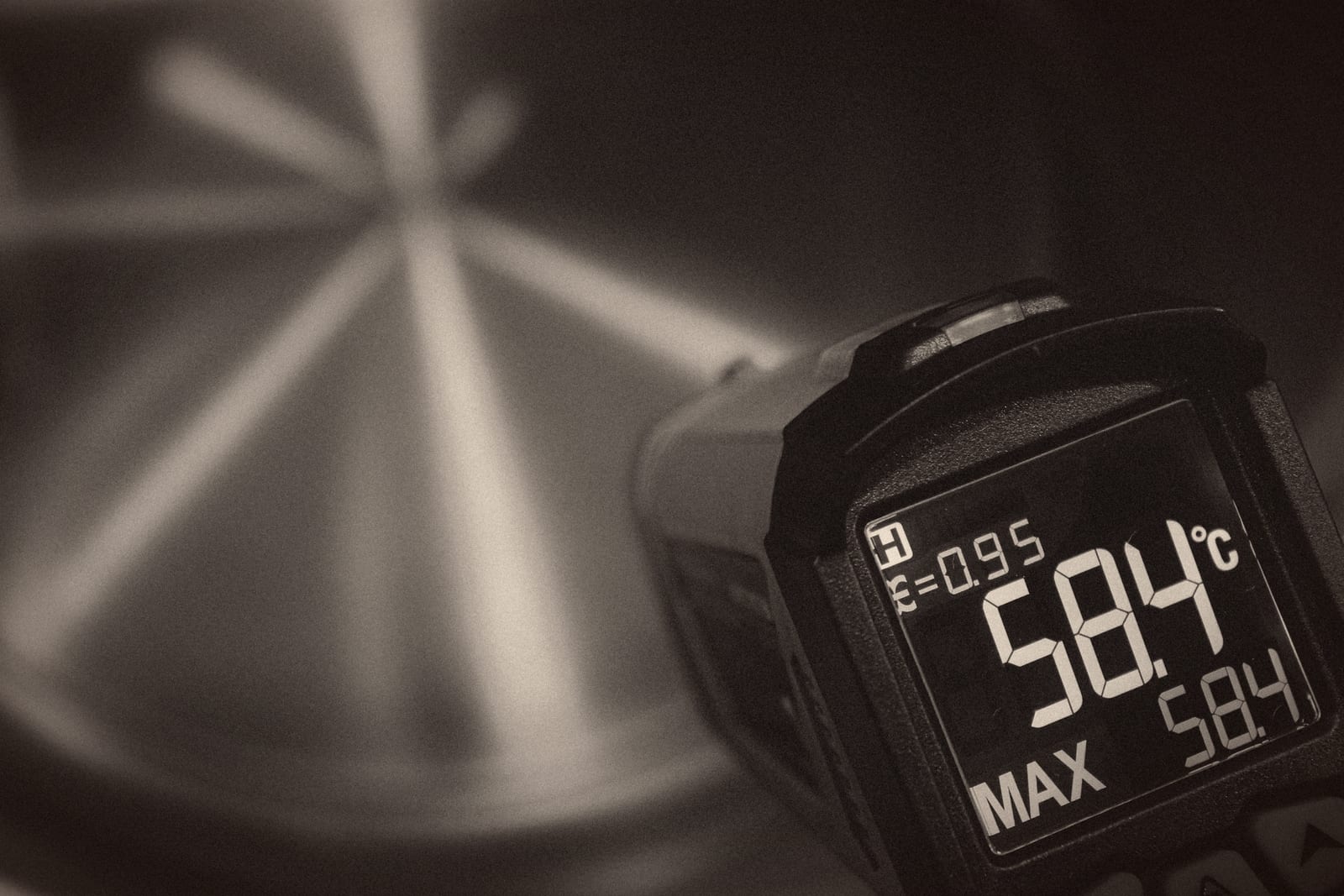
The bath cooks, the pan browns
Sous vide, French for "under vacuum", is cooking food sealed in a plastic bag in a water bath at a precisely controlled temperature. It was developed in French professional kitchens and food industry in the 1970s, notably by Georges Pralus and Bruno Goussault, and became a home technique in the 2010s with inexpensive immersion circulators.
For a steak it separates the two jobs of cooking. The bath brings the whole steak to the final doneness, slowly and evenly; a very short sear afterwards provides the crust. A vacuum sealer is not strictly necessary: a heavy zip bag with the air pressed out by lowering it into water works for the times involved.
Time grows with the square of thickness
Water transfers heat far more efficiently than air at the same temperature, and a bath held at 55 °C / 131 °F cannot heat anything above 55 °C. The steak therefore approaches the bath temperature asymptotically: it rises quickly at first and then ever more slowly, and once it has arrived it stays there. The time needed depends on the thickness, not the weight, and grows roughly with the square of the thickness: doubling the thickness roughly quadruples the time.
Holding the steak at temperature after it has reached it changes texture. At steak temperatures the muscle enzymes remain active for a while, and over several hours fibres soften; beyond about 4 hours for tender cuts the texture can become soft and mealy. Tougher cuts such as flank, short rib or chuck benefit from 24–72 hours at 55–60 °C / 131–140 °F, which softens collagen without taking the meat past medium.
Bath temperatures by doneness
| Doneness | Bath and final temperature | Note |
|---|---|---|
| Rare | 50–52 °C 122–126 °F | Keep total time under 2½ h (see Safety) |
| Medium-rare | 54–56 °C 129–133 °F | The most common choice |
| Medium | 58–60 °C 136–140 °F | Good for well-marbled cuts |
| Medium-well | 63–65 °C 145–149 °F | Drier, noticeably firmer |
| Well done | 68–70 °C 154–158 °F | Juicier than well done by other methods |
Times by thickness
Minimum times below are approximate heating times for a steak going in from the refrigerator (about 5 °C / 41 °F) until its centre is within about 0.5 °C / 1 °F of a bath at 55 °C / 131 °F, rounded from the heating tables published by Douglas Baldwin. Maximum times are for texture, for tender cuts.
| Thickness | Minimum time | Comfortable maximum |
|---|---|---|
| 2 cm / ¾ in | about 50 min | 3 h |
| 2.5 cm / 1 in | about 1 h 15 min | 4 h |
| 4 cm / 1½ in | about 2 h 30 min | 4–5 h |
| 5 cm / 2 in | about 3 h 30 min | 5–6 h |
| Frozen steak | add about 50 % | — |
Step by step
- Season the steak with salt; aromatics such as garlic and thyme can be added, but raw garlic turns harsh over long times.
- Seal it in a vacuum bag, or in a heavy zip bag with the air pushed out by slowly lowering the open bag into water.
- Heat the bath to the chosen temperature and put the bag in once it is there; keep it fully submerged.
- Cook at least the minimum time for the thickness.
- Remove the steak from the bag and dry it very thoroughly with paper; a wet surface will not brown.
- Sear in a smoking-hot pan with a high-smoke-point oil, or over the hottest part of a grill, 45–60 seconds per side, just long enough for colour; a longer sear overcooks the edge and spoils the main advantage of the method.
- Serve at once; there is no carryover to rest for.
The 54.4 °C / 130 °F line
Douglas Baldwin's review in the International Journal of Gastronomy and Food Science (2012) is the standard reference for the safety of sous vide cooking. On an intact steak, pathogens are on the surface, so the issue is not the interior but the time the whole piece spends at temperatures where bacteria can multiply. Food-safety guidance treats 54.4 °C / 130 °F as the lowest temperature at which meat can be held for long periods; below it, total time from refrigerator to plate should stay under about 4 hours, so rare sous vide steaks are cooked to temperature and eaten, not held.
Pasteurisation, the reduction of pathogens on the whole piece, needs a combination of time and temperature: hours at 54–55 °C / 129–131 °F, much less at 60 °C / 140 °F. This matters for steaks that have been mechanically tenderised or for people at higher risk. Food should go into the bag cold and come out to be eaten or chilled quickly in ice water; it should not cool slowly in the bag at room temperature.
Wet sears and mushy steaks
Searing a wet steak, or searing for too long, which produces a grey band and undoes the evenness. Leaving tender steaks in the bath for many hours, which makes them mushy. Holding rare steaks below 54.4 °C / 130 °F for more than about 4 hours. Letting the bag float, which leaves part of the steak above the water. And expecting the method to make a mediocre steak great: it controls doneness precisely but does not add flavour, which still comes from the meat and the crust.
Frequently asked questions
What temperature is sous vide steak medium-rare?
A bath of 54–56 °C / 129–133 °F. The steak finishes at that temperature, edge to edge.
How long do you sous vide a steak?
Long enough to heat through: about 1 h 15 min for 2.5 cm / 1 in and 2 h 30 min for 4 cm / 1½ in, from the refrigerator. Tender cuts are best within about 4 hours.
Is it safe to sous vide steak below 54 °C / 130 °F?
Yes, if the total time stays under about 4 hours and the steak is eaten immediately; longer times at those temperatures are not recommended.
Do you need to sear a sous vide steak?
Yes, for colour and flavour: dry it thoroughly and sear at very high heat for 45–60 seconds per side.
Sources
5
- Myhrvold, Nathan; Young, Chris; Bilet, Maxime. Modernist Cuisine: The Art and Science of Cooking. Bellevue: The Cooking Lab, 2011.
- USDA Food Safety and Inspection Service. Safe Minimum Internal Temperature Chart. 2023. www.fsis.usda.gov/food-safety/safe-food-handling-and-preparation/food-safety-basics/safe-temperature-chart
- McGee, Harold. On Food and Cooking: The Science and Lore of the Kitchen, rev. ed. New York: Scribner, 2004.
- Baldwin, Douglas E. "Sous vide cooking: A review." International Journal of Gastronomy and Food Science 1, no. 1 (2012): 15–30. doi.org/10.1016/j.ijgfs.2011.11.002
- López-Alt, J. Kenji. The Food Lab: Better Home Cooking Through Science. New York: W. W. Norton, 2015.
Related