Cooking · High heat, brown crust
Searing
Searing is cooking the surface of meat at high heat, typically 200–260 °C / 390–500 °F, for a short time to form a brown crust through the Maillard reaction. The crust brings colour, roasted aroma and a firm edge against the tender interior; contrary to a belief that lasted over a century, it does not seal in the juices.
At a glance
- Goal
- Brown crust (Maillard), not sealing
- Surface heat
- 200–260 °C / 390–500 °F
- Time
- 1–3 min per side
- Oil
- Refined, smoke point above 200 °C / 390 °F
A stage, not a method
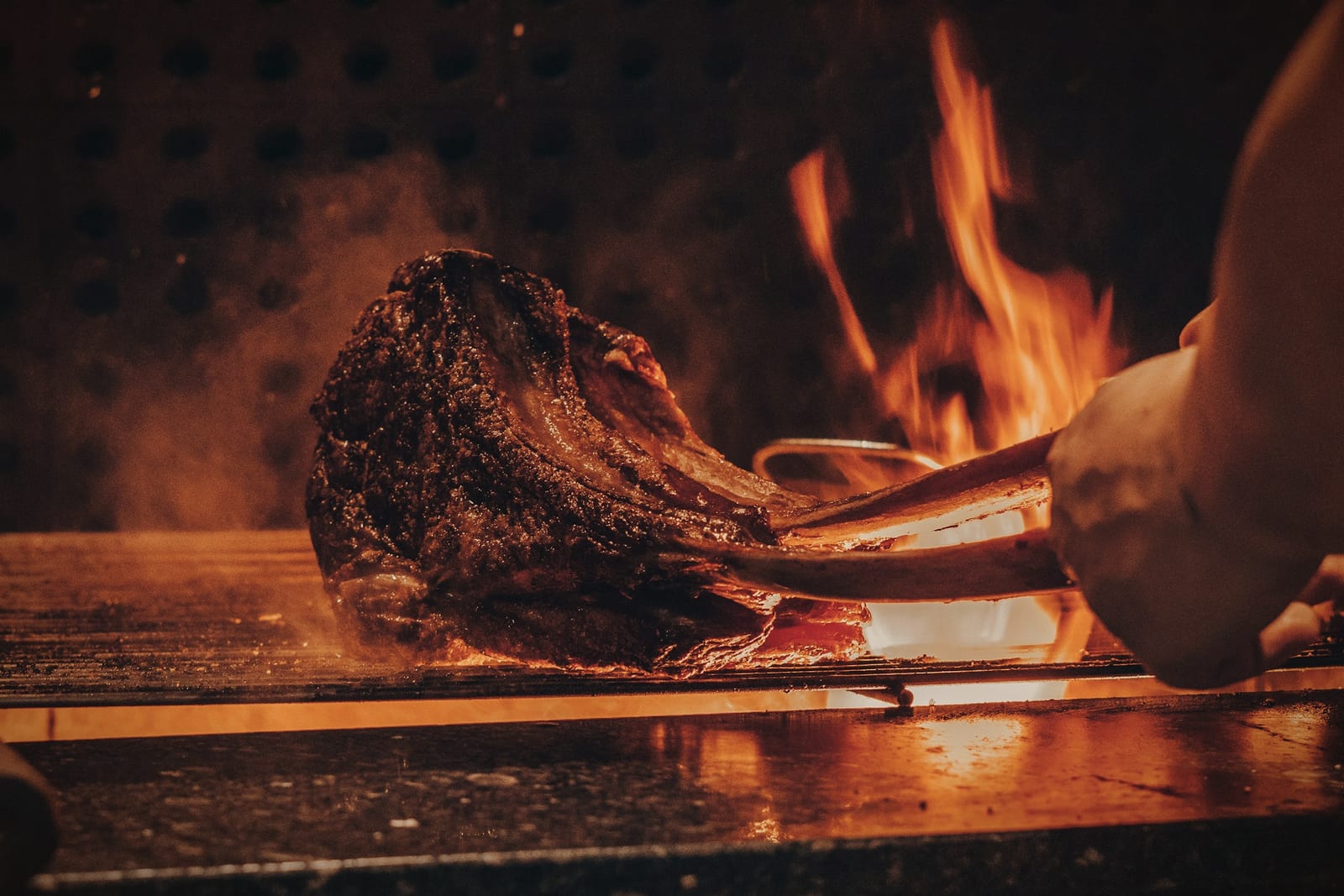
Searing is the high-heat browning of the surface of a piece of meat. It is a stage rather than a complete method: a thin steak can be cooked entirely by searing, while a thick one is seared before, after or between gentler stages, as in the reverse sear or after sous vide. Its purpose is the crust: colour, roasted aroma and a firm, slightly crisp texture that contrasts with the tender interior.
The crust is the product of the Maillard reaction, which needs a dry surface above about 140 °C / 284 °F. Everything about searing technique, from drying the steak to choosing the pan, is a way of getting the surface past the boiling point of water quickly and keeping it there.
Not how hot, but how much heat
What matters is not only how hot the cooking surface is but how much heat it can deliver. A cold steak placed on metal pulls heat out of it immediately and releases water that must be evaporated; a pan that is thin or light cools sharply and the steak steams. Heavy cast iron and thick carbon steel store a large amount of heat and recover slowly but steadily; stainless steel with an aluminium core heats evenly but stores less. A grill over embers transfers most of its heat by radiation, which browns without contact and keeps working even where the bars do not touch.
Fat helps. A thin film of oil fills the microscopic gaps between an uneven steak and the metal, so that the whole surface, not only its high points, receives conducted heat. The oil must tolerate the temperature: above its smoke point it breaks down into acrid compounds and, eventually, ignites.
Surfaces compared
| Surface | How it heats | Strengths | Limits |
|---|---|---|---|
| Cast-iron skillet | Conduction, high stored heat | Even, deep crust; holds heat when the steak goes in | Heavy; slow to heat; hot spots on small burners |
| Carbon steel pan | Conduction, good stored heat | Lighter than cast iron, similar crust | Needs seasoning; thinner models cool faster |
| Plancha / griddle | Conduction over a large flat area | Space for many steaks; even contact | Thin plates lose heat under heavy loads |
| Grill over embers | Radiation plus contact on the bars | Dry heat, smoke aroma, crust without oil in the pan | Uneven by nature; needs zones and attention |
| Gas grill | Radiation and convection, moister combustion | Easy control | Combustion water and lower radiant heat give a paler crust |
Oils and smoke points
Smoke points vary with refining and freshness; the figures below are typical published ranges. Unrefined oils and whole butter smoke far earlier than their refined counterparts. Butter is best added for basting at the end, at lower heat, when its milk solids brown rather than burn.
| Fat | Approx. smoke point | Use for searing |
|---|---|---|
| Refined avocado oil | 250–270 °C 480–520 °F | Very good |
| Refined peanut, sunflower or rice bran oil | 225–235 °C 435–455 °F | Very good |
| Refined canola (rapeseed) oil | 200–230 °C 390–445 °F | Good |
| Clarified butter, ghee | 230–250 °C 445–480 °F | Good, buttery flavour |
| Beef tallow | about 205 °C 400 °F | Good, beefy flavour |
| Extra virgin olive oil | about 190–210 °C 375–410 °F | Moderate heat only |
| Whole butter | about 150 °C 300 °F | Basting at the end, not for the initial sear |
Step by step
- Dry the steak thoroughly and salt it at least 40 minutes ahead or immediately before.
- Heat the pan or plancha empty for 5–10 minutes over medium-high heat, until a drop of water skitters and evaporates in a second or two; on a grill, wait until the embers are covered in fine white ash.
- Add a thin film of high-smoke-point oil to the pan (or oil the steak for the grill) and lay the steak away from you.
- Do not move it until it releases on its own, usually 45–90 seconds; then turn it, every minute or so, until both sides are deep brown and the centre is a few degrees short of the target.
- Sear the fat edge and any thick sides by holding the steak upright with tongs.
- Check the core with a probe and pull it according to the temperature chart.
The myth of sealing in the juices
The idea that searing "seals" a steak is usually traced to the German chemist Justus von Liebig, who argued in the mid-nineteenth century that a quick, hot sear coagulated the surface proteins into a barrier that kept the juices in. It became standard cookbook wisdom. Experiments since the 1930s have repeatedly shown that it is false: seared steaks lose as much moisture as unseared ones cooked to the same internal temperature, and often slightly more, because the surface is hotter. The sizzle of a seared steak is the sound of water leaving it.
What determines juiciness is the internal temperature reached and how evenly it is reached. Searing is worth doing because it creates flavour, not because it saves juice.
Steaming, smoking and pressing
A pan that is not hot enough, or too small for the steaks, so the meat steams. Using olive oil or butter at full searing heat, which smokes and turns bitter. Pressing the steak with a spatula, which squeezes out juice and does nothing for the crust. Searing a very thick steak only, which leaves a wide grey band under the crust and a raw centre. And searing with the extractor off: smoke is part of the process and needs ventilation.
Frequently asked questions
Does searing a steak seal in the juices?
No. Experiments show seared steaks lose as much moisture as unseared ones, or slightly more. Searing creates flavour and texture through the Maillard reaction.
What oil is best for searing steak?
A refined oil with a smoke point above about 200 °C / 390 °F, such as avocado, peanut, sunflower, rice bran or canola; clarified butter or beef tallow also work.
How long should you sear a steak on each side?
Usually 1–3 minutes per side over high heat, turning until the crust is deep brown; thick steaks need a gentler stage as well.
Can you sear with butter?
Whole butter burns at about 150 °C / 300 °F. Sear with oil and add butter at the end, at lower heat, for basting.
Sources
3
- McGee, Harold. On Food and Cooking: The Science and Lore of the Kitchen, rev. ed. New York: Scribner, 2004.
- Myhrvold, Nathan; Young, Chris; Bilet, Maxime. Modernist Cuisine: The Art and Science of Cooking. Bellevue: The Cooking Lab, 2011.
- López-Alt, J. Kenji. The Food Lab: Better Home Cooking Through Science. New York: W. W. Norton, 2015.
Related