Cooking · Heavy pan, stored heat
Cast-iron steak
A cast-iron skillet is the most reliable way to cook a steak on a domestic stove: its heavy metal stores enough heat to keep the surface above browning temperature when a cold steak lands on it. Steaks 2–4 cm / ¾–1½ in thick cook through in 6–12 minutes, turned every 30–60 seconds and basted at the end with butter, garlic and herbs.
At a glance
- Best thickness
- 2–4 cm / ¾–1½ in
- Preheat
- 5–10 min, medium-high
- Pan surface
- about 230–260 °C / 445–500 °F
- Turn
- Every 30–60 s, or once
- Finish
- Butter, garlic, thyme; rest 5 min
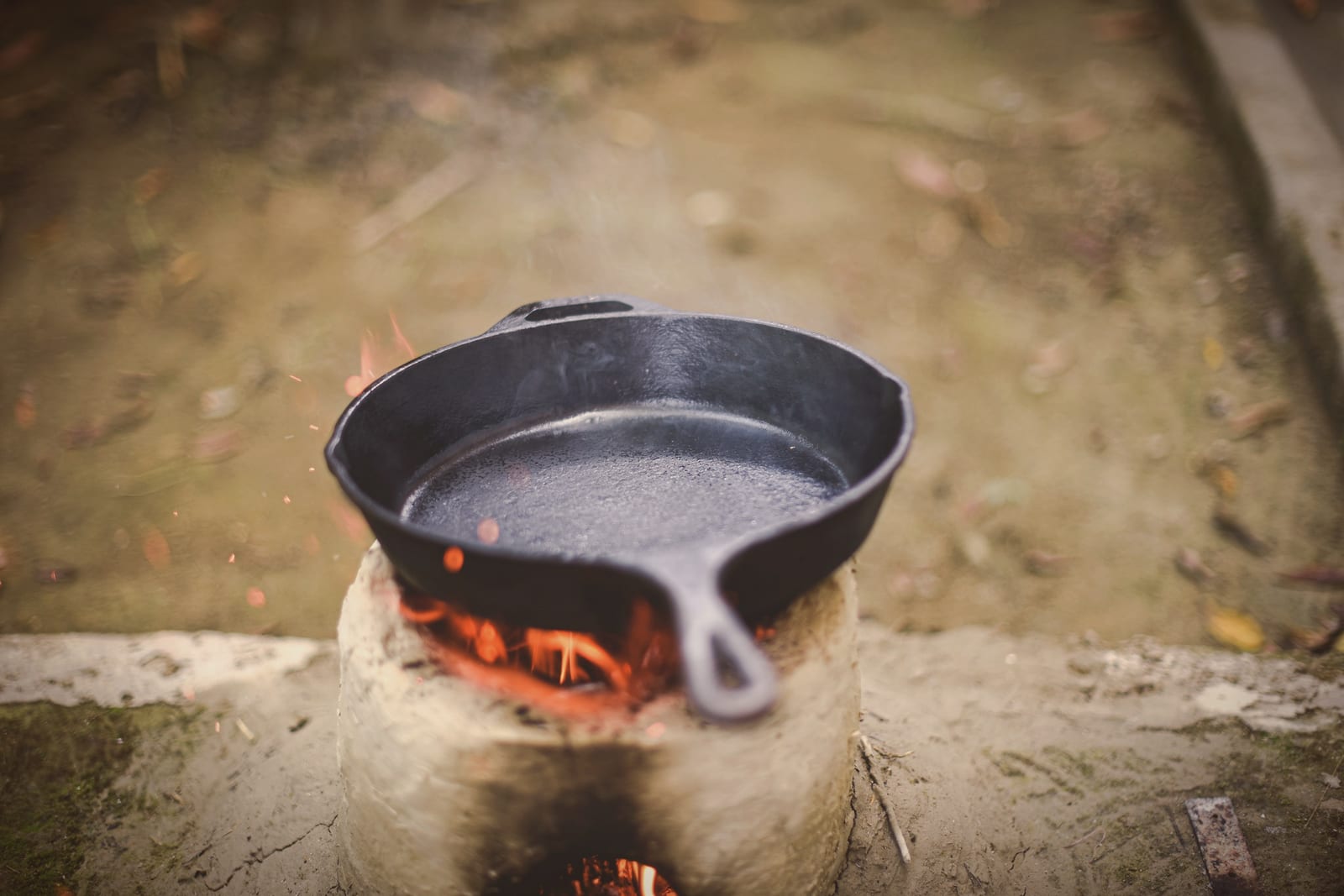
The steakhouse steak, at home
Pan-searing in cast iron cooks a steak entirely on the hob, using direct contact with very hot metal for both the crust and the interior. It is the method behind the steakhouse steak at home: a heavy skillet, a little oil, high heat, and butter, garlic and herbs spooned over at the end. It suits steaks of moderate thickness; very thick ones benefit from the reverse sear, which uses the same pan only at the end.
Why heavy iron keeps browning
Cast iron conducts heat relatively poorly, so it heats slowly and unevenly, but once hot it holds a great deal of heat because it is thick and dense. That stored heat is what matters: when a cold steak lands on the surface, the pan gives up heat to evaporate the moisture and keep the surface above the 140 °C / 284 °F that the Maillard reaction needs. A thin pan of the same size drops in temperature far more and the steak steams.
Frequent turning, every 30–60 seconds, is an efficient way to cook the interior evenly: each side alternately receives heat and lets it soak inward, which narrows the grey band under the crust. Tests by Harold McGee and J. Kenji López-Alt found that frequent flipping cooks a steak somewhat faster and more evenly than a single turn; a single turn gives a slightly darker crust. Both work.
Step by step
- Take the steak from the refrigerator, dry it with paper, and salt it at least 40 minutes ahead (left uncovered on a rack) or just before cooking.
- Heat a 25–30 cm / 10–12 in cast-iron skillet over medium-high heat for 5–10 minutes, until it smokes faintly when a few drops of oil are added; on a small burner, rotate the pan halfway through so it heats evenly.
- Add 1–2 tablespoons of refined high-smoke-point oil and swirl to coat.
- Lay the steak in the pan away from you. Leave it until it releases, about 45–60 seconds, then turn it; keep turning every 30–60 seconds.
- Hold the steak on its edge with tongs to render and brown the fat cap for 30–60 seconds.
- When the centre is about 8–10 °C / 15–18 °F below the target, lower the heat to medium, add 30–50 g / 1–2 oz of butter, two crushed garlic cloves and a few sprigs of thyme or rosemary, tilt the pan and spoon the foaming butter over the steak for 1–2 minutes.
- Pull the steak at the pull temperature for its thickness (see the temperature chart), rest it on a rack for about 5 minutes, and slice across the grain.
Times by thickness
Times are approximate, for a steak taken straight from the refrigerator, in a well-preheated skillet, turned frequently, aiming at medium-rare (final 54 °C / 129 °F). The thermometer decides.
| Thickness | Total time in the pan | Pull at | Note |
|---|---|---|---|
| 1.5 cm / ½–¾ in | 3–5 min | 52–53 °C 126–127 °F | High heat throughout; little carryover |
| 2.5 cm / 1 in | 6–8 min | 50–51 °C 122–124 °F | Butter baste in the last 1–2 min |
| 3.5–4 cm / 1¼–1½ in | 9–12 min | 49–50 °C 120–122 °F | Lower to medium after the crust forms |
| 5 cm / 2 in and thicker | Sear 4–5 min, then oven at 120–135 °C 250–275 °F | 48–49 °C 118–120 °F | Better as a reverse sear |
The pan and the smoke
A seasoned pan, with a smooth layer of polymerised oil, releases the steak cleanly; a new or poorly seasoned one may stick until the crust forms. Enamelled cast iron works but should not be heated empty for long. Smoke is unavoidable at searing temperatures: turn the extractor on before starting, and keep the oil at the minimum needed. After cooking, the pan is cleaned with hot water and a brush, dried over heat and wiped with a thin film of oil.
A cool pan, a crowded pan, early butter
Not preheating long enough: cast iron needs several minutes, and a pan that looks hot in the centre may be much cooler at the edges. Cooking several steaks in a pan that fits one, which cools it below browning temperature. Adding butter at the start, where it burns. Leaving a thick steak on high heat until the centre is done, which overbrowns the surface. And cutting into the steak to check instead of using a thermometer.
Frequently asked questions
How long do you cook a steak in a cast-iron skillet?
About 6–8 minutes in total for a 2.5 cm / 1 in steak to medium-rare, turning every 30–60 seconds; 9–12 minutes for 4 cm / 1½ in.
How hot should a cast-iron pan be for steak?
Around 230–260 °C / 445–500 °F at the surface: preheat it empty for 5–10 minutes over medium-high heat until oil just begins to smoke.
Should you flip a steak often or once?
Both work. Frequent flipping cooks a little faster and more evenly; a single flip gives a slightly darker crust.
When do you add butter to a pan-seared steak?
In the last 1–2 minutes, over medium heat, with garlic and herbs, spooning it over the steak; added earlier it burns.
Sources
3
- McGee, Harold. On Food and Cooking: The Science and Lore of the Kitchen, rev. ed. New York: Scribner, 2004.
- Myhrvold, Nathan; Young, Chris; Bilet, Maxime. Modernist Cuisine: The Art and Science of Cooking. Bellevue: The Cooking Lab, 2011.
- López-Alt, J. Kenji. The Food Lab: Better Home Cooking Through Science. New York: W. W. Norton, 2015.
Related