Main course · Florence, rare
Bistecca alla fiorentina
Bistecca alla fiorentina is a thick T-bone steak from young cattle, traditionally Chianina, grilled over wood embers, served rare and seasoned only after cooking. Cut about 5 cm / 2 in thick, it often weighs over a kilo and feeds two to four.
At a glance
- Origin
- Florence, Tuscany
- Cut
- T-bone with tenderloin, from the loin
- Thickness
- About 5 cm / 2 in ("three to four fingers")
- Weight
- Usually 1.2–1.8 kg / 2.6–4 lb
- Doneness
- Al sangue: rare, core about 45–50 °C / 113–122 °F
- Serves
- 2–4
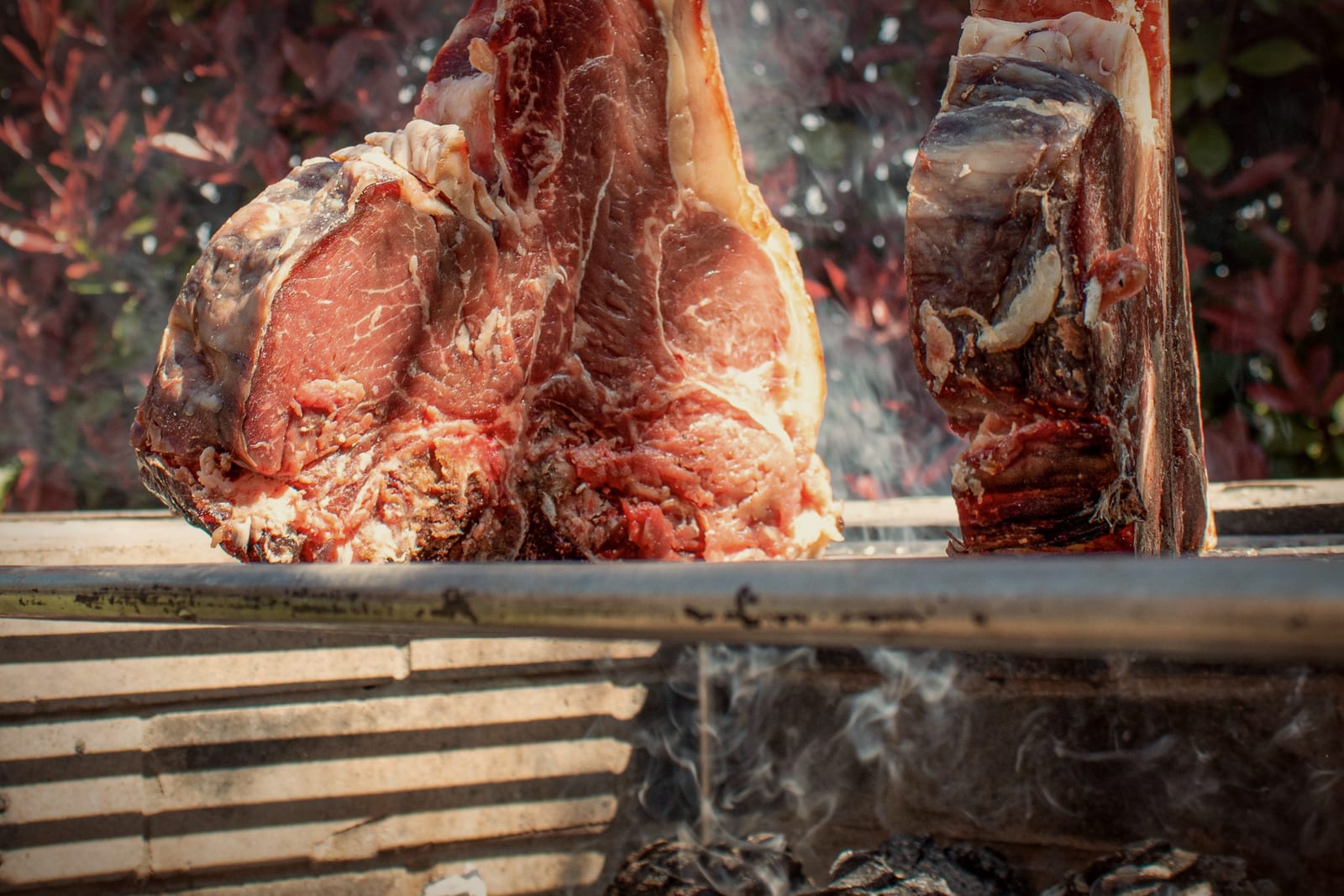
Two muscles, one bone, 5 cm thick
The fiorentina is cut across the loin so that it includes the T-shaped vertebra with the striploin (controfiletto) on one side and the tenderloin (filetto) on the other: a T-bone or, when the fillet is large, a porterhouse. A steak from the same loin without the fillet is a costata. What sets the fiorentina apart is size: it is cut about 5 cm / 2 in thick and commonly weighs well over a kilogram, enough for two to four people.
It is cooked simply and fast over intense heat, stood upright on its bone to finish, and served al sangue — rare — sliced off the bone at the table. Cooking it to well done is considered to spoil it.
Medici legends, Artusi's 1891 recipe
A popular story places its origin at the feasts of San Lorenzo held by the Medici in Florence, where English travellers supposedly asked for "beef steak", giving rise to the Italian bistecca. The legend is undocumented, but the word bistecca is indeed an Italian adaptation of the English beefsteak.
Pellegrino Artusi included bistecca alla fiorentina in La scienza in cucina e l'arte di mangiar bene (1891), describing it as a grilled steak cooked over charcoal and seasoned after cooking. The Accademia della Fiorentina, founded in Florence, publishes a disciplinare that sets out the cut, its thickness, the embers and the doneness. From 2001 to 2006 European rules adopted during the BSE crisis restricted bone-in cuts from the vertebral column of older cattle, and the fiorentina temporarily disappeared from Italian butchers.
The rules: embers, bone, salt at the end
The Accademia's rules describe the bistecca as a cut from the loin of young cattle (vitellone), including the bone, the striploin and the fillet, about three to four fingers thick. Tradition favors the white Chianina of the Val di Chiana, now protected as Vitellone Bianco dell'Appennino Centrale IGP, but Tuscan butchers also cut fiorentine from Maremmana and other breeds.
The cooking is codified as well: hardwood charcoal or embers without flame, the meat at room temperature, no marinade, no salt before cooking, a few minutes per side, then a few minutes standing on the bone until the fat at the base sizzles, and salt only at the end.
Ingredients
| Ingredient | Amount | Note |
|---|---|---|
| Bistecca (T-bone) of young beef | 1 piece, 1.2–1.5 kg / 2.6–3.3 lb | 5 cm / 2 in thick, at room temperature |
| Coarse sea salt | to taste | only after cooking |
| Black pepper | to taste | freshly ground |
| Tuscan extra-virgin olive oil | a drizzle | optional, at the table |
| Hardwood charcoal or embers | a deep, even bed | oak, holm oak or olive wood |
Method
- Take the steak out of the refrigerator 2–3 hours before cooking so that it reaches room temperature throughout. Do not salt, oil or marinate it.
- Prepare a bed of glowing embers with no flame. The grill should be about 10–15 cm / 4–6 in above the coals and very hot.
- Place the steak on the grill and cook 4–5 minutes, until a crust forms; turn it once, with tongs, never piercing it with a fork.
- Cook the second side 4–5 minutes. Then stand the steak upright on the base of its T-bone for 5–8 minutes so the heat passes through the bone and renders the fat at the base.
- Check the core: about 45–50 °C / 113–122 °F at the thickest point, near the bone, is al sangue. Rest 5 minutes.
- At the table, cut the fillet and the striploin off the bone, slice each across the grain, season with coarse salt and pepper, and add a thread of olive oil if desired.
Costata, rosemary and loose copies
The costata alla fiorentina is the same cut without the fillet. Some Tuscan cooks rub the hot steak with a sprig of rosemary or brush it with oil and pepper after grilling; the Accademia's rules exclude marinades and garlic. Outside Italy, the term is used loosely for any thick porterhouse cooked over coals.
On a board, with white beans and Chianti
The fiorentina is brought to the table whole on a wooden board, often with the bone, and shared. Traditional sides are white beans (fagioli all'olio), roast potatoes or a green salad, with a red wine from Tuscany such as Chianti Classico.
Frequently asked questions
Why is bistecca alla fiorentina served rare?
The thick cut is meant to be charred outside and red inside; Florentine tradition and the Accademia consider anything beyond rare to medium-rare a different dish.
What is the difference between bistecca alla fiorentina and a T-bone?
The fiorentina is a T-bone or porterhouse, but much thicker (about 5 cm / 2 in), from young Tuscan-style cattle, and cooked over embers according to set rules.
How much does a bistecca alla fiorentina weigh?
Typically 1.2 to 1.8 kg (2.6 to 4 lb), served for two to four people.
Do you salt a fiorentina before grilling?
Traditionally no: it is salted after cooking, at the table.
Sources
4
- Accademia della Fiorentina. Disciplinare della Bistecca alla Fiorentina. Florence.
- McGee, Harold. On Food and Cooking: The Science and Lore of the Kitchen, rev. ed. New York: Scribner, 2004.
- Artusi, Pellegrino. La scienza in cucina e l'arte di mangiar bene. Florence, 1891.
- European Commission. Vitellone Bianco dell'Appennino Centrale, Protected Geographical Indication (IGP), registered 1998. eAmbrosia register of geographical indications.
Related