Cut · Short loin, two muscles
T-bone
The T-bone is a cross-section of the short loin with the vertebra in place: striploin on one side of the T, tenderloin on the other — two muscles that want different doneness on one bone. Cut thick from the hip end, with a larger piece of tenderloin, it is a porterhouse; cut very thick from Chianina cattle, a bistecca alla fiorentina.
Key takeaways
- 79.6 % of each whole piece ended up usable: number 2 of the 7 cuts we have measured.
- Per kilo bought it gives about 774 g of portions (77.4 % of the weight).
- 8.9 % is fat trimmed off. Measured on 28 pieces, 266.5 kg in total.
Measured by Steakpedia · Steakpedia Field Kitchen
At a glance
- Primal
- Short loin, bone-in
- Muscles
- Longissimus lumborum (strip side) and psoas major (tenderloin side)
- Weight
- 500 g–1.5 kg, 2.5–5 cm thick
- Porterhouse rule
- Tenderloin ≥ 32 mm wide (USDA); T-bone ≥ 13 mm
- Best cooked
- Pulled at 50–54 °C / 122–129 °F in the strip side
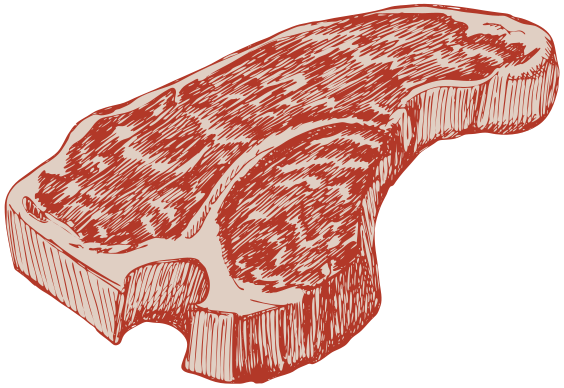 T-bone
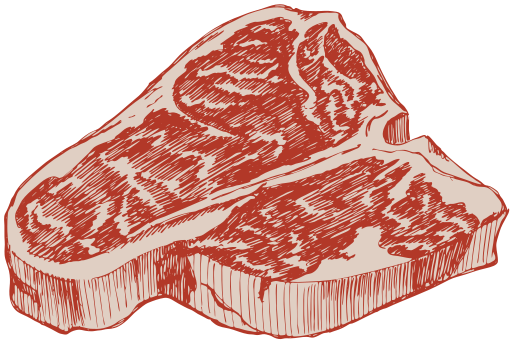 Porterhouse
A cut through the vertebra
A T-bone is not a muscle but a cut through the short loin, bone in, taken across the lumbar vertebrae. The T is the vertebra: on its outer side the striploin, on its inner side the tenderloin. Because the tenderloin tapers towards the ribs, the proportion of tenderloin in the steak changes along the loin: at the rib end there is barely any (in the US such steaks are sold as bone-in strip or club steak), in the middle a small round (a T-bone), at the hip end a large one (a porterhouse). The USDA fixes the line: a porterhouse must have a tenderloin at least 32 mm wide at its widest point; a T-bone at least 13 mm.
The word porterhouse is a trap across borders. In the United States it is the big bone-in steak described above; in Australia and New Zealand it is a boneless striploin steak; in Britain it has historically meant either. Steakpedia uses the American definition and notes the others.
The thickest T-bone in common use is the bistecca alla fiorentina of Tuscany: cut from Chianina cattle, 4–5 cm thick, 1–1.5 kg, grilled over oak or olive wood embers and never cooked past rare. The Accademia della Fiorentina publishes a specification for it.
T-bone vs porterhouse
The two are the same cut from different parts of the short loin, and the line between them is a measurement. The USDA Institutional Meat Purchase Specifications (IMPS) measure the tenderloin at its widest point, parallel to the backbone: 1.25 in (3.2 cm) or more makes a porterhouse, 0.5 in (1.3 cm) or more a T-bone; with less, the steak is a bone-in strip. Outside the United States the word porterhouse does not always mean the same steak.
Fig. 1
Where one kilo of t-bone goes
Share of the whole piece by weight, %. 28 pieces measured.
Portions 77.4 %Other usable meat 2.2 %Fat 8.9 %Silverskin, sinew, loss 11.5 %
| What changes | T-bone | Porterhouse |
|---|---|---|
| Where in the short loin | Middle, towards the ribs | Hip end |
| Tenderloin width (USDA IMPS) | 0.5 in / 13 mm or more, under 1.25 in | 1.25 in / 32 mm or more |
| IMPS number | 1174 | 1173 |
| Usually serves | One | Two, often sold as a steak for two |
| In the UK | The same bone-in steak | Bone-in, sirloin and a large piece of fillet |
| In Australia and NZ | The same bone-in steak | A boneless striploin steak |
Two traps: porterhouse and chuletón
The T-bone keeps its English name in most of the world. The traps are the porterhouse, which is a boneless striploin in Australia, and the Spanish chuletón, which is a thick bone-in rib steak and not a T-bone.
Fig. 2
Usable meat, cut by cut
Usable share of each whole piece after trimming, %. n = pieces measured.
| Name | Where | What it is |
|---|---|---|
| T-bone · porterhouse | United States, Canada | Bone-in short loin; the porterhouse has the wider tenderloin |
| T-bone · porterhouse | UK, Ireland | The same; the two sides are called sirloin and fillet |
| T-bone | Australia, NZ | Bone-in short loin (porterhouse = boneless striploin) |
| Bistecca alla fiorentina | Italy (Tuscany) | T-bone or porterhouse 4–5 cm thick, 1–1.5 kg |
| T-bone · bife con lomo | Argentina | Bone-in short loin |
| Chuletón | Spain | Not a T-bone: a thick bone-in rib steak |
| Tボーン tībōn | Japan | T-bone |
| 티본 tibon | South Korea | T-bone |
| T骨牛排 T-gǔ niúpái | China, Hong Kong, Singapore | T-bone |
Between the last rib and the hip
The short loin is the section of the back between the last rib and the hip. Left on the bone it is a primal of 8–12 kg from which a butcher cuts, from front to back, bone-in strip steaks, T-bones and porterhouses, each 2.5–5 cm thick. The same primal boned out gives one striploin and the centre of one tenderloin, which is why a kitchen that cuts T-bones is also a kitchen that sells striploin steaks: the ends of the loin that do not make a balanced T-bone are cut boneless.
Cutting T-bones requires a band saw to go through the vertebra cleanly. The chine (the body of the vertebra) and the feather bones are usually trimmed so the steak lies flat, leaving the vertical bar and the cross of the T between the two muscles.
How much steak a short loin gives
Across 28 bone-in short loins cut by the Steakpedia Field Kitchen between July and October 2026, 266.5 kg in total, 77.4% of the weight became steaks: T-bones and porterhouses from the centre, and boneless striploin steaks from the ends that do not make a balanced T. Very little else is usable meat; most of the rest is fat and the chine and feather bones trimmed so that the steaks lie flat. The steaks are weighed with their bone.
In round numbers, a 9.5 kg short loin gives about 7.4 kg of steaks: around 15 of 500 g, 18 of 400 g or 12 of 600 g, fewer if it is cut thick for porterhouses.
| Part | Share | Per kg bought | Used for |
|---|---|---|---|
| Steaks | 77.4% | ≈ 775 g | T-bones, porterhouses, boneless strip steaks from the ends |
| Other usable meat | 2.2% | ≈ 20 g | Trim: mince, stir-fries |
| Fat | 8.9% | ≈ 90 g | Rendered or discarded |
| Bone, sinew, loss | ≈ 11.5% | ≈ 115 g | Chine and feather bones: stock or discarded |
Cooking it: two muscles, one bone
Two muscles with different ideal temperatures share one bone: the tenderloin side wants rare, the striploin side medium-rare, and the bone slows the cooking of the meat next to it. The usual answer is to position the steak with the tenderloin away from the hottest part of the fire, to cook thick steaks slowly first and sear at the end, and to pull at 50–54 °C / 122–129 °F measured in the striploin, close to the bone.
The fiorentina is the model: 4–5 cm thick, brought to room temperature, grilled over embers without oil, 5–7 minutes a side and then stood on its bone for a few minutes, salted after cooking, served rare and carved off the bone at the table. Thinner T-bones are grilled or pan-seared hot and rested as any steak.
To serve, each muscle is cut away from the bone in one piece and sliced across the grain, then laid back against the bone so that both sides can be shared.
Choosing one: the tenderloin side first
Look first at the tenderloin side: its width decides whether the steak is a T-bone or a porterhouse, and the price usually follows. Then at the thickness: under 2.5 cm the tenderloin overcooks before the striploin browns, and 4 cm or more makes the two-stage cook possible. The striploin side should carry a fat strip of 5–10 mm and the cut faces should be clean, without bone dust from the saw.
Because the steak includes the vertebra, a large share of its weight is bone; a 1 kg porterhouse yields noticeably less meat than 1 kg of boneless steak. The short loin is a common primal for dry-ageing on the bone, and aged T-bones and porterhouses are cut to order from the aged loin.
Names around the world
20
The same muscle, named by language and by trade system.
| English | T-bone |
| Tiếng Việt | Bít tết T-bone |
| Español | T-bone · bife con lomo |
| 한국어 | 티본 스테이크 |
| 日本語 | Tボーンステーキ |
| Français | T-bone · côte d’aloyau |
| Italiano | Bistecca alla fiorentina · T-bone |
| Русский | Ти-бон |
| 中文 | T骨牛排 |
All the cuts' names, country by country →
Trade and national systems
| System | Name | Reference |
|---|---|---|
| United States | T-bone · porterhouse (hip end, wider tenderloin) | IMPS 1174 / 1173 |
| United Kingdom | T-bone · porterhouse | AHDB |
| Australia / NZ | T-bone (note: Australian "porterhouse" is a boneless striploin steak) | HAM 1552 |
| Argentina | T-bone · bife con lomo | IPCVA |
| Brazil | T-bone · chuleta com filé | Portaria 5/88 |
| France | T-bone · côte d'aloyau | Larousse |
| Italy | Bistecca alla fiorentina (Chianina, 4–5 cm thick, 1–1.5 kg) | Accademia della Fiorentina |
| Japan | Tボーン | JMGA |
| South Korea | 티본 (tibon) | |
| China · Hong Kong · Singapore | T骨牛排 (T-gǔ niúpái) | |
| Spain | T-bone (a chuletón is a bone-in rib steak, not a T-bone) |
Field data
Numbers measured in a working kitchen, piece by piece, not taken from a table. Another kitchen, another trimming specification, another number. How field data is collected.
Field data
Short loin, bone-in (T-bone)
Steakpedia Field Kitchen4 Jul 2026 – 21 Oct 2026
Frequently asked questions
T-bone vs porterhouse: what is the difference?
Only the size of the tenderloin. Both are cut across the short loin with the bone in; the porterhouse comes from the hip end and, under the USDA rule, has a tenderloin at least 32 mm wide. A T-bone has a smaller one, at least 13 mm.
Is a fiorentina a T-bone?
Yes. The bistecca alla fiorentina is a very thick T-bone or porterhouse, traditionally from Chianina cattle, 4–5 cm thick and 1–1.5 kg, grilled over embers and served rare.
Why is the T-bone hard to cook evenly?
Because it holds two different muscles. The tenderloin is lean and cooks faster than the striploin, and the bone slows the meat next to it, so the tenderloin side is kept away from the strongest heat.
What two steaks make up a T-bone?
A striploin (New York strip) on the long side of the T-shaped vertebra and a piece of tenderloin (filet mignon) on the short side. A porterhouse has the same two, with a larger piece of tenderloin.
Is a T-bone a good cut of steak?
Yes: it is one of the premium steaks, with two of the most tender muscles of the animal on one bone. Its difficulty is cooking: the tenderloin side cooks faster than the strip side, so it rewards a thick cut and a thermometer.
Which is better, a T-bone or a ribeye?
It depends on what you want. A ribeye has more fat and marbling and is easier to cook evenly; a T-bone gives two textures on one plate, the beefy strip and the soft tenderloin, and is leaner overall.
Which is more expensive, porterhouse or T-bone?
Usually the porterhouse, because it carries more tenderloin, the most expensive muscle, and only the few steaks from the hip end of each short loin qualify.
What is a porterhouse called in the UK and Australia?
In the UK a porterhouse is the same bone-in steak as in the US, with sirloin and fillet on the bone. In Australia and New Zealand “porterhouse” means a boneless striploin steak, so the bone-in steak is sold as a T-bone.
How many T-bones are in a short loin?
About three-quarters of the weight of a bone-in short loin becomes steaks (77.4% measured across 28 loins), so a 9.5 kg loin gives about 15 steaks of 500 g or 12 of 600 g; the rest is fat, trimmed bone and a little trim.
What is the best way to cook a T-bone steak?
If it is 4 cm or thicker, start it over low or indirect heat with the tenderloin away from the fire, then sear it hard; pull at 50–54 °C / 122–129 °F in the strip side, near the bone, and rest it. Thinner T-bones go on a hot grill or pan for a few minutes a side.
Sources
7
- USDA Agricultural Marketing Service. Institutional Meat Purchase Specifications: Fresh Beef Series 100. Washington, DC, 2014. www.ams.usda.gov/sites/default/files/media/IMPS_100_Fresh_Beef%5B1%5D.pdf
- AUS-MEAT Limited. Handbook of Australian Meat, 7th ed. (International Red Meat Manual). Brisbane, 2005. www.ausmeat.com.au
- Accademia della Fiorentina. Disciplinare della Bistecca alla Fiorentina. Florence.
- Instituto de Promoción de la Carne Vacuna Argentina (IPCVA). Cortes de carne vacuna argentina — nomenclatura y usos. Buenos Aires. www.ipcva.com.ar
- Larousse Gastronomique, rev. ed. London: Hamlyn, 2009.
- McGee, Harold. On Food and Cooking: The Science and Lore of the Kitchen, rev. ed. New York: Scribner, 2004.
- Steakpedia Field Kitchen. Butchery records, July–October 2026: 279 sheets, 1,604.6 kg of meat processed, weighed piece by piece on a calibrated scale and logged per cut. Open data, CC BY 4.0. steakpedia.com/field-data
Related