Breed · England, the white face
Hereford
Hereford is a beef breed from Herefordshire in the west of England, recognisable by its red body and white face, and now found on every continent. Bred since the eighteenth century to gain weight efficiently on grass, it became the base of large herds in the Americas and Australia.
At a glance
- Origin
- Herefordshire, England
- Colour
- Red body, white face
- Horned / polled
- Both (Polled Hereford since 1901)
- First herd book
- 1846
- Strong in
- UK, USA, Argentina, Uruguay, Australia
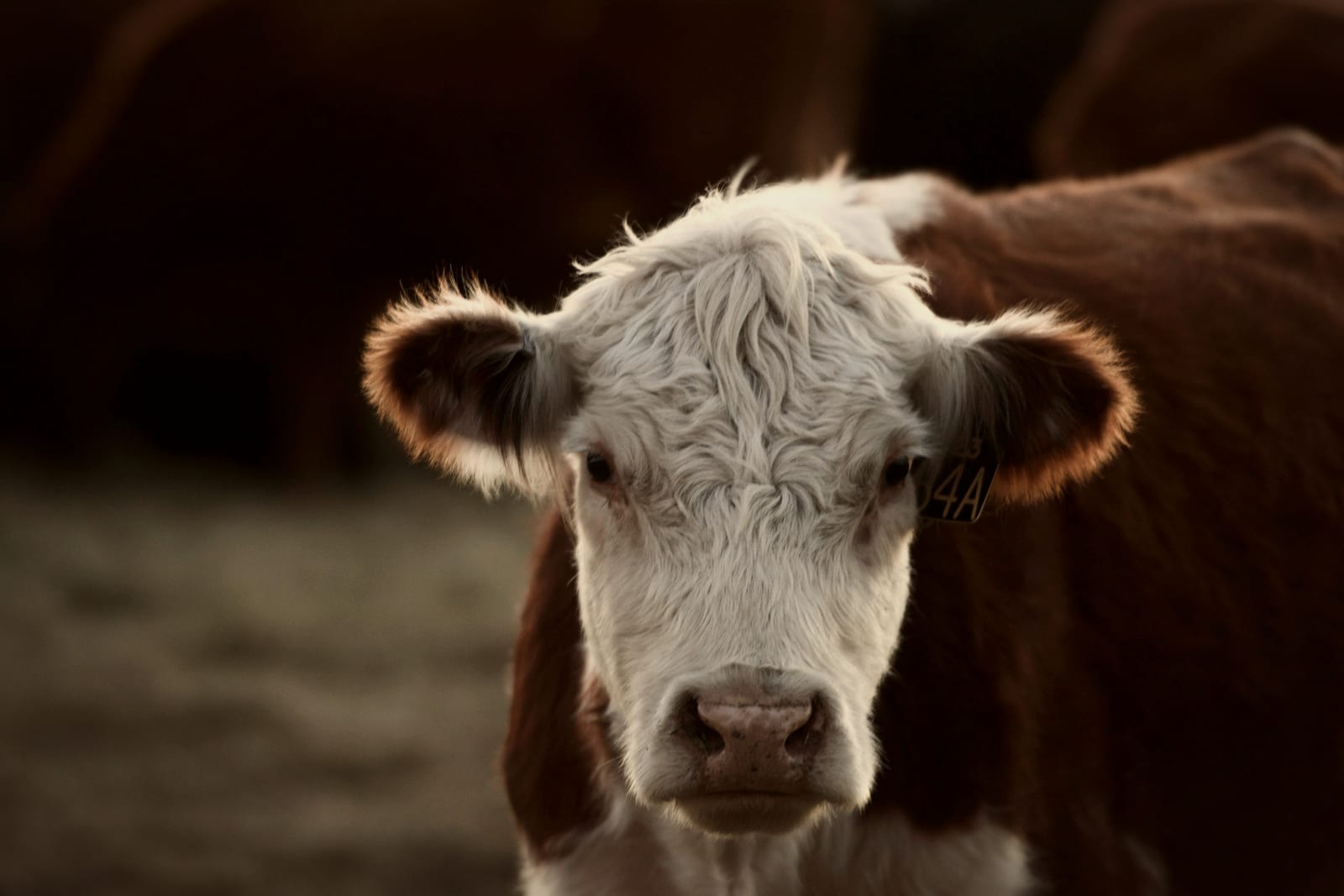
A white face most crossbred calves inherit
The Hereford is a medium to large, hardy beef breed. Its colour pattern is dominant: a deep red body with a white face, white crest, white underline and white lower legs, and crossbred calves usually inherit the white face. The breed exists in horned and polled (hornless) forms.
Herefords are known as docile, long-lived and efficient converters of pasture into beef. They tolerate cold and a range of climates well, which explains their early success on the open ranges and pampas. The beef is typically lean to moderately marbled, with fat that may be more yellow when the animals are finished on grass; marbling depends heavily on genetics within the breed and on finishing.
Benjamin Tomkins, 1742: beef from grass
The breed descends from the draught and beef cattle of Herefordshire, on the English border with Wales. Benjamin Tomkins, who began breeding in 1742, is usually credited as its founder; he and later breeders selected for size, early maturity and the ability to fatten on grass, then in high demand to feed Britain’s industrial cities. The first herd book was published in 1846, and the Hereford Herd Book Society was established in 1878.
Herefords were exported widely in the nineteenth century. Henry Clay is said to have brought the first to Kentucky in 1817, and the breed became one of the dominant range cattle of the American West; the American Hereford Association was founded in 1881. The Polled Hereford was developed in Iowa from 1901 by Warren Gammon, who gathered naturally hornless animals from existing herds.
Argentina, Uruguay and Australia
Argentina. Herefords reached Argentina in the second half of the nineteenth century, alongside Shorthorn and Angus, and the three British breeds replaced the native criollo cattle as the basis of the export trade. Hereford became especially important in the cooler south of Buenos Aires Province and in Patagonia; in the north-east it is often crossed with Brahman to form the Braford, which copes better with heat and parasites. See Argentine beef.
Uruguay. For much of the twentieth century Hereford was the leading breed of Uruguay’s national herd, and Hereford and its crosses with Angus still make up a large share of a beef industry that is raised mostly on natural grassland. Uruguay’s reputation for grass-fed beef rests largely on these two breeds.
Australia. Herefords arrived in the early nineteenth century and became a major breed in the temperate south-east. In the hot north they are less suited — white-faced cattle are prone to sunburn and eye cancer under strong sun — and are commonly crossed with tropical breeds.
On pasture, and the black baldy cross
Most Herefords worldwide are raised on pasture, and in Argentina, Uruguay, New Zealand and parts of Australia many are also finished on grass. In North America they are commonly finished on grain in feedlots. Hereford bulls are widely used in crossbreeding: the Hereford × Angus cross, the “black baldy”, combines the hardiness of the Hereford with the marbling of the Angus, and the hybrid vigour of the cross improves fertility and growth.
For the effect of pasture or grain on the meat, see Grass-fed vs grain-fed.
A breed name says less than a grade
Breed associations in several countries run Hereford-branded beef programmes, which usually require a minimum share of Hereford genetics — often shown by the white face — and carcass specifications. As with Angus, a breed name on a label says less about eating quality than a grade from a system such as USDA or MSA (see Grading systems).
Tenderness: age and ageing, not breed
Hereford beef is tough. The breed tends to marble less than Angus on average, but tenderness depends above all on age at slaughter, handling, chilling and ageing. Young, well-finished Herefords grade well in every major system.
Any white-faced animal is a Hereford. The white face is dominant and appears in most crossbred calves with a Hereford parent, so it shows Hereford ancestry, not a purebred animal.
Frequently asked questions
Where does the Hereford breed come from?
From Herefordshire in the west of England, where it was developed from the eighteenth century, notably by Benjamin Tomkins from 1742.
Is Hereford beef good for steak?
Yes. It is often leaner than Angus, but young, well-finished Herefords grade well; tenderness depends more on age, handling and ageing than on breed.
What is the difference between Hereford and Angus?
Hereford is red with a white face and may be horned or polled; Angus is solid black or red and always polled. Angus tends to marble more; Hereford is valued for hardiness on grass.
What is a black baldy?
A cross between Hereford and Angus: a black animal with the Hereford’s white face, widely used in commercial herds for its hybrid vigour.
Sources
4
- Hereford Cattle Society. Breed history. Hereford, England. www.herefordcattle.org
- American Hereford Association. Hereford history. Kansas City, Missouri. hereford.org
- Instituto de Promoción de la Carne Vacuna Argentina (IPCVA). Cortes de carne vacuna argentina — nomenclatura y usos. Buenos Aires. www.ipcva.com.ar
- Instituto Nacional de Carnes (INAC), Uruguay. Uruguayan beef: production system and breeds. Montevideo. www.inac.uy
Related