Cut · Diaphragm, one per animal
Hanger steak
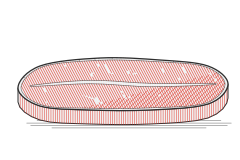
Hanger steak is the hanging tender, the thick pillar of the diaphragm that hangs from the spine between the plate and the flank. There is one per animal, about 0.5–0.7 kg, split by a central sinew into two lobes 3–5 cm thick — thick enough for a browned crust over an even rare centre. It is the French onglet and the Japanese sagari.
At a glance
- Primal
- Between plate and flank, hanging from the lumbar spine
- Muscles
- Crura (pillars) of the diaphragm, joined by a central sinew
- Weight
- About 0.5–0.7 kg, one per animal
- Best cooked
- Hot and fast, rare to medium-rare
The pillar, not the sheet
The hanger is not part of the thin sheet of the diaphragm that gives the skirt steak, but the muscular pillars, the crura, that anchor the diaphragm to the lumbar spine. The two pillars meet in a V and are held together by a thick, inedible sinew that runs down the middle. Once that sinew is removed, the hanger becomes two long lobes, each 3–5 cm thick, which are cooked as two steaks.
Its grain is coarse and loose, like the skirt's, but the muscle is thicker, so it can be cooked to an even rare centre with a well-browned crust. It is darker than most steaks and its flavour is often described as mineral or slightly livery, which reflects both its work (it moves with every breath) and its position close to the kidneys.
In English it is also called butcher's steak, a name usually explained by the tradition that butchers kept it for themselves rather than sell it: with only one per carcass, it was not worth putting in the window.
One per animal, mostly for restaurants
The hanging tender lies inside the carcass at the back of the diaphragm, hanging from the spine in the area where the plate meets the flank, near the last ribs and the kidneys. Each animal has a single one of about 0.5–0.7 kg, which is why it is rarely seen in supermarkets and is usually sold to restaurants.
In the United States it is IMPS item 140, hanging tender. In French butchery the onglet has long been a bistro cut, served as onglet à l'échalote, pan-fried and finished with shallots softened in butter and red wine. In Japan sagari is grilled at the yakiniku table alongside harami, the skirt; in Korea tosisal is one of the prized small cuts of a barbecue house. In the Río de la Plata the same piece is not treated as a named steak, and is not the entraña, which is the outside skirt.
Hanger, onglet, thick skirt: the names
The hanger has fewer names than the skirt, but two of them trip people up: Australians call it thick skirt, although it is not a skirt, and in Spain it is entraña gruesa, “thick entraña”, while plain entraña is the skirt. The table in skirt steak sorts out all the diaphragm cuts together.
| Name | Where | Note |
|---|---|---|
| Hanger steak · hanging tender | United States (IMPS 140) | Also sold as butcher's steak |
| Thick skirt | Australia, NZ | Not a skirt, despite the name |
| Onglet | France, UK | In French, the skirt is hampe |
| Solomillo de pulmón · entraña gruesa | Spain | Entraña alone is the skirt |
| Lombatello | Italy | — |
| サガリ sagari | Japan | In Hokkaido often the whole diaphragm |
| 토시살 tosisal | South Korea | A prized small cut at barbecue houses |
| 封門柳 · 肝連 | Hong Kong · Taiwan | Cantonese · Taiwanese names |
| No name of its own | Argentina, Uruguay | Not the entraña, which is the outside skirt |
Cooking it: hot, fast, to 52–54 °C
Hot and fast, like skirt or flank. Each lobe goes onto a very hot grill or pan and is turned several times until the outside is browned and the core reaches about 52–54 °C / 126–129 °F, rare to medium-rare (a warm red to pink centre). It needs a rest of five minutes or so. Past medium, the loose fibres tighten and the strong flavour turns metallic.
Its open grain makes it a good cut for marinades and dry rubs; 30 minutes to a few hours is enough. It should be sliced across the grain, which on the hanger runs at an angle along the lobe: cutting a few test slices shows the direction.
Some butchers sell the hanger whole, sinew in, for roasting; the sinew does not soften with cooking and is cut out at the table. In the bistro method the steak is seared in butter, the pan deglazed with wine and shallots, and the meat sliced and returned to the sauce.
Deep red, evenly thick, often frozen
Ask for hanger steak or hanging tender; in a French butcher's shop, onglet. It is often sold already trimmed, the sinew removed and the two lobes separated. Whole, it should come with its outer membrane and some fat, which the butcher or cook trims away.
A good hanger is deep red to purple, firm and evenly thick, with no strong smell; a piece that smells of kidney has usually been stored too long. Because there is only one per animal, it often has to be ordered in advance, and it is frequently sold frozen and vacuum-packed.
Names around the world
18
The same muscle, named by language and by trade system.
| English | Hanger steak |
| Tiếng Việt | Diềm thăn |
| Español | Solomillo de pulmón · entraña gruesa |
| 한국어 | 토시살 |
| 日本語 | サガリ |
| Français | Onglet |
| Italiano | Lombatello |
| Русский | Скёрт |
| 中文 | 封門柳 · 肝連 |
All the cuts' names, country by country →
Trade and national systems
| System | Name | Reference |
|---|---|---|
| United States | Hanger steak · hanging tender · butcher's steak | IMPS 140 |
| Australia / NZ | Thick skirt · hanging tender · hanger steak (not the thin or inside skirt) | HAM |
| France | Onglet | Larousse |
| United Kingdom | Onglet · hanger steak | |
| Spain | Solomillo de pulmón · entraña gruesa · pito | |
| Italy | Lombatello | |
| Japan | サガリ (sagari); in Hokkaido sagari can mean the whole diaphragm | JMGA |
| Korea | 토시살 (tosisal) | KAPE |
| Hong Kong · Taiwan | 封門柳 (Hong Kong) · 肝連 (Taiwan) |
Frequently asked questions
What is hanger steak?
The hanging tender, the thick pillar of the diaphragm that hangs from the spine. There is one per animal, about 0.5–0.7 kg, split by a central sinew into two lobes that are cooked as steaks.
Hanger steak vs skirt steak: what is the difference?
Both come from the diaphragm, but the skirt is the thin, wide sheet of muscle and the hanger is the thick pillar that anchors it. The hanger is thicker, has a central sinew and a stronger, more mineral flavour.
Why is hanger steak called butcher's steak?
Because there is only one per carcass and, by tradition, butchers kept it for themselves rather than selling it.
Is onglet the same as hanger steak?
Yes. Onglet is the French name for the hanging tender. The French name for the skirt is hampe.
What is hanger steak called in Australia?
Thick skirt, or hanging tender. Despite the name it is not a skirt: the Australian thin skirt is the outside skirt, a different muscle.
What is hanger steak called in the grocery store?
Hanger steak, hanging tender or butcher's steak; in Britain, onglet. Many supermarkets do not stock it at all, because there is only one per animal, so it often has to be ordered from a butcher.
Why is hanger steak expensive?
Each animal has only one, about 0.5–0.7 kg before the sinew is removed, and restaurants buy much of the supply. It was cheap when butchers kept it for themselves; its price rose as bistros and steakhouses put it on the menu.
Is hanger steak like filet mignon?
It can come close in tenderness when cooked rare to medium-rare and sliced across the grain, but it is a different steak: looser in grain, darker and much stronger in flavour, closer to skirt than to the tenderloin.
Is hanger steak a good cut of steak?
Yes, if it is trimmed of its sinew and not overcooked. It is one of the most flavourful steaks, tender enough to serve as a steak, and usually cheaper than the premium loin steaks.
What is onglet called in Spain?
Usually solomillo de pulmón or entraña gruesa; some butchers call it pito. Entraña alone is the skirt, not the hanger.
Sources
4
- USDA Agricultural Marketing Service. Institutional Meat Purchase Specifications: Fresh Beef Series 100. Washington, DC, 2014. www.ams.usda.gov/sites/default/files/media/IMPS_100_Fresh_Beef%5B1%5D.pdf
- Larousse Gastronomique, rev. ed. London: Hamlyn, 2009.
- McGee, Harold. On Food and Cooking: The Science and Lore of the Kitchen, rev. ed. New York: Scribner, 2004.
- Korea Institute for Animal Products Quality Evaluation (KAPE). Beef cuts and grading. www.ekape.or.kr
Related