Cooking · Blue to well done
Doneness
Doneness is how far the centre of a piece of meat has been cooked, named on a scale from blue to well done. Each step is a core temperature and a change in the muscle: proteins firm from about 40 °C / 104 °F, fibres press out juice from 50 °C / 122 °F, and near 60 °C / 140 °F red turns pink, then grey.
At a glance
- Scale
- Blue · rare · medium-rare · medium · medium-well · well done
- Colour change
- Myoglobin denatures ≈ 60 °C / 140 °F
- Juice loss
- Sharpest above 65 °C / 149 °F
- Collagen to gelatin
- Hours at 70–95 °C / 158–203 °F
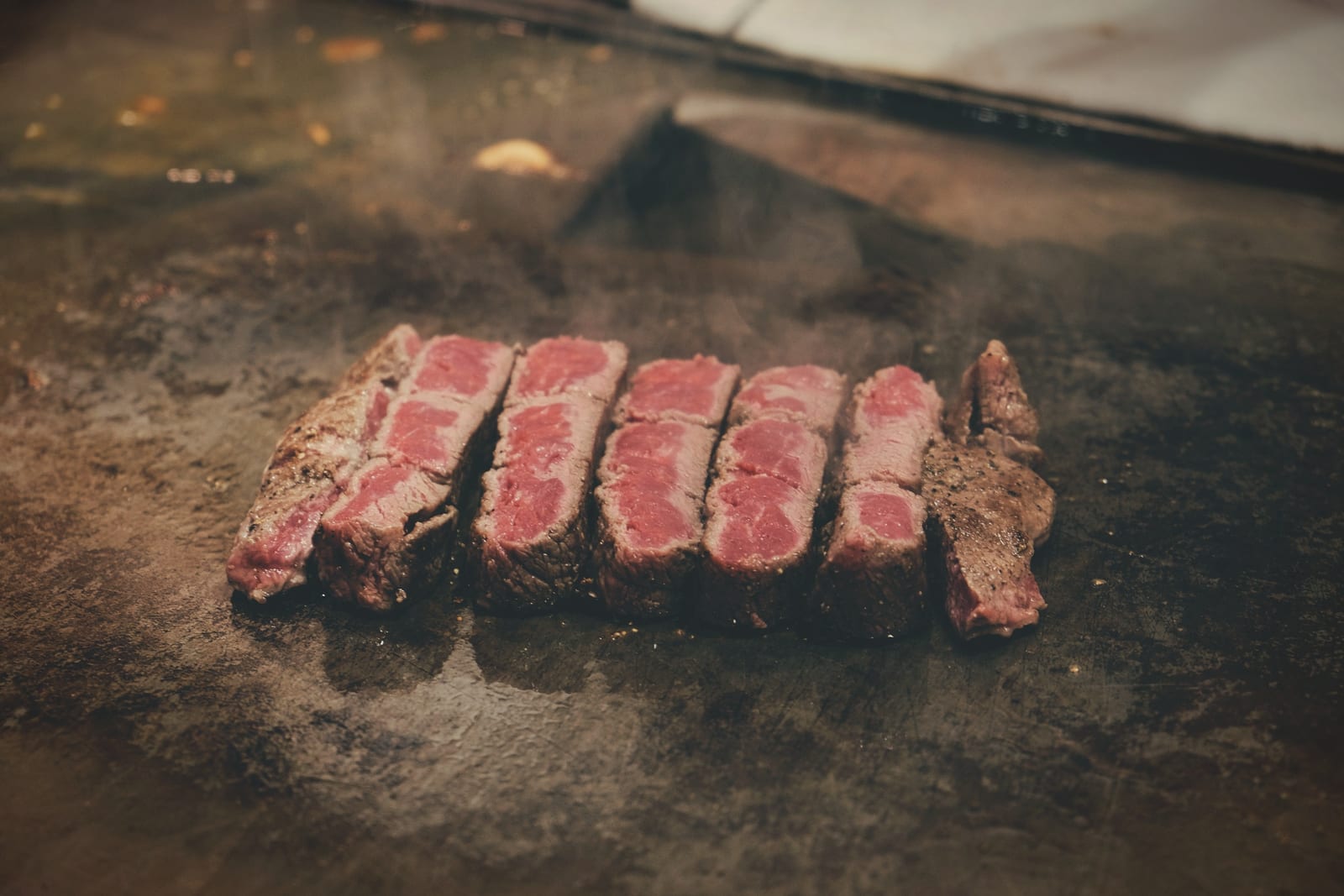
One continuum, many vocabularies
Doneness is a continuum that cooks divide into words. The vocabulary is French in origin (bleu, saignant, à point, bien cuit) and English in its most widespread form: blue, rare, medium-rare, medium, medium-well and well done. Other cuisines cut the scale differently: Argentine grill cooks speak of jugoso, a punto and cocido; Mexico uses término rojo, término medio, tres cuartos and bien cocido. Underneath every vocabulary lies the same thing, the temperature reached at the centre.
The figures most professional kitchens use, measured after resting, are summarised below. The full chart, with pull temperatures and carryover by thickness, is in Steak temperatures.
| Doneness | Core after rest | What you see |
|---|---|---|
| Blue | below 45 °C 113 °F | Seared outside, cool raw-red centre, soft |
| Rare | 48–52 °C 118–126 °F | Red, warm centre; red juices; yielding |
| Medium-rare | 52–56 °C 126–133 °F | Pink-red, warm through; the steakhouse default |
| Medium | 57–62 °C 135–144 °F | Pink centre, firmer; fat fully rendered |
| Medium-well | 63–67 °C 145–153 °F | A trace of pink; noticeably drier |
| Well done | 70 °C 158 °F and above | Grey-brown throughout; firm; little free juice |
What each degree does to the muscle
Lean muscle is about 75 % water held in a lattice of proteins. Heat changes those proteins in a sequence. From about 40 °C / 104 °F, myosin, the main contractile protein, begins to denature and the meat loses its raw, slippery texture and starts to firm. Between 50 and 55 °C / 122 and 131 °F the fibres shrink in diameter and begin to press out water; this is the zone of rare to medium-rare, where the meat is cooked but still holds most of its juice.
Around 60 °C / 140 °F myoglobin, the pigment that makes beef red, denatures and the centre turns from red to pink and then to grey-brown. Above 65 °C / 149 °F the collagen sheaths that wrap each bundle of fibres shrink lengthwise, squeezing the bundles like a wrung cloth; juice loss accelerates sharply, which is why the step from medium to well done costs far more moisture than the step from rare to medium. Measured cooking losses rise from roughly 10–15 % of weight at medium-rare to 25–35 % at well done.
Fat follows its own schedule. Intramuscular fat softens from around 40–50 °C / 104–122 °F and is fully liquid by medium; heavily marbled cuts such as ribeye or Wagyu are therefore usually served medium-rare to medium, where the fat lubricates the bite, rather than rare, where it can feel waxy.
Which doneness for which cut
Tender cuts with little connective tissue (tenderloin, striploin, ribeye, rump cap) are at their best rare to medium: their collagen never needed to dissolve, so further cooking only removes juice. Lean working cuts (flank, skirt, inside round) are either kept rare to medium-rare and sliced thin across the grain, or cooked far past well done for hours, at 70–95 °C / 158–203 °F, until collagen melts into gelatin, as in braises and the long Argentine cooking of short ribs. The middle of the scale, 65–75 °C / 149–167 °F held briefly, is where those cuts are at their toughest.
Carryover and resting
A steak keeps cooking after it leaves the heat, because the outside is hotter than the core and heat keeps flowing inward. The rise is large for thick steaks cooked over fierce heat, up to 5–8 °C / 9–14 °F, and small for thin steaks or gentle methods, 1–2 °C / 2–4 °F. The practical rule is to pull the steak before the target and let it rest; see Resting steak for what the rest does and does not achieve.
Bacteria live on the surface
The USDA's safe minimum for whole cuts of beef is 63 °C / 145 °F with a three-minute rest, which is medium. The guidance rests on the fact that, in an intact muscle, bacteria live on the surface, and the surface of any seared steak passes 70 °C / 158 °F within seconds, while the interior is essentially sterile. This is why rare steak is regarded as a low-risk food for healthy adults. It does not apply to ground beef, which should reach 71 °C / 160 °F, nor to mechanically tenderised or reassembled steaks, in which surface bacteria have been carried inside and which should not be served rare. People who are pregnant, elderly, very young or immunocompromised are advised to follow the 63 °C figure.
Colour lies; temperature does not
Judging by colour alone: myoglobin reacts to more than heat, so meat from older animals, meat that has been frozen, or meat cooked in a vacuum bag can look pinker or greyer than its temperature suggests. Ordering or cooking every cut to the same word, regardless of its fat and collagen. And treating the words as absolute: a restaurant's medium-rare may be a few degrees from another's, so a temperature is the only unambiguous request.
Frequently asked questions
What is the difference between medium-rare and medium?
About 5 °C / 9 °F at the centre: medium-rare is 52–56 °C / 126–133 °F, red-pink and juicy; medium is 57–62 °C / 135–144 °F, pink and firmer, with noticeably more juice lost.
Why do steakhouses recommend medium-rare?
It is the highest temperature at which the meat still holds most of its juice, while the fat has begun to soften and the texture is no longer raw.
Why is well-done steak dry?
Above about 65 °C / 149 °F collagen sheaths shrink and squeeze the muscle fibres, so juice loss accelerates; a well-done steak typically loses a quarter to a third of its weight.
Is pink steak raw?
No. Pink means the myoglobin has not fully denatured, which happens around 60 °C / 140 °F; the proteins are already cooked.
Sources
5
- USDA Food Safety and Inspection Service. Safe Minimum Internal Temperature Chart. 2023. www.fsis.usda.gov/food-safety/safe-food-handling-and-preparation/food-safety-basics/safe-temperature-chart
- McGee, Harold. On Food and Cooking: The Science and Lore of the Kitchen, rev. ed. New York: Scribner, 2004.
- Myhrvold, Nathan; Young, Chris; Bilet, Maxime. Modernist Cuisine: The Art and Science of Cooking. Bellevue: The Cooking Lab, 2011.
- Toldrá, Fidel (ed.). Lawrie's Meat Science, 8th ed. Duxford: Woodhead, 2017.
- López-Alt, J. Kenji. The Food Lab: Better Home Cooking Through Science. New York: W. W. Norton, 2015.
Related