Starter · Venice, Harry's Bar
Carpaccio
Carpaccio is raw beef sliced almost translucent and dressed with lines of a light mayonnaise-based sauce, created at Harry's Bar in Venice by Giuseppe Cipriani. It is named after the painter Vittore Carpaccio, known for intense reds and whites.
At a glance
- Origin
- Harry's Bar, Venice, 1950 (by its own account)
- Creator
- Giuseppe Cipriani
- Cut
- Sirloin (controfiletto) or tenderloin
- Serves
- 4 as a starter
- Time
- 20 min + 1 h freezing
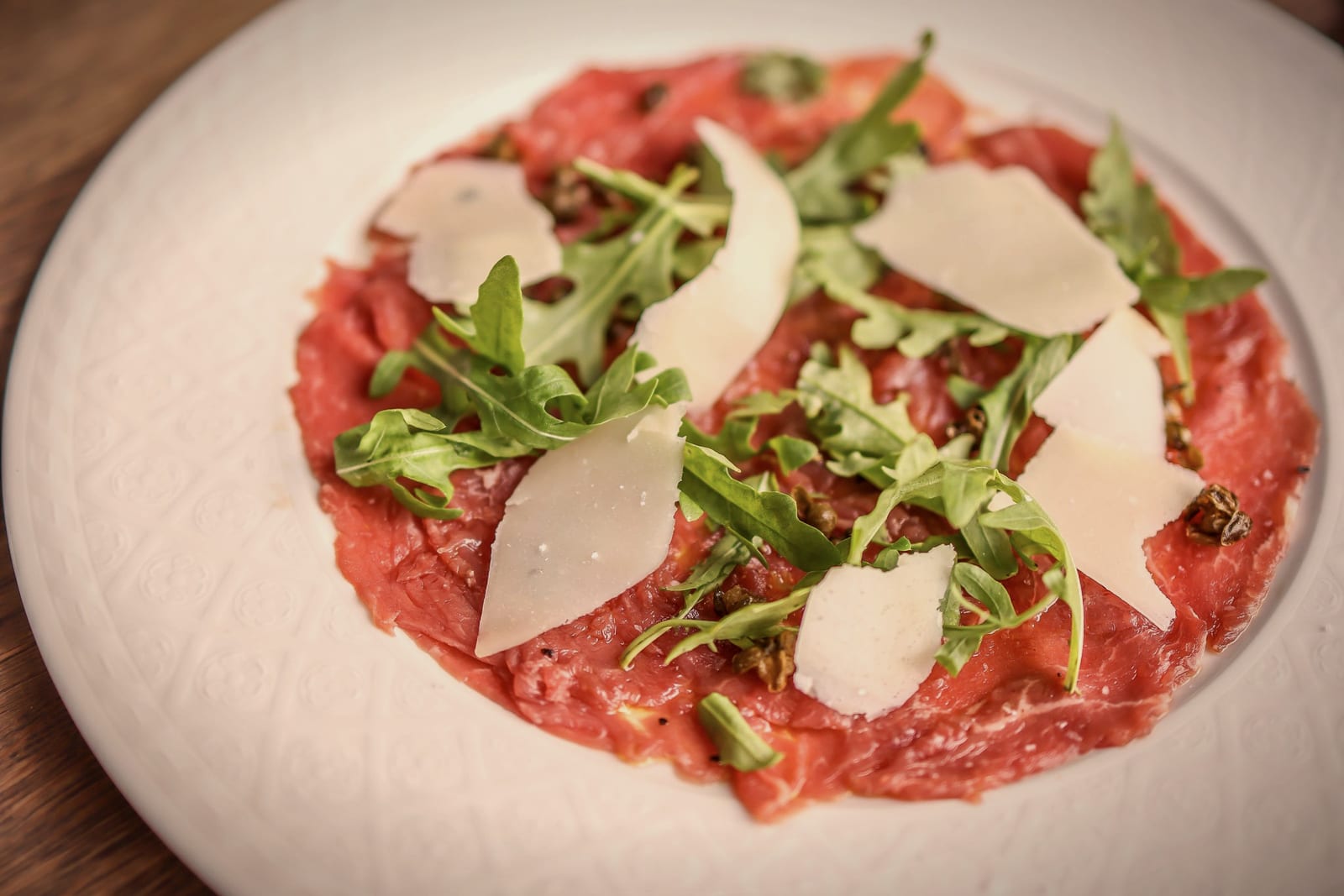
Edge to edge, almost translucent
Carpaccio is a plate covered edge to edge with slices of raw, lean beef so thin they are almost translucent, dressed at the moment of serving. In the original, the dressing is drawn over the meat in thin lines of a pale sauce: mayonnaise thinned with lemon, milk and Worcestershire sauce.
Outside Venice, the word has come to mean any thinly sliced raw food — tuna, salmon, even beetroot. In its strict sense it is beef, and the version most often served today, with olive oil, lemon, rocket and shavings of Parmigiano, is a later variation.
Harry's Bar, 1950, by the family's account
According to the Cipriani family, Giuseppe Cipriani created the dish at Harry's Bar, which he had opened in Venice in 1931, for the countess Amalia Nani Mocenigo, whose doctor had told her to avoid cooked meat. Arrigo Cipriani, his son, gives the date as 1950 in The Harry's Bar Cookbook (1991).
The name comes from Vittore Carpaccio (c. 1465–1525), the Venetian painter known for intense reds and whites. The story says the color of the dish reminded Cipriani of the paintings shown in a major Carpaccio exhibition in Venice; that retrospective is usually dated to 1963, so the name may be later than the dish. Harry's Bar still serves it with the original sauce.
A whole, fresh muscle; freezing is not enough
Like steak tartare, carpaccio is never cooked. Pathogens live on the surface of meat, and slicing a whole piece does not push them inside the way grinding does (McGee). The meat must therefore be a whole, very fresh muscle from an inspected supplier, trimmed of its outer surface, kept below 5 °C / 41 °F and served right after slicing.
Briefly freezing the beef firms it for slicing but does not make it safe: freezing does not reliably kill bacteria such as E. coli or Salmonella. The FDA Food Code requires restaurants to advise customers about the risk of raw animal foods, and people who are pregnant, very young, elderly or immunocompromised are advised to avoid them. A common alternative is to sear the outside of the piece for a few seconds and chill it before slicing.
Ingredients
| Ingredient | Amount | Note |
|---|---|---|
| Beef sirloin or tenderloin | 300 g / 10½ oz | whole piece, fully trimmed |
| Mayonnaise | 180 ml / ¾ cup | homemade, made with pasteurized yolk if preferred |
| Worcestershire sauce | 1–2 tsp | to taste |
| Lemon juice | 1 tsp | fresh |
| Milk | 2–3 tbsp / 30–45 ml | to thin the sauce to a pouring consistency |
| Salt, white pepper | to taste |
Method
- Trim all fat, sinew and outer surface from the beef, wrap it tightly in film and freeze for about 1 hour, until firm but not frozen through.
- Chill four plates. Slice the beef as thinly as possible with a very sharp knife or a slicer, about 1 mm / 1/32 in.
- If the slices are not thin enough, place them between sheets of film and press them gently with the flat of a knife or a light mallet.
- Cover each plate with the slices in a single layer, edge to edge. Season lightly with salt.
- Whisk the mayonnaise with Worcestershire, lemon juice and enough milk to make a sauce that flows from a spoon. Taste for salt and white pepper.
- Just before serving, drizzle the sauce over the beef in thin criss-cross lines. Serve at once, cold.
Oil, lemon, rocket and Parmigiano
The most common modern version replaces the sauce with extra-virgin olive oil and lemon, and adds rocket, shaved Parmigiano-Reggiano and sometimes capers or truffle. Piedmont's carne cruda all'albese is a related dish of sliced or chopped raw beef dressed with oil and lemon. In Japanese cuisine, gyū tataki sears the outside of beef before slicing it thinly. The name is now also used for fish and vegetable dishes cut the same way.
Cold plates, dressed at the last moment
Carpaccio is a starter. It is served cold, on cold plates, as soon as it is dressed; acid left on the meat for long turns it grey, much as lime "cooks" fish in ceviche. Bread or grissini usually accompany it.
Frequently asked questions
Is beef carpaccio safe to eat?
It carries the risks of any raw meat. It is acceptable when made from a whole, very fresh, trimmed piece from an inspected supplier, kept cold and served immediately; people at higher risk should avoid it.
Does freezing make carpaccio safe?
No. Freezing helps with slicing and kills some parasites, but it does not reliably kill bacteria such as E. coli or Salmonella.
What cut of beef is used for carpaccio?
Harry's Bar uses lean sirloin; tenderloin and other lean, sinew-free cuts are also common.
Why is it called carpaccio?
After the Venetian painter Vittore Carpaccio, whose deep reds the dish was said to recall.
Sources
4
- McGee, Harold. On Food and Cooking: The Science and Lore of the Kitchen, rev. ed. New York: Scribner, 2004.
- USDA Food Safety and Inspection Service. Safe Minimum Internal Temperature Chart. 2023. www.fsis.usda.gov/food-safety/safe-food-handling-and-preparation/food-safety-basics/safe-temperature-chart
- Cipriani, Arrigo. The Harry's Bar Cookbook. New York: Bantam, 1991.
- U.S. Food and Drug Administration. Food Code 2022, §3-603.11 Consumer Advisory. College Park, MD, 2022. www.fda.gov/food/fda-food-code/food-code-2022
Related