Cut · Rump, a working muscle
Rump
The rump is the large muscle group over the hip, centred on the gluteus medius. It works when the animal walks, which gives it a coarser grain, more flavour and a firmer bite than the loin; it is sold as rump steak in Australia and Britain and as top sirloin in the United States.
At a glance
- Primal
- Sirloin / rump
- Muscles
- Gluteus medius (the eye), gluteus accessorius; biceps femoris cap on top, tensor fasciae latae at the base
- Weight
- 5–7 kg (11–15 lb), whole Australian rump
- Best cooked
- Hot and rare as steak; roast or long water bath whole
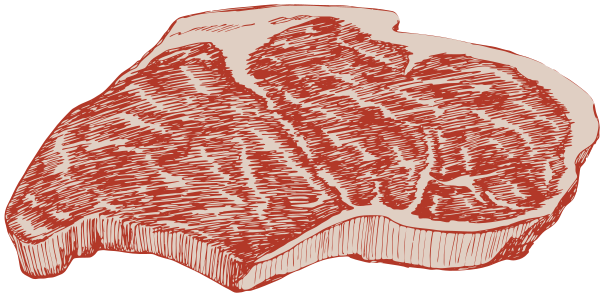 Rump steak
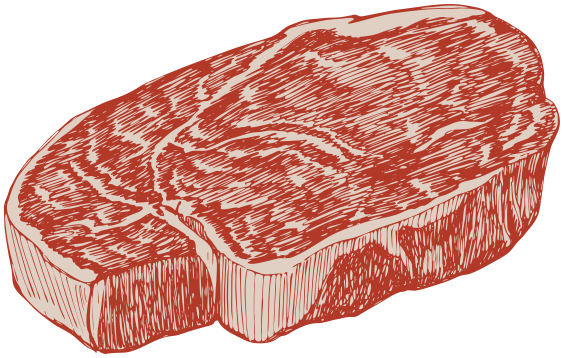 Sirloin steak
Several muscles over the hip
The rump is the muscle group over the hip joint, between the striploin and the leg. Its centre is the gluteus medius, a thick, lean muscle that does real work when the animal walks, which gives it a coarser grain, more flavour and a firmer texture than the loin cuts. A full Australian rump weighs 5–7 kg (11–15 lb) and contains several muscles running in different directions: the eye of rump, the rostbiff, the cap (picanha) and the tri-tip.
Because these muscles are cut together in a single steak in some countries and separated in others, the word covers different things. A British or Australian rump steak is a cross-section through several of them; an American top sirloin steak is usually the centre muscle alone, trimmed of the cap; Argentine cuadril is the whole group minus the tapa; Brazilian alcatra includes the cap and the tri-tip unless they are sold separately as picanha and maminha.
It is the cut most often used to show the difference between tenderness and flavour: a rump will never be as tender as a tenderloin, and most butchers will say it tastes more of beef.
Behind the loin, close to the leg
Over the hip, behind the loin. Its position, close to the leg, means it takes part in locomotion, unlike the muscles along the spine, and its connective tissue is greater than that of the striploin in front of it. In American butchery the region is split from the short loin and called the sirloin; the top sirloin butt (IMPS 184) is the upper half, and the bottom sirloin, below it, carries the tri-tip and the flap (the Argentine vacío extends into this area).
Grading systems treat the rump as a separate carcass region. In Meat Standards Australia grading, for instance, the rump is graded with its own cut-by-cooking-method scores, and individual rump muscles receive different eating-quality predictions: the centre of the gluteus medius scores higher as a grilled steak than the outer muscles do. Australian specifications also distinguish the full rump from the D-rump (HAM 2100), named for the D shape left once the tail (the tri-tip) is removed.
Cooking it: fast and rare, or slow and long
A working muscle wants either fast and rare or slow and long. As a steak, 2–3 cm thick, it is grilled or pan-fried hot and served rare to medium-rare (52–55 °C / 126–131 °F at the core after resting), then sliced across the grain; past medium it tightens. Thick pieces of the centre muscle are roasted, a common choice for the British Sunday roast, or cooked in a water bath for several hours at 55–57 °C / 131–135 °F, which softens them without losing colour.
In Argentina the cuadril is grilled in thick slabs over moderate embers; in Brazil the alcatra is a churrasco cut, skewered whole or in thick pieces. Because the muscles inside a cross-cut rump steak run in different directions, carving it into its separate muscles before slicing gives a more even result than slicing the steak as one piece.
Reading the label by country
The name on the label must be read against the country. Rump steak in a British or Australian shop is a cross-cut; top sirloin in an American shop is a single muscle; a piece marked sirloin outside the United States may be the striploin. For steaks, the most consistent pieces come from the centre of the gluteus medius, cut thick, with fine-textured, bright red meat and a visible but thin seam of fat.
Whole rumps are sold in vacuum packs and age well, wet or dry; the extra days of ageing reduce the firmness of the muscle more noticeably than they do in naturally tender cuts. A buyer who wants the cap and the tri-tip for separate use should ask for them to be left on, since many trade specifications remove both.
Names around the world
16
The same muscle, named by language and by trade system.
| English | Rump |
| Tiếng Việt | Thăn mông |
| Español | Cuadril |
| 한국어 | 우둔 |
| 日本語 | ランプ |
| Français | Rumsteck |
| Italiano | Scamone |
| Русский | Рамп |
| 中文 | 臀肉 |
All the cuts' names, country by country →
Trade and national systems
| System | Name | Reference |
|---|---|---|
| United States | Top sirloin · sirloin steak · centre-cut sirloin | IMPS 184 |
| United Kingdom | Rump steak | AHDB |
| Australia / NZ | Rump · rump steak · D-rump | HAM 2090 |
| Argentina | Cuadril | IPCVA |
| Brazil | Alcatra · miolo da alcatra (centre) | Portaria 5/88 |
| France | Rumsteck | Larousse |
| Japan | ランプ (ranpu) | JMGA |
Field data
Numbers measured in a working kitchen, piece by piece, not taken from a table. Another kitchen, another trimming specification, another number. How field data is collected.
Field data
Rump
Not yet measured.
Frequently asked questions
Is rump steak the same as sirloin?
In the United States, rump steak is roughly what is sold as top sirloin. In Britain and Australia, sirloin means the striploin, a different cut further forward along the back.
Is rump steak tender?
Less than loin cuts, but tender enough as a steak if cooked rare to medium-rare and sliced across the grain. Its strength is flavour.
What is the difference between rump and picanha?
The picanha is the cap on top of the rump, sold separately with its fat. The rump proper is the gluteus medius underneath.
How long should rump be cooked?
As a 2–3 cm steak, about 2–4 minutes a side over high heat to 52–55 °C / 126–131 °F at the core, then a few minutes' rest.
Sources
6
- USDA Agricultural Marketing Service. Institutional Meat Purchase Specifications: Fresh Beef Series 100. Washington, DC, 2014. www.ams.usda.gov/sites/default/files/media/IMPS_100_Fresh_Beef%5B1%5D.pdf
- AUS-MEAT Limited. Handbook of Australian Meat, 7th ed. (International Red Meat Manual). Brisbane, 2005. www.ausmeat.com.au
- Agriculture and Horticulture Development Board (UK). Beef Meat Purchasing Guide. Kenilworth, 2016. ahdb.org.uk
- Instituto de Promoción de la Carne Vacuna Argentina (IPCVA). Cortes de carne vacuna argentina — nomenclatura y usos. Buenos Aires. www.ipcva.com.ar
- Meat & Livestock Australia. Meat Standards Australia: Standards Manual for Beef Grading. Sydney, 2021. www.mla.com.au/marketing-beef-and-lamb/meat-standards-australia
- McGee, Harold. On Food and Cooking: The Science and Lore of the Kitchen, rev. ed. New York: Scribner, 2004.
Related