Street food · Argentina's north-west
Beef empanadas
Argentine beef empanadas are half-moon pastries filled with beef, onion, hard-boiled egg and spices, sealed with a braided edge called the repulgue and baked or fried. Beef cut by knife into 3–5 mm dice keeps its juices where mince turns drier, and the northern salteña and tucumana are known for their juice.
At a glance
- Origin
- Argentina; Iberian roots
- Filling
- Beef cut by knife or minced, onion, egg, cumin, paprika
- Oven
- 220–250 °C / 430–480 °F, 12–18 min
- Serves
- 8 (about 24 empanadas)
- Time
- About 75 min active, 3 h in total
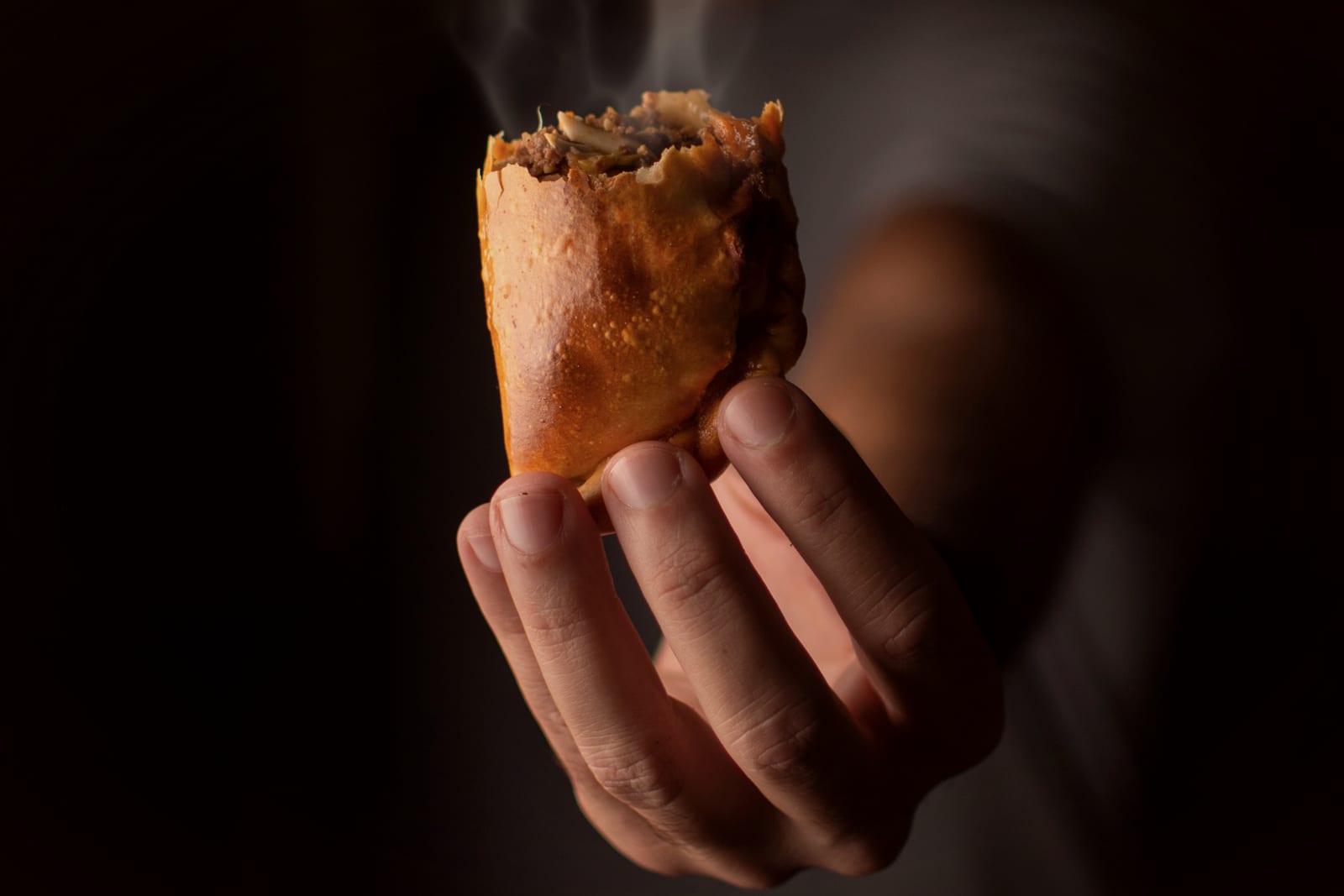
Knife-cut or minced, sealed by hand
An empanada (from empanar, "to wrap in bread") is a disc of dough folded over a filling and sealed. In Argentina the beef empanada is the most common: a filling of beef, onion, fat and spices such as cumin and sweet paprika, with chopped hard-boiled egg and often green olives or raisins, enclosed in a wheat dough made with beef fat or lard. It is eaten by hand, hot, as a starter, a snack, or a whole meal of several pieces.
The beef is either minced (carne picada) or, in the northern traditions, cut by knife (cortada a cuchillo) into small dice of 3–5 mm / ⅛–¼ in. Knife-cut beef keeps its texture and juices; minced beef gives a finer, drier filling. The edge is closed with the repulgue, a pleat folded by hand along the rim. In shops its pattern often tells the filling apart, a code that differs from place to place.
From Spain to the colonial north-west
Filled pastries of this kind are old across the Mediterranean, and the empanada reached the Americas with the Spanish. In Spain the empanada gallega of Galicia is a large pie; medieval Iberian cookery, influenced by Arab cuisine, already had small filled pastries. The exact lineage is debated, and similar pastries developed independently in many cultures.
In Argentina the empanada took root in the colonial north-west, around Salta, Tucumán, Jujuy and Santiago del Estero, where it is still most varied, and spread throughout the country. Petrona C. de Gandulfo's El libro de Doña Petrona (1933) gives several versions, and today the city of Famaillá, in Tucumán, holds a national empanada festival.
Salta, Tucumán, Mendoza and beyond
Salteña (Salta): small and very juicy, with knife-cut or minced beef, potato in small cubes, hard-boiled egg, spring onion, cumin and paprika, the fat often coloured red with paprika; closed with a repulgue on top, standing upright, and baked in a hot clay oven. Tucumana (Tucumán): knife-cut beef, sometimes matambre, with a large amount of spring onion, hard-boiled egg and cumin, no potato and very juicy; baked in a clay oven or fried in beef fat. Mendocina (Mendoza): larger, with a high proportion of onion to beef, green olive, hard-boiled egg and oregano, usually baked.
Other styles include the cordobesa (Córdoba), slightly sweet, with raisins and sugar sprinkled on the crust; the santiagueña of Santiago del Estero, with knife-cut beef and a juicy filling; and the jujeña (Jujuy), sometimes with peas. In Buenos Aires the minced beef empanada, baked, is the most common. Chile's empanada de pino is a related, larger pastry.
Ingredients
| Ingredient | Amount | Note |
|---|---|---|
| Beef (top round, matambre or rump) | 700 g / 1.5 lb | cut by knife into 3–5 mm dice, or minced |
| Beef fat or lard | 100 g / 3½ oz | for the filling; or oil |
| Onion | 500 g / 1.1 lb | finely chopped |
| Spring onion | 1 bunch, about 100 g / 3½ oz | chopped |
| Ground cumin, sweet paprika, chili flakes | 1 tsp, 1 tbsp, ½ tsp | to taste |
| Hard-boiled eggs | 3 | chopped |
| Green olives | 60 g / 2 oz | optional, chopped |
| Flour (plain wheat) | 750 g / 6 cups | for the dough |
| Beef fat or lard, melted | 150 g / ⅔ cup | for the dough |
| Warm salted water | about 350 ml / 1½ cups | 1 tsp salt dissolved |
Method
- Make the filling: melt the fat in a wide pan and cook the onion slowly until soft and translucent, about 15 minutes. Add the beef and stir over high heat just until it changes colour, 2–3 minutes; it finishes cooking in the oven.
- Off the heat, season with salt, cumin, paprika and chili, add the spring onion, and let the filling cool completely, then refrigerate for at least 1 hour or overnight. Cold fat sets the filling and keeps it juicy when baked.
- Make the dough: mix the flour with the melted fat, add the warm salted water little by little and knead until smooth. Rest it covered for 30 minutes.
- Roll the dough to about 2–3 mm / ⅛ in and cut discs of 12–13 cm / 5 in. (Ready-made discs, tapas de empanada, are sold in Argentina.)
- Place a spoonful of cold filling on each disc with some egg and olive. Moisten the edge with water, fold into a half-moon, press, and close with the repulgue, folding the edge over itself in small overlapping pleats.
- To bake, brush with beaten egg and bake at 220–250 °C / 430–480 °F for 12–18 minutes, until golden. To fry, cook in fat or oil at 170–180 °C / 340–355 °F, 3–4 minutes per side.
- Rest a few minutes before eating: the filling is very hot inside.
Humita, ham and cheese, árabes
Beyond beef, Argentine empanadas are filled with chicken, ham and cheese, humita (sweet corn), onion and cheese, tuna or vegetables; the triangular empanadas árabes season the meat with lemon. Some families add a pinch of sugar to the beef or brush the baked crust with sugar water. Large single pies, empanadas de horno cut in wedges, are known as empanadas gallegas after the Spanish model. For an all-beef dish with the same flavours, see the asado, where empanadas are often served before the grill.
By the dozen, before the asado
Empanadas are served hot or warm, by the dozen, often as a starter before an asado or as the main dish on 25 May and 9 July, Argentina's national holidays, with red wine or beer. Some add a squeeze of lemon; salsa criolla is common in some regions. Common mistakes: filling the dough while the filling is warm, which melts the fat and tears the dough; overcooking the beef before assembly, which dries it out; filling too much, so the empanadas burst; a dough too thick; and a weak repulgue that lets the juice escape.
Frequently asked questions
What is the difference between salteñas and tucumanas?
Salteñas usually include small cubes of potato and are baked upright; tucumanas use knife-cut beef with plenty of spring onion and no potato, and are baked or fried.
Is the beef in empanadas cut by knife or ground?
Both exist. Northern styles cut it by knife into small dice for a juicier texture; minced beef is common in Buenos Aires and at home.
What is the repulgue?
The hand-folded pleated edge that seals an empanada. Its pattern can indicate the filling, but the code is not standard and varies by shop and region.
Are Argentine empanadas baked or fried?
Both. Baking in a hot oven is the most common today; frying in beef fat is traditional in Tucumán and other northern provinces.
Sources
3
- Instituto de Promoción de la Carne Vacuna Argentina (IPCVA). Cortes de carne vacuna argentina — nomenclatura y usos. Buenos Aires. www.ipcva.com.ar
- Gandulfo, Petrona C. de. El libro de Doña Petrona. Buenos Aires, 1933.
- Ducrot, Víctor Ego. Los sabores de la patria. Buenos Aires: Norma, 1998.
Related