Main course · Italian roots
Milanesa
The milanesa is a thin slice of lean beef dipped in egg seasoned with garlic and parsley, coated in breadcrumbs and fried or baked; Italian immigrants brought it to the Río de la Plata from the Milanese cotoletta. Cut about 5 mm / ¼ in thick and across the grain, the slice stays tender while hot oil turns the crumb golden.
At a glance
- Origin
- Argentina, Uruguay; from the Italian cotoletta alla milanese
- Cut
- Top round (nalga), cuadrada, eye of round (peceto)
- Thickness
- About 5 mm / ¼ in
- Serves
- 4 (8 milanesas)
- Time
- 40 min active, 70 min in total
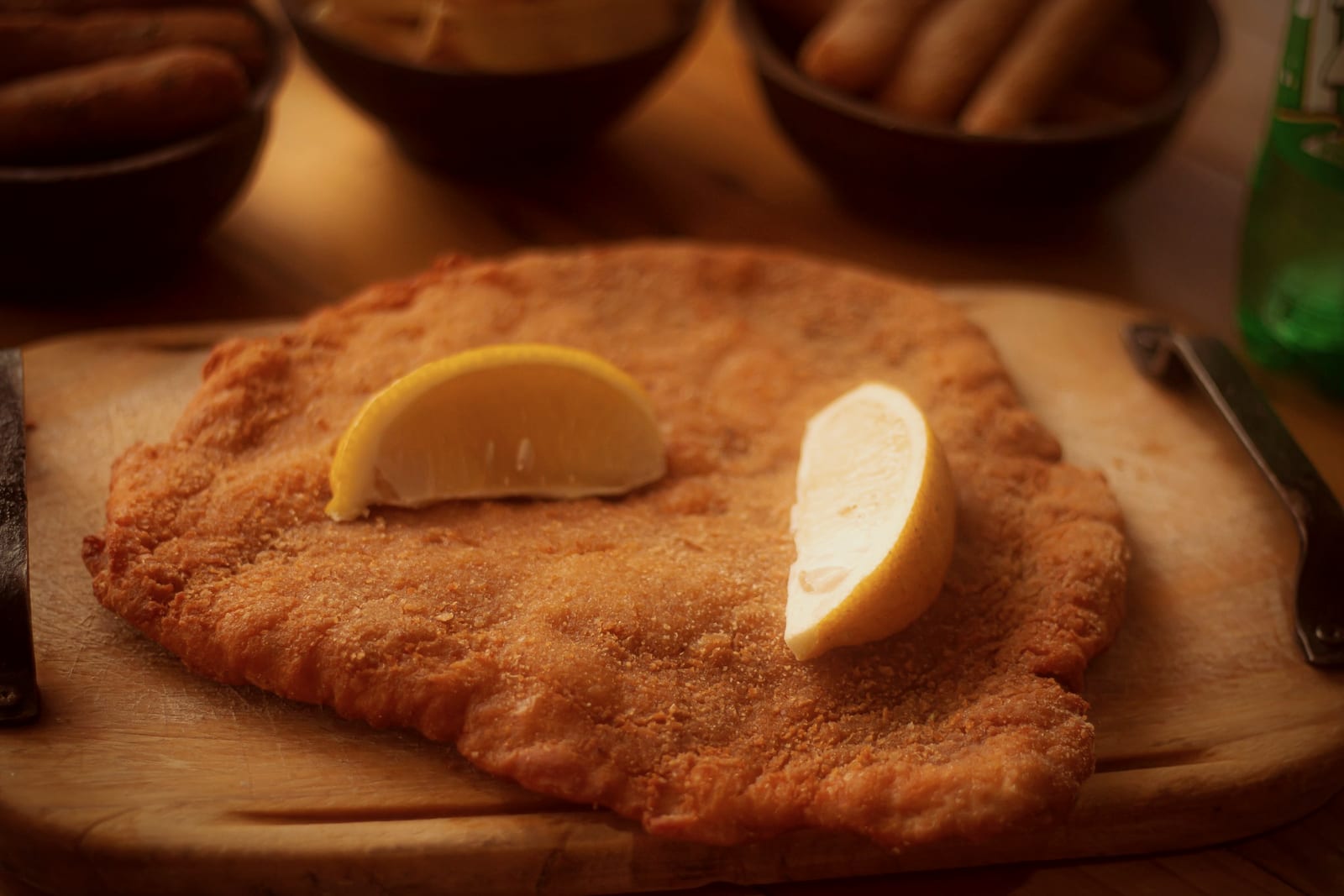
Five millimetres, across the grain
A milanesa is a boneless slice of lean beef, about 5 mm / ¼ in thick, passed through beaten egg seasoned with garlic and parsley and then through breadcrumbs, and cooked in hot oil or in the oven until golden. It is eaten hot as a main course with mashed or fried potatoes or a salad, cold the next day, or in a sandwich (sándwich de milanesa).
In Argentina the usual cuts are from the round: nalga (top round), cuadrada (part of the bottom round) and peceto (eye of round), all lean, with long fibres and little connective tissue, cut across the grain so the thin slice stays tender. Butchers sell the meat already sliced for milanesas, and often already breaded. The same name and technique are used for chicken (milanesa de pollo; the breast version is called suprema), veal, pork, eggplant and soy.
From Milan's veal chop to beef
The milanesa descends from the cotoletta alla milanese of Milan, a veal rib chop with its bone, coated in egg and breadcrumbs and fried in butter. Pellegrino Artusi's La scienza in cucina (1891) includes it. Its relationship with the Austrian Wiener Schnitzel, which is very similar, has long been debated, and neither city's claim of priority is settled.
Italian immigration to Argentina and Uruguay, which brought millions of people between the 1870s and the 1930s, carried the cutlet to the Río de la Plata. There it changed: beef was cheap and plentiful, so the veal chop became a boneless slice of beef, butter gave way to oil, and garlic and parsley went into the egg. Petrona C. de Gandulfo's El libro de Doña Petrona (1933), the reference home cookbook of 20th-century Argentina, gives milanesas among its basic recipes.
Ingredients
| Ingredient | Amount | Note |
|---|---|---|
| Beef top round (nalga) or eye of round | 800 g / 1.8 lb | 8 slices, 5 mm / ¼ in, across the grain |
| Eggs | 3 | beaten |
| Garlic | 2 cloves | finely chopped |
| Parsley | 2 tbsp, about 8 g / ¼ oz | chopped |
| Salt | 1 tsp, about 6 g | plus more to taste |
| Dry breadcrumbs (pan rallado) | 250 g / 2½ cups | fine |
| Neutral oil (sunflower) | 500 ml / 2 cups | for shallow frying |
| Lemon | 1 | in wedges, to serve |
Method
- Trim any fat or silverskin from the slices. If they are uneven, place them between sheets of plastic film and flatten gently with a mallet to an even 5 mm / ¼ in. Do not tear the meat.
- Beat the eggs with the garlic, parsley and salt. Some cooks add a splash of milk or a little grated cheese.
- Dip each slice in the egg, let the excess drip off, and lay it on the breadcrumbs. Cover it with more crumbs and press firmly with the palm of the hand on both sides so the coating sticks. For a thicker crust, repeat egg and crumbs once.
- Rest the breaded slices in the refrigerator for 20–30 minutes, so the coating sets and does not fall off in the oil.
- Heat the oil in a wide frying pan to about 170–175 °C / 340–350 °F, about 1 cm / ½ in deep. Fry the milanesas one or two at a time, 2–3 minutes per side, until golden. Drain on a rack or paper.
- To bake instead, place them on an oiled tray, brush or spray the tops with oil and bake at 200 °C / 390 °F for about 10–12 minutes per side, until golden and crisp.
- Serve at once, with lemon wedges.
Napolitana, a caballo, al pan
Milanesa a la napolitana is topped with ham, tomato sauce and melted mozzarella and finished in the oven. Its name does not refer to Naples. The commonly told story places its birth in the 1940s in Buenos Aires, at a restaurant called Nápoli near the Luna Park stadium, whose cook covered an overcooked milanesa with ham, sauce and cheese; the dish took the restaurant's name. The story is widely repeated but rests on oral tradition rather than documents.
Milanesa a caballo ("on horseback") is topped with one or two fried eggs. In Uruguay the milanesa al pan is a staple sandwich, and the milanesa napolitana is as common as in Argentina. The milanesa travelled across Latin America: in Mexico it is a usual filling of the torta de milanesa, and Paraguay, Bolivia and Chile have their own versions. A thin grilled steak, by contrast, is a different dish; for grilling see the asado.
Puré, fries and lemon
Typical sides are mashed potatoes (puré), French fries, a mixed salad or, in a milanesa completa, fries and fried eggs together. Lemon is squeezed over at the table. Common mistakes: slicing with the grain, which makes the meat tough; slices of uneven thickness, which cook unevenly; oil not hot enough, so the crust soaks up fat and turns soggy; too many pieces in the pan at once, which cools the oil; and covering the hot milanesas, whose steam softens the crust.
Frequently asked questions
What cut is used for milanesa?
Lean cuts of the round: in Argentina nalga (top round), cuadrada or peceto (eye of round), sliced across the grain about 5 mm / ¼ in thick.
Is a milanesa the same as a schnitzel?
They are close relatives: both are breaded, fried thin cutlets. The milanesa usually uses beef and seasons the egg with garlic and parsley; the Wiener Schnitzel is veal fried in fat without seasoning in the egg.
Why is it called milanesa a la napolitana?
The commonly told story says it was created in the 1940s at a Buenos Aires restaurant called Nápoli and took its name, not from the city of Naples.
Can milanesas be baked instead of fried?
Yes. Baked on an oiled tray at 200 °C / 390 °F for about 10–12 minutes per side, they are less crisp but use far less oil.
Sources
4
- Larousse Gastronomique, rev. ed. London: Hamlyn, 2009.
- Instituto de Promoción de la Carne Vacuna Argentina (IPCVA). Cortes de carne vacuna argentina — nomenclatura y usos. Buenos Aires. www.ipcva.com.ar
- Artusi, Pellegrino. La scienza in cucina e l'arte di mangiar bene. Florence, 1891.
- Gandulfo, Petrona C. de. El libro de Doña Petrona. Buenos Aires, 1933.
Related