Stew · Indonesia, cooked dry
Beef rendang
Rendang is a Minangkabau dish from West Sumatra: beef cooked for hours in coconut milk and a paste of chillies, shallots, ginger, galangal, turmeric and lemongrass until the liquid evaporates. The coconut milk splits and the darkened meat fries in its oil — four hours or more to reach the dry end point.
At a glance
- Origin
- Minangkabau, West Sumatra, Indonesia
- Cut
- Lean round or topside; brisket, shank or chuck
- Liquid
- Coconut milk, cooked until it disappears
- Serves
- 8, with rice
- Time
- 1½ h active, 4–6 h in total
Gulai, kalio, then rendang
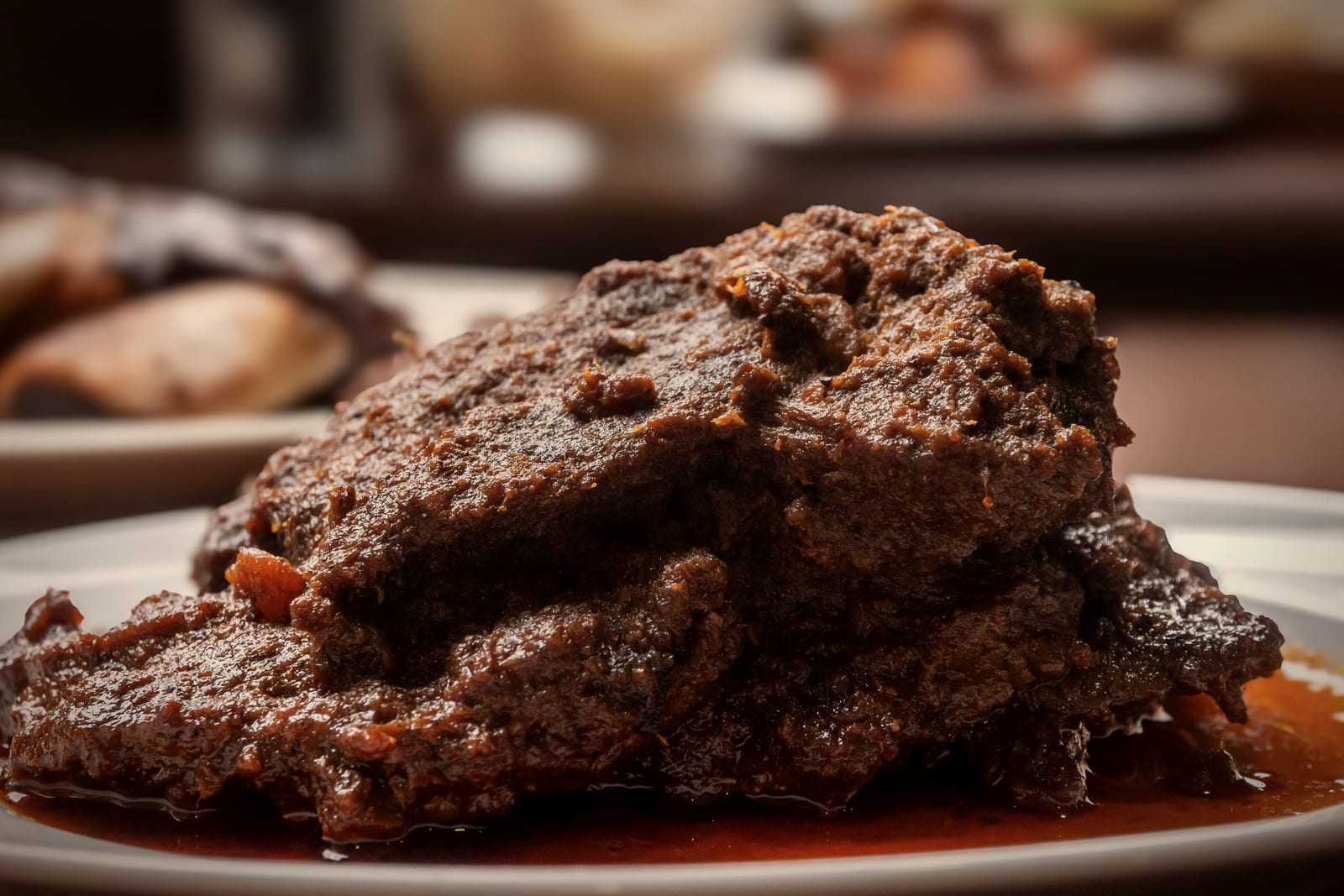
Rendang is less a recipe than a process. Pieces of beef are simmered in coconut milk with a ground spice paste (bumbu) and aromatic leaves, and stirred over a falling heat for four hours or more. As the water evaporates, the sauce thickens, the coconut milk splits and releases its oil, and the beef finally fries in that oil with the reduced spices clinging to it. The finished dish is dark brown, almost dry, intensely spiced and rich.
In the Minangkabau kitchen the stages have their own names. Gulai is the soupy, yellow first stage; kalio is the intermediate one, thick, moist and light brown, often eaten as it is; rendang proper is the dry, dark end point. Much of what is called rendang outside Sumatra is, by this definition, kalio.
The Minangkabau highlands
Rendang belongs to the Minangkabau people of the highlands of West Sumatra and is a central dish of their ceremonies, weddings and religious festivals, and of the Padang restaurants that spread Minang food across Indonesia and Malaysia. The word is usually traced to the Minang verb marandang, to cook slowly while stirring until dry.
The long cooking removes most of the water, and the spices and coconut oil act as a barrier; rendang is therefore traditionally described as keeping for days or even weeks without refrigeration, which is often linked to the Minang custom of merantau, young men leaving home to work and trade elsewhere. That keeping quality is traditional knowledge, not a food-safety guarantee; modern practice is to refrigerate it. Minang communities who settled in what is now Negeri Sembilan took the dish to the Malay Peninsula, where it developed its own versions.
Ingredients
| Ingredient | Amount | Note |
|---|---|---|
| Beef: round, topside, brisket or chuck | 1.5 kg / 3.3 lb | in 5 cm / 2 in pieces, cut with the grain |
| Coconut milk | 2 L / 8½ cups | from 3 grated coconuts, or canned, unsweetened |
| Shallots | 250 g / 9 oz | for the paste |
| Garlic | 60 g / 2 oz | for the paste |
| Large red chillies | 150 g / 5 oz | seeded for less heat; for the paste |
| Ginger, galangal, fresh turmeric | 40 g, 60 g, 30 g / 1½, 2, 1 oz | for the paste |
| Lemongrass | 3 stalks | bruised and knotted |
| Kaffir lime leaves | 6 | torn |
| Turmeric leaf | 1 | knotted; optional but traditional |
| Indonesian bay leaves (daun salam) | 3 | optional |
| Asam kandis (dried garcinia) | 2 pieces | or 1 tbsp / 15 g tamarind pulp |
| Salt | about 2 tsp / 12 g | to taste |
Method
- Grind the shallots, garlic, chillies, ginger, galangal and turmeric to a fine paste in a mortar or blender, with a little coconut milk if needed.
- In a wide, heavy pot or wok, bring the coconut milk, paste, lemongrass, lime leaves, turmeric leaf, salam and asam kandis to a boil, stirring constantly so the milk does not split too early.
- Add the beef and salt. Simmer uncovered over medium heat, stirring often, for about 2 hours; the sauce reduces to a thick, light-brown gravy. This is kalio, and it can be served at this point.
- Lower the heat and keep cooking, stirring and scraping the bottom more and more often, for another 1½–3 hours. The coconut oil separates and the paste darkens.
- Once the water has evaporated, the pot rises above 100 °C / 212 °F and the meat begins to fry in the coconut oil. Stir continuously over low heat until the beef is dark brown and coated in a dry, crumbly paste. Remove the leaves and asam before serving.
Kerisik in Malaysia, jackfruit in Sumatra
In Malaysia and Singapore rendang is a dish of Hari Raya, the end of Ramadan. Malaysian versions commonly add kerisik, grated coconut toasted and pounded to a paste, which thickens and darkens the sauce, and some add palm sugar; rendang tok from Perak is a well-known dry style. Within West Sumatra, rendang is also made with chicken, duck, offal, jackfruit, cassava leaves or eggs, and rendang paru uses beef lung. Spiced beef braises elsewhere in Southeast Asia, such as the Vietnamese bò kho, stop while still saucy.
With rice, better the next day
Rendang is eaten with steamed rice, often as part of a Padang spread of many dishes, or with ketupat or lemang, rice cooked in woven palm leaves or in bamboo, at festivals. Like most braises, it tastes better a day after cooking.
Common mistakes: stopping at the wet stage and calling it rendang; cooking too fast at the end, which scorches the paste instead of frying it; not stirring, so the coconut sticks and burns; using very tender cuts such as tenderloin, which crumble into fibres; and adding sugar or flour to imitate the colour that only the long reduction and Maillard browning give.
Frequently asked questions
What is the difference between rendang and kalio?
Kalio is the intermediate, still moist stage; rendang is cooked further until the liquid has evaporated and the meat fries in its own coconut oil.
Where does rendang come from?
From the Minangkabau people of West Sumatra, Indonesia; versions are also made in Malaysia and Singapore.
How long does rendang take to cook?
A dry Minang rendang takes about four to six hours; kalio is ready in about two.
What cut of beef is used for rendang?
Lean but firm cuts such as round or topside, or brisket, shank and chuck; very tender cuts fall apart.
Sources
3
- McGee, Harold. On Food and Cooking: The Science and Lore of the Kitchen, rev. ed. New York: Scribner, 2004.
- Owen, Sri. Sri Owen's Indonesian Food. London: Pavilion, 2008.
- Owen, Sri. Indonesian Regional Food and Cookery. London: Doubleday, 1994.
Related