Cut · Brisket, flat and point
Brisket
Brisket is the boneless breast of the animal: two overlapping pectoral muscles, the lean flat and the fatty point, joined by a seam of fat. They carry a standing animal of 500–600 kg, so they are full of connective tissue; 10–16 hours of smoke, or a long braise, turn that collagen to gelatin.
At a glance
- Primal
- Brisket (lower chest, forequarter)
- Muscles
- Pectoralis profundus (flat), pectoralis superficialis (point)
- Weight
- Whole packer 5–8 kg / 11–18 lb
- Best cooked
- Low and slow: smoking, braising, curing
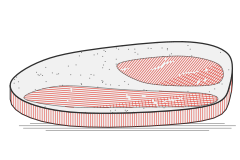
Flat, point and the fat between
Brisket is the pair of pectoral muscles that lie under the first five ribs and the breastbone. The flat (pectoralis profundus) is a long, even, lean slab with a clear grain; the point (pectoralis superficialis) sits on top of one end, thicker, rounder and much richer in fat. Between them runs a layer of hard fat that pitmasters call the nose or deckle, although in meat specifications "deckle" also names the fat and intercostal meat on the bone side that is removed before sale.
These muscles carry the weight of a standing animal of 500–600 kg, and they are used every time it lies down and gets up. The result is meat with a lot of collagen and a coarse grain. Cooked quickly, brisket is chewy; cooked for hours at low heat, the collagen melts into gelatin and the meat becomes soft enough to pull apart, while staying juicy.
The whole piece with both muscles is sold in the United States as a packer brisket and usually weighs 5–8 kg (11–18 lb). Specifications also sell the flat alone, trimmed and easier to slice evenly.
Off the breastbone, bones removed
The brisket is the lower front of the chest, ahead of and below the plate and behind the foreshank. On the carcass it is attached to the sternum and the cartilage of the first ribs, and it is separated from the forequarter with the bones removed. Behind it lies the plate, where the short ribs are cut, and above it the chuck.
Each national system divides the region differently. The US IMPS lists the boneless brisket with the deckle removed (120) and the flat cut alone (120A). Australian and New Zealand butchers split it into a point end and a navel end. In Argentina the pecho is often sold with part of the ribs for stews and for the grill, and in Brazil the peito is a cut for slow braising. In Korea the region is yangji, and the fatty point sliced paper-thin and grilled at the table is chadolbagi.
Point, flat or deckle: brisket names that get mixed up
Brisket names travel badly. “Point end” in an Australian butcher's shop is not the American point, “deckle” means one thing to a pitmaster and another in a meat specification, and the Cantonese 牛腩 that menus translate as “brisket” is mostly meat from the belly. Corned beef is brisket in New York and Dublin but usually silverside, from the hind leg, in Sydney and Auckland.
| Name | Where | What it is |
|---|---|---|
| Packer brisket | United States | The whole boneless brisket, point and flat together (IMPS 120 deckle-off; 119 deckle-on) |
| Flat · first cut | United States | The lean lower muscle alone (IMPS 120A) |
| Point · second cut | United States | The fatty top muscle alone (IMPS 120B); burnt ends are cubes of it |
| Deckle (pitmasters) | United States | The point, or the fat between point and flat |
| Deckle (specifications) | IMPS | Hard fat and rib-side meat removed from the brisket: not the point |
| Point end · navel end | Australia, NZ | The front half and the rear half of the brisket: not the US point and flat |
| Corned beef | US, Ireland | Usually brisket flat, brined and simmered |
| Corned beef | Australia, NZ | Usually silverside (hind leg), not brisket |
| Salt beef | United Kingdom | Brisket brined and simmered |
| Pastrami | United States | Brisket or navel (plate), cured, peppered and smoked |
| Pecho · peito · poitrine | Spanish-speaking countries, Brazil, France | Brisket |
| ブリスケ burisuke | Japan | Brisket, part of 肩バラ kata-bara |
| 三角バラ sankaku-bara | Japan | The neighbouring chuck rib meat, sold as top karubi: not brisket |
| 양지 yangji | South Korea | Brisket and flank region, for broths |
| 차돌박이 chadolbagi | South Korea | Fatty brisket point, sliced paper-thin |
| 우삼겹 usamgyeop | South Korea | Thin-sliced short plate (belly): often taken for chadolbagi |
| 牛腩 niúnǎn | Hong Kong, China, Singapore | Stewed “brisket” on menus: mostly belly and flank meat |
| Gầu | Vietnam | Fatty brisket, sliced thin for phở |
| Nạm | Vietnam | Flank, often translated “brisket” on phở menus |
Cooking it: smoke, the stall, 10–16 hours
In Texas barbecue the whole packer is seasoned with salt and coarse black pepper and smoked over post oak at a chamber temperature of about 110–125 °C / 225–257 °F. A large brisket takes 10–16 hours. Partway through, the internal temperature stops rising for several hours, usually somewhere around 65–75 °C / 150–167 °F: this is the stall, caused by moisture evaporating from the surface and cooling the meat. Many cooks wrap the brisket in butcher paper or foil at this point to push through it.
The meat is typically considered done between about 93 and 96 °C / 200 and 205 °F internal, although the practical test is tenderness: a probe should slide in with almost no resistance. Rested for one or more hours, the brisket is sliced across the grain. Because the grain of the flat and the point run in different directions, the two muscles are usually separated and sliced on their own.
Brisket is also the classic cut for curing. Brined and simmered, it is corned beef in Ireland and North America and salt beef in Britain; brined, coated in pepper and coriander and smoked, it becomes pastrami. In Jewish home cooking it is braised in the oven with onions. In Vietnamese phở, thin slices of fatty brisket (gầu) are one of the classic toppings, and in Korea brisket is boiled for broths such as gomtang and yukgaejang.
Brisket does not suit fast cooking as a thick piece. The only quick method is slicing it very thin across the grain, as in Korean chadolbagi, where each slice is cooked in seconds.
An even fat cap, a brisket that bends
For smoking, a whole packer with an even fat cap of about 0.5–1 cm after trimming cooks more evenly than one with a thin, tapering flat. A brisket that bends easily when held in the middle is often a sign of a softer, better-marbled piece. Higher marbling grades (USDA Prime and Choice, or higher marbling scores in other systems) forgive the long cook better, because the point and flat both stay juicier.
For braising or curing, the flat is simpler to portion and slice. For phở and hot pot, Asian butchers sell the fatty part already sliced thin and frozen. A brisket loses a large share of its raw weight during a long smoke, through fat rendering and moisture loss, so it is bought heavier than the cooked weight needed.
Names around the world
23
The same muscle, named by language and by trade system.
| English | Brisket |
| Tiếng Việt | Gầu bò |
| Español | Pecho |
| 한국어 | 양지 (yangji) / 차돌박이 (chadolbagi) |
| 日本語 | ブリスケット |
| Français | Poitrine |
| Italiano | Petto |
| Русский | Грудинка |
| 中文 | 牛胸肉 (niú xiōngròu) · 牛腩 (niúnǎn, approx.) |
| Deutsch | Rinderbrust |
| Português | Peito |
All the cuts' names, country by country →
Trade and national systems
| System | Name | Reference |
|---|---|---|
| United States | Brisket · packer (whole) · flat · point · deckle | IMPS 119 / 120 / 120A / 120B |
| United Kingdom | Brisket · salt beef (cured) | AHDB |
| Australia / NZ | Brisket · point end · navel end | HAM |
| Argentina | Pecho | IPCVA |
| Brazil | Peito | Portaria 5/88 |
| France | Poitrine | Larousse |
| Japan | ブリスケット · 肩バラ (kata-bara) | JMGA |
| Korea | 양지 (yangji) · 차돌박이 (chadolbagi, thin-sliced point) | KAPE |
| China · Hong Kong · Singapore | 牛胸肉 niú xiōngròu (brisket) · 牛腩 niúnǎn (menu “brisket”, mostly belly and flank meat) | |
| Vietnam | Gầu (fatty brisket, for phở) · ức bò | |
| Germany | Rinderbrust | |
| Spain · Mexico | Pecho |
Frequently asked questions
What is brisket?
Brisket is the boneless chest of the cow, made of two pectoral muscles: the lean flat and the fatty point. It is tough and needs long, slow cooking.
Brisket flat vs point: what is the difference?
The flat is the leaner, thinner muscle that slices evenly; the point sits on top of it, is thicker and much fattier, and is often used for burnt ends.
Why does brisket stall?
During smoking the surface loses water by evaporation, which cools the meat and holds the internal temperature steady, usually around 65–75 °C / 150–167 °F, for hours. Wrapping reduces evaporation and shortens the stall.
What temperature is brisket done?
Usually between 93 and 96 °C / 200 and 205 °F internal, when a probe slides in with almost no resistance.
Can you buy just the point of a brisket?
Yes. The point alone is a standard item (IMPS 120B), sold mostly to restaurants for burnt ends; the flat alone (120A) is easier to find in supermarkets. Many butchers will also separate a whole packer on request.
What cut is a poor man's brisket?
Usually a chuck roast. It comes from the shoulder, has similar collagen and more marbling than the flat, and smokes or braises in a fraction of the time of a whole brisket.
What is brisket called in the UK and Australia?
Brisket in both. In Britain, brined and simmered brisket is salt beef. Australian and New Zealand butchers divide it into a point end and a navel end, which are the front and rear of the brisket, not the American point and flat.
Is brisket a cheap cut?
Per kilo raw it is one of the cheaper beef cuts. But a long smoke loses a large share of the weight through rendered fat and evaporated water, and takes many hours of fuel, so cooked brisket is not cheap.
Is corned beef always brisket?
No. In the United States and Ireland it is usually brisket flat; in Australia and New Zealand corned beef is usually silverside from the hind leg. New York pastrami is often made from the navel (plate) rather than brisket.
Sources
4
- USDA Agricultural Marketing Service. Institutional Meat Purchase Specifications: Fresh Beef Series 100. Washington, DC, 2014. www.ams.usda.gov/sites/default/files/media/IMPS_100_Fresh_Beef%5B1%5D.pdf
- McGee, Harold. On Food and Cooking: The Science and Lore of the Kitchen, rev. ed. New York: Scribner, 2004.
- AUS-MEAT Limited. Handbook of Australian Meat, 7th ed. (International Red Meat Manual). Brisbane, 2005. www.ausmeat.com.au
- Franklin, Aaron; Mackay, Jordan. Franklin Barbecue: A Meat-Smoking Manifesto. Berkeley: Ten Speed Press, 2015.
Related