Cooking · Collagen to gelatin
Braising
Braising is the slow cooking of browned meat in a covered pot with a little liquid, kept at a gentle simmer for hours, often in an oven at 140–160 °C / 285–320 °F. In that moist heat the collagen of hard-working cuts — shank, cheek, oxtail — dissolves into gelatin, and a tough muscle turns tender and silky.
At a glance
- Oven
- 140–160 °C / 285–320 °F
- Liquid
- Simmering, 85–95 °C / 185–203 °F, never boiling
- Liquid level
- One-third to halfway up the meat
- Time
- 2½–4 h; longer for shank and oxtail
- Cuts
- Shank, cheek, oxtail, chuck, short ribs, brisket
Dry heat first, then a closed pot
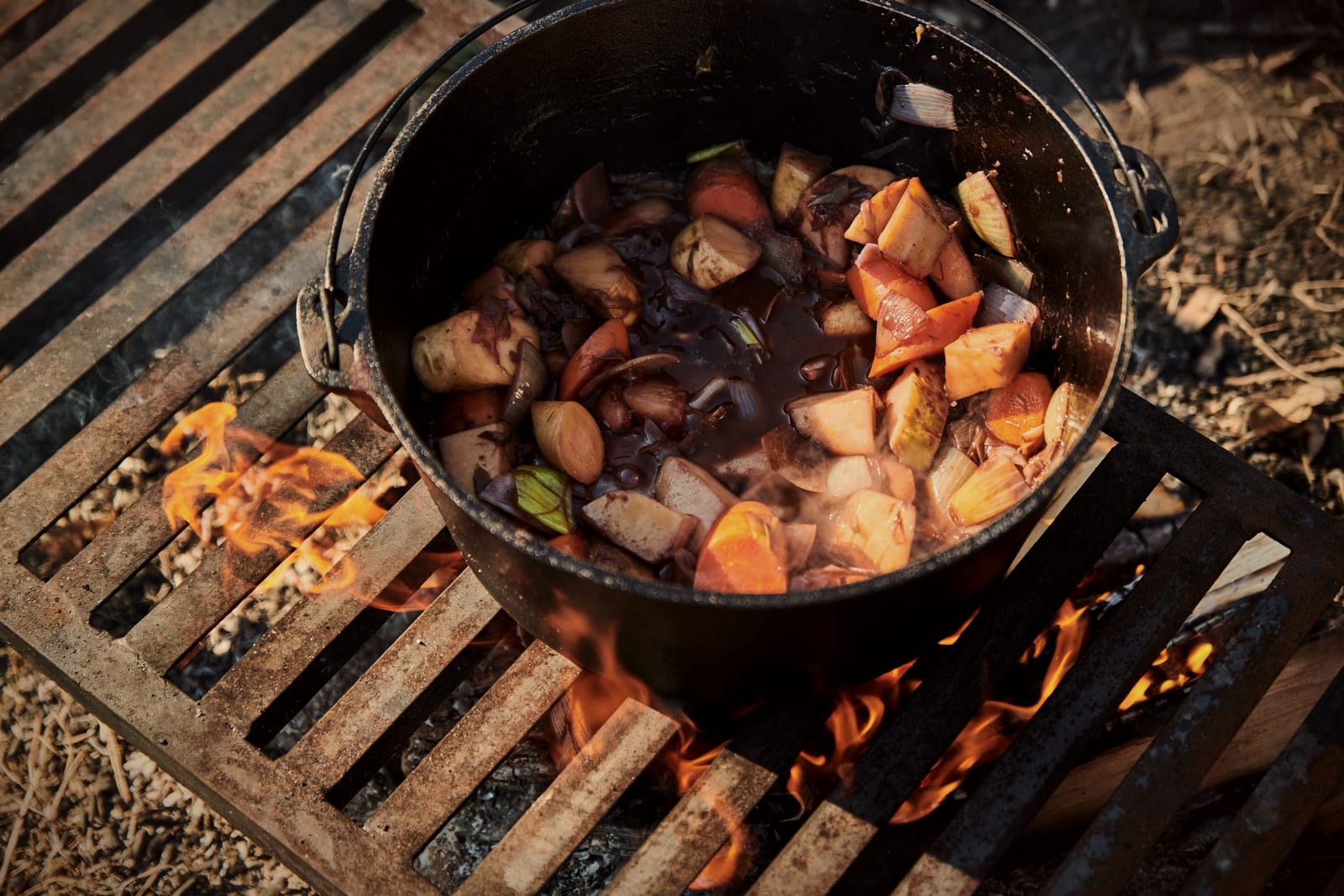
Braising is a combination method: dry heat first, to brown the meat, then moist heat in a closed pot. The liquid, which may be stock, wine, beer, tomatoes or water, comes only part of the way up the meat, so the top cooks in steam while the bottom simmers, and the liquid reduces into a sauce. When the meat is cut small and fully covered in liquid, the same process is usually called stewing.
Braising is for the cuts that steak cooking cannot use: muscles that work hard and are rich in connective tissue, such as shank, cheek, oxtail, chuck, short ribs and brisket. Cooked quickly they are chewy; braised, they become soft and succulent. Classic braises include bœuf bourguignon, ossobuco, pot roast and beef stew.
How collagen becomes gelatin
Connective tissue is built mainly of collagen, a protein made of three strands wound into a tight helix. Heated, the fibres first shrink, from about 60 °C / 140 °F, squeezing juice out of the meat. With continued heat and water, the helices unwind and break down into gelatin, which is soft, holds water and gives braises their silky, sticky texture. As Harold McGee explains, this conversion starts slowly at around 60–70 °C / 140–160 °F and speeds up greatly above about 80 °C / 175 °F, so time and temperature trade off: hours at a simmer, or days at the low temperatures used in sous-vide. Collagen from older animals is more cross-linked and needs longer, a point covered in Lawrie's Meat Science.
The muscle fibres themselves pull the other way. Above about 60–70 °C / 140–160 °F they contract and lose moisture, and the hotter the liquid, the faster they dry out. This is why a braise kept at a hard boil gives dry, stringy meat even though it sits in liquid, and why gelatin-rich cuts are chosen: the dissolved gelatin and melted fat make the meat feel juicy. A gentle simmer of 85–95 °C / 185–203 °F is the compromise, and an oven at 140–160 °C / 285–320 °F holds a covered pot there evenly, without the hot spot of a burner.
Browning happens first because the Maillard reaction needs a dry surface above about 140 °C / 285 °F, impossible in liquid at 100 °C / 212 °F. The browned crust and the brown residue left in the pan (the fond) carry that flavour into the sauce.
Step by step
- Choose a collagen-rich cut. Leave it whole or cut it into large pieces of 5–7 cm / 2–3 in; dry it and salt it, ideally a few hours ahead.
- Brown the meat well in a little fat in a heavy pot, in batches so it does not steam, until deep brown on all sides. Remove it.
- Soften the aromatics (onion, carrot, celery, garlic) in the same fat, add tomato paste if using, then deglaze with wine or stock, scraping up the fond.
- Return the meat and add liquid to one-third or halfway up its sides. Bring it to a bare simmer on the stove.
- Cover with a lid or a sheet of parchment pressed onto the surface and move the pot to an oven at 140–160 °C / 285–320 °F.
- Cook for 2½–4 hours, longer for shank and oxtail, turning the meat once or twice, until a fork slides in and the meat yields without falling apart.
- Let the meat cool in its liquid, ideally overnight in the refrigerator. Lift off the solidified fat, reduce the liquid to a sauce, and reheat the meat gently in it.
Temperatures
| What | Temperature | Note |
|---|---|---|
| Collagen fibres shrink | about 60 °C 140 °F | juice is squeezed out |
| Muscle fibres dry out noticeably | above 60–70 °C 140–160 °F | faster the hotter the liquid |
| Collagen to gelatin, slow | 60–70 °C 140–160 °F | takes a day or more (sous-vide range) |
| Collagen to gelatin, fast | above 80 °C 175 °F | takes hours |
| Braising liquid (target) | 85–95 °C 185–203 °F | a few lazy bubbles |
| Oven for a covered pot | 140–160 °C 285–320 °F | keeps the liquid at a simmer |
| Boiling | 100 °C 212 °F | avoid: dries the fibres, clouds the sauce |
| Typical internal when tender | 90–95 °C 195–203 °F | tenderness, not the number, decides |
Boiling it, drowning it, stopping early
Letting the liquid boil, which dries the meat and emulsifies fat into a greasy, cloudy sauce. Adding too much liquid, which dilutes the flavour and turns the braise into a boiled dish. Crowding the pan when browning, so the meat steams grey instead of browning. Using lean, low-collagen cuts such as round or tenderloin, which go dry and stringy. Stopping too early, when the meat is cooked but the collagen has not yet dissolved, so it is still tough. Salting the liquid fully at the start, before it reduces. And serving straight from the oven: a braise rested in its liquid, and better still the next day, is moister, easier to degrease and fuller in flavour.
Frequently asked questions
What is the difference between braising and stewing?
Braising uses large pieces partly covered in liquid; stewing uses smaller pieces fully submerged. The principle, slow moist cooking after browning, is the same.
What temperature should the oven be for braising beef?
Usually 140–160 °C / 285–320 °F, which keeps the liquid in a covered pot at a gentle simmer.
Why is my braised beef tough or dry?
Tough means it needs more time for collagen to dissolve; dry and stringy usually means the liquid boiled or the cut was too lean.
What are the best cuts of beef for braising?
Collagen-rich, hard-working cuts: shank, cheek, oxtail, chuck, short ribs and brisket.
Sources
4
- McGee, Harold. On Food and Cooking: The Science and Lore of the Kitchen, rev. ed. New York: Scribner, 2004.
- Myhrvold, Nathan; Young, Chris; Bilet, Maxime. Modernist Cuisine: The Art and Science of Cooking. Bellevue: The Cooking Lab, 2011.
- Toldrá, Fidel (ed.). Lawrie's Meat Science, 8th ed. Duxford: Woodhead, 2017.
- Stevens, Molly. All About Braising: The Art of Uncomplicated Cooking. New York: W. W. Norton, 2004.
Related