Stew · Home cooking, chuck
Beef stew
Beef stew is tough beef cut into cubes, browned, then simmered in stock, wine or beer with onions and root vegetables until tender. Heat below the boil turns the collagen of cuts like chuck into gelatin, softening the meat and giving the sauce body.
At a glance
- Origin
- Widespread; the English-speaking home kitchen
- Cut
- Chuck in 4 cm / 1½ in cubes
- Heat
- Bare simmer, about 90 °C / 195 °F
- Liquid
- Stock, wine or beer
- Serves
- 6
- Time
- 45 min active, 3–3½ h total
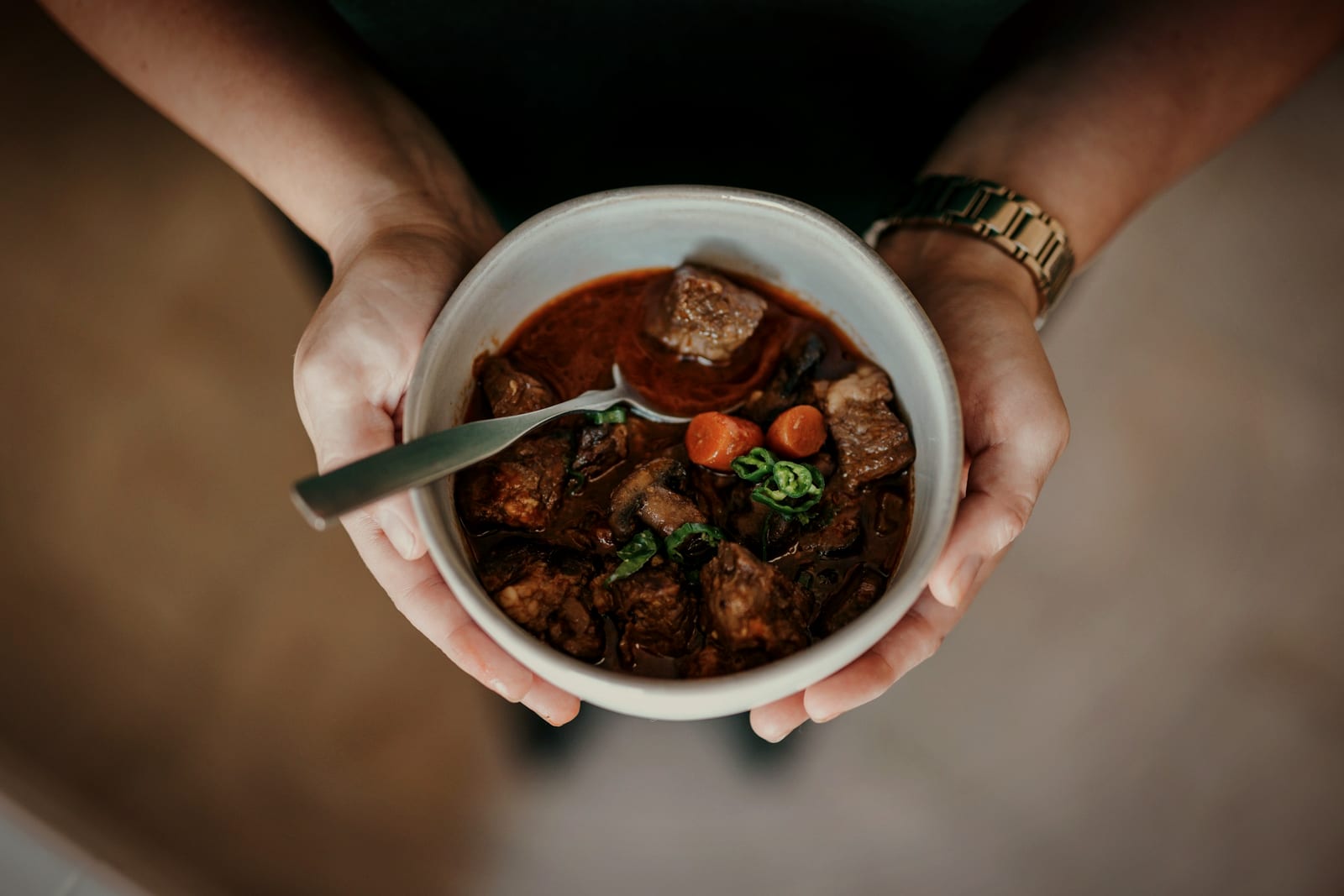
Cubes, covered, below the boil
A stew differs from a pot roast in two ways: the meat is cut into pieces, usually cubes of 3–5 cm / 1¼–2 in, and it is fully covered by the cooking liquid. The principle is the same as in every braise: long, gentle heat below the boil converts the collagen of hard-working muscles into gelatin, which makes the meat tender and gives the liquid body.
The right cuts are those with plenty of connective tissue: chuck (shoulder), oyster blade, shank, cheek and boneless short rib. Packs labeled "stewing beef" are often trimmings of mixed cuts, which cook unevenly. Lean cuts such as round or sirloin become dry and grainy in a stew because they have little collagen to melt.
One method under many national stews
Cooking meat for hours in a pot over the fire is among the oldest techniques in cooking, and nearly every beef-eating culture has its stew. The English word "stew" comes from the Old French estuver, to soak in a hot bath, and "ragout" from the French ragoûter, to revive the appetite. What English-speaking cooks now call simply "beef stew", with browned chuck, flour, onions, carrots and potatoes, is a home dish of Britain, Ireland and North America that took a fixed form in household cookbooks of the 19th and 20th centuries.
Many national stews have become dishes in their own right: bœuf bourguignon in red wine, Hungarian goulash with paprika, Vietnamese bò kho with lemongrass and star anise, and Texan chili con carne. This article covers the generic method that underlies them.
Ingredients
| Ingredient | Amount | Note |
|---|---|---|
| Beef chuck, boneless | 1.2 kg / 2.6 lb | trimmed, in 4 cm / 1½ in cubes |
| Salt | 12 g / ⅖ oz | about 2 tsp, plus to taste |
| Plain flour | 30 g / ¼ cup | |
| Neutral oil or beef dripping | 3 tbsp / 45 ml | |
| Onions | 2, about 300 g / 10 oz | chopped |
| Garlic | 3 cloves | chopped |
| Tomato paste | 1 tbsp / 15 g | |
| Red wine, dark beer or extra stock | 300 ml / 1¼ cups | |
| Beef stock | 750 ml / 3 cups | hot |
| Bay leaves and thyme | 2 leaves, 4 sprigs | |
| Carrots | 3, about 300 g / 10 oz | in thick rounds |
| Celery | 2 stalks, about 100 g / 3½ oz | sliced |
| Potatoes | 600 g / 1⅓ lb | in large chunks |
| Parsley and black pepper | to finish |
Method
- Pat the beef dry and season it with salt. Toss it with the flour and shake off the excess; the flour helps browning and will thicken the sauce.
- Heat the fat in a heavy pot over medium-high heat. Brown the beef in batches, without crowding the pan, 5–6 minutes per batch, until deep brown on at least two sides. Set each batch aside.
- Lower the heat, add the onions and cook 8 minutes, scraping the browned residue (the fond). Add the garlic and tomato paste and stir for 1 minute.
- Pour in the wine or beer, scrape the bottom well and let it bubble for 2 minutes. Return the beef with its juices, add stock to just cover, and add the herbs.
- Bring to a boil, then lower the heat to a bare simmer, with a bubble breaking the surface only now and then (about 90 °C / 195 °F). Cover with the lid slightly ajar, or cook in the oven at 150–160 °C / 300–320 °F.
- After 1½ hours, add the carrots, celery and potatoes. Cook another 1–1½ hours, until the beef breaks apart under light pressure from a spoon and the vegetables are tender. Add a little stock if it reduces too much.
- Remove the bay leaves, skim off surface fat, taste for salt and pepper and finish with chopped parsley. The stew improves if cooled and reheated the next day.
Irish stew, carbonnade, estofado
Irish stew is traditionally made with mutton or lamb, potatoes and onions, without browning and often without carrots; beef versions are common outside Ireland but are an adaptation, as are versions with stout. Carbonnade flamande (Belgium and northern France) braises beef with a large quantity of onions in dark Belgian beer, sweetened with brown sugar and thickened with slices of gingerbread or bread spread with mustard. The Spanish estofado de ternera is cooked in a covered pot with wine, onion, garlic and bay, and in Latin America estofado and guiso name many local stews, often with potatoes and peppers.
Other members of the family include the Irish and British beef-and-Guinness stew served with dumplings, American beef stew with tomato and peas, Italian spezzatino and the Burgundian, Hungarian and Vietnamese stews linked above. Oxtail, shank and cheek make richer stews than chuck because of their higher gelatin content; see oxtail stew.
In deep bowls, with bread or mash
Beef stew is served in deep plates or bowls, with bread, mashed potatoes, rice, egg noodles or dumplings cooked on top of the stew in the last 20 minutes. Common mistakes: crowding the pan, so the meat steams instead of browning; boiling hard, which tightens the fibers and makes the meat dry even in liquid; adding the vegetables at the start, so they collapse; using lean cuts; and serving too early, before the collagen has softened.
Frequently asked questions
What is the best beef for stew?
Chuck from the shoulder is the standard; shank, cheek, oyster blade and boneless short rib also work well because of their connective tissue.
Why is my beef stew meat tough?
Either it has not cooked long enough for the collagen to soften, or it has boiled hard, which tightens the muscle fibers. Keep it at a bare simmer and give it more time.
Should beef be floured before browning for stew?
It is optional. Flour helps browning and thickens the sauce; without it, the stew can be thickened at the end by reducing the liquid or adding a butter-flour paste.
Is Irish stew made with beef?
Traditionally no: Irish stew is made with mutton or lamb, potatoes and onions. Beef versions are a later adaptation.
Is beef stew better the next day?
Many cooks find it is, as flavors blend and the fat can be lifted off cold. Cool it quickly and keep it refrigerated, then reheat until simmering.
Sources
4
- McGee, Harold. On Food and Cooking: The Science and Lore of the Kitchen, rev. ed. New York: Scribner, 2004.
- Larousse Gastronomique, rev. ed. London: Hamlyn, 2009.
- Davidson, Alan. The Oxford Companion to Food. Oxford: Oxford University Press, 1999.
- Allen, Darina. Irish Traditional Cooking. London: Kyle Books, 2012.
Related