Cut · Shoulder blade, with sinew
Oyster blade
Oyster blade is the Australian name for the whole infraspinatus, the muscle that covers the outer face of the shoulder blade, sold with the band of sinew that runs through its centre. Braised whole for hours, that sinew turns soft and translucent; sliced thin across, it gives the marbled, gristle-lined slices of Korean and Japanese table grilling.
At a glance
- Primal
- Chuck / blade (on the shoulder blade)
- Muscles
- Infraspinatus, whole, with its central sinew
- Weight
- Whole muscle around 1–2 kg / 2–4 lb
- Best cooked
- Braised whole, or sliced thin across for fast grilling
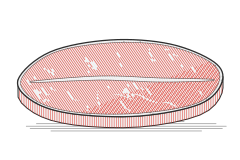
A hand-sized muscle split by sinew
The infraspinatus is a flat, wedge-shaped muscle on the shoulder blade, about the size of a hand. Through its length runs a thick band of connective tissue, and on either side of that band the meat is fine-grained and, for a shoulder muscle, well marbled. Anatomy and tenderness research on this muscle are covered in the article on the flat iron, the American steak made by lifting the sinew out.
The oyster blade is the same muscle kept intact. That choice changes everything about how it is used. With the sinew in, the muscle either needs long, moist cooking, which turns the band of collagen into a soft, gelatinous seam, or it is cut so thin across the grain that the sinew becomes a small, chewable line in each slice. Both traditions treat the sinew not as a defect but as part of the cut.
Blade steak, top blade, feather blade
In Australian and New Zealand specifications, the oyster blade is separated from the blade, the boneless meat around the shoulder blade, and sold whole. Cut across into steaks 1–2 cm thick, it becomes the Australian blade steak or oyster blade steak, recognisable by the line of gristle down the middle. In the United States the same muscle is the top blade (IMPS 114D) and its cross-cut slices are top blade steaks. In Britain the whole muscle is the feather blade, a name inspired by the pattern the sinew makes when the muscle is cut.
In France the muscle falls within the paleron, the shoulder cut known for its central gelatinous nerve, used in pot-au-feu and bœuf bourguignon. In Japan it is misuji, one of the rarer cuts of a carcass and highly valued in high-marbling wagyu. In Korea it is buchaesal, literally "fan meat", after the fan-like pattern of the sinew in each slice. In Vietnamese markets the cut is sold as lõi vai.
Cooking it: braised whole or sliced thin
Braised whole. The whole oyster blade, or thick pieces of it, is browned and then cooked covered in liquid at about 150 °C / 300 °F for 2½–3½ hours. Collagen begins to dissolve into gelatin from around 70 °C / 158 °F inside the meat, but the process takes hours; when it is complete the central sinew turns soft and translucent, and the meat can be cut with a spoon. British feather blade and French paleron dishes are cooked this way.
Sliced thin and grilled. In Korean barbecue, buchaesal is cut across into slices of about 5 mm (¼ in), each with its thin line of sinew, and cooked for seconds per side on a hot grill at the table. Japanese yakiniku treats misuji the same way, often in even thinner slices, and wagyu misuji is also served briefly seared or raw as sashimi-style slices. Thin slices of the muscle are a common choice for hot pot, where they cook in a few seconds in the broth.
Cross-cut steaks. Australian blade steaks are grilled quickly to medium-rare, about 54 °C / 129 °F, eaten around the sinew, or cooked slowly in casseroles and pies. Between these extremes, cooking an oyster blade to well done without moisture gives the worst of both: firm meat and an unsoftened band of gristle.
Whole for braising, sliced for the grill
For braising, a whole oyster blade with its silverskin trimmed but the central sinew intact is the piece to ask for. For table grilling and hot pot, butchers who supply Korean and Japanese restaurants sell it already sliced, often partly frozen to allow very thin, even slices; the line of sinew should be thin and centred in each slice.
Marbling varies widely with breed and feeding, and the cut is graded with the rest of the carcass. When a single steak to grill is wanted rather than a braise or slices, the flat iron is the same muscle with the sinew removed. Other shoulder cuts with a similar balance of flavour and marbling include the rib-end chuck eye.
Names around the world
16
The same muscle, named by language and by trade system.
| English | Oyster blade · top blade |
| Tiếng Việt | Lõi vai |
| Español | Paleta |
| 한국어 | 부채살 (buchaesal) |
| 日本語 | ミスジ (misuji) |
| Français | Paleron (approx.) |
| Italiano | Copertina (approx.) |
| Русский | Лопаточная часть |
| 中文 | 板腱 |
All the cuts' names, country by country →
Trade and national systems
| System | Name | Reference |
|---|---|---|
| Australia / NZ | Oyster blade · blade steak (cross-cut) | HAM |
| United Kingdom | Feather blade | AHDB |
| United States | Top blade (whole) · top blade steak (cross-cut) | IMPS 114D |
| France | Paleron (approx.) | Larousse |
| Japan | ミスジ (misuji) | JMGA |
| Korea | 부채살 (buchaesal) | KAPE |
| Vietnam | Lõi vai | Market name |
Frequently asked questions
What is oyster blade?
Oyster blade is the Australian name for the infraspinatus, the muscle on the shoulder blade, sold whole with its central sinew. It is braised, cut into blade steaks or sliced thin for grilling.
Is oyster blade the same as flat iron?
It is the same muscle. Oyster blade is the whole piece with the sinew in; the flat iron is the American steak cut from it with the sinew removed.
What is buchaesal in English?
Buchaesal is the Korean name for the top blade or oyster blade, sliced across so that each slice shows a fan-like line of sinew.
What is misuji?
Misuji is the Japanese name for the same shoulder blade muscle, valued in wagyu for its marbling and usually served in thin slices for yakiniku.
Sources
5
- AUS-MEAT Limited. Handbook of Australian Meat, 7th ed. (International Red Meat Manual). Brisbane, 2005. www.ausmeat.com.au
- Meat & Livestock Australia. Australian Beef — cuts and cooking methods. www.australianbeef.com.au/know-your-meat/beef-cuts
- Korea Institute for Animal Products Quality Evaluation (KAPE). Beef cuts and grading. www.ekape.or.kr
- USDA Agricultural Marketing Service. Institutional Meat Purchase Specifications: Fresh Beef Series 100. Washington, DC, 2014. www.ams.usda.gov/sites/default/files/media/IMPS_100_Fresh_Beef%5B1%5D.pdf
- Von Seggern, D. D.; Calkins, C. R.; Johnson, D. D.; Brickler, J. E.; Gwartney, B. L. "Muscle profiling: characterizing the muscles of the beef chuck and round." Meat Science 71, no. 1 (2005): 39–51.
Related