Cut · Chuck, sinew removed
Flat iron steak
The flat iron is a steak cut from the infraspinatus, the top blade muscle of the shoulder, once the thick band of sinew through its centre is lifted out, leaving two even steaks about 2 cm thick. Developed in the United States around 2002, it ranks among the most tender beef muscles in shear-force studies; its fine marbling melts out past medium.
At a glance
- Primal
- Chuck (shoulder clod, top blade)
- Muscles
- Infraspinatus, without its central sinew
- Steak size
- Usually 225–340 g / 8–12 oz, about 2 cm thick
- Best cooked
- Grilled or pan-seared to medium-rare
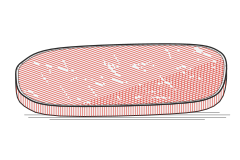
A tender muscle with a sinew through it
The infraspinatus is a muscle of the shoulder that lies on the outer face of the shoulder blade, below the spine of the bone. It is roughly the size and shape of a hand, wedge-shaped in cross-section, and has a thick, flat band of connective tissue running lengthwise through its middle. Around that band the meat itself is finely textured and well marbled for a shoulder muscle.
For most of the 20th century, that central sinew decided the muscle's fate: cut across into top blade steaks, each slice had a line of gristle through it, and the muscle was more often ground or left in a pot roast. The flat iron is the result of a different cut. The muscle is opened lengthwise along the sinew and the sinew is lifted off, leaving two flat, rectangular pieces of clean meat, each a steak. The whole muscle, with its sinew and its other uses, is described under oyster blade.
The name refers to the shape of an old flat iron for pressing clothes: a long, even slab tapering slightly at one end.
Found by muscle research
In US fabrication the infraspinatus is part of the shoulder clod, the boneless meat around the shoulder blade, and is specified on its own as the top blade (IMPS 114D). It sits just above the Denver steak muscle, on the other side of the blade bone.
The flat iron came out of the muscle-profiling research of the chuck and round, funded by the US beef checkoff and carried out by teams led by Chris Calkins at the University of Nebraska and Dwain Johnson at the University of Florida. Testing each muscle for tenderness, they found the infraspinatus among the most tender in the carcass, behind only the tenderloin in some trials, once its sinew was removed. The cutting method was published and promoted from around 2002, and the flat iron spread through US restaurants and supermarkets in the following years.
The muscle exists under other names in every system. In Britain the whole piece is the feather blade; in Australia it is the oyster blade; in Japan misuji and in Korea buchaesal, where it is usually sliced across rather than opened.
Cooking it: high heat, 3–4 minutes a side
Because the flat iron is even in thickness, about 2 cm (¾ in), it cooks predictably on a grill, griddle or heavy pan over high heat, in roughly 3–4 minutes per side. It is at its best rare to medium-rare, pulled at about 52–54 °C / 126–129 °F and rested for 5 minutes; past medium, about 60 °C / 140 °F, the fine marbling melts out and the meat firms up.
Its grain runs across the width of the steak, so it is usually sliced against the grain into strips before serving. It takes marinades and spice rubs well, because the flat surface browns evenly and the meat has enough fat to carry flavour. Thin strips are also used in stir-fries.
Since much of its value depends on removing the sinew, the flat iron is a steak for direct heat. The same muscle, kept whole with the sinew in, is the version to braise.
No line of gristle through the meat
A properly cut flat iron shows no trace of the central sinew: one face may carry a thin, silvery mark where the band was lifted, but there should be no line of gristle through the meat. Steaks labelled top blade that show a line of sinew across the middle are the older cross-cut and cook differently; see oyster blade.
Each muscle gives two flat irons, sometimes trimmed and cut into portions of even size. Look for fine flecks of marbling across the surface rather than large seams of fat. As with other chuck steaks, the grade of the carcass shows clearly in the result. For a richer, more marbled shoulder steak, the Denver and the rib-end chuck eye come from the same region.
Names around the world
15
The same muscle, named by language and by trade system.
| English | Flat iron steak · top blade |
| Tiếng Việt | Lõi vai |
| Español | Paleta |
| 한국어 | 부채살 (buchaesal) |
| 日本語 | ミスジ (misuji) |
| Français | Paleron (approx.) |
| Italiano | Copertina di spalla (approx.) |
| Русский | Лопаточная часть |
| 中文 | 板腱 |
All the cuts' names, country by country →
Trade and national systems
| System | Name | Reference |
|---|---|---|
| United States | Flat iron steak · top blade (boneless) | IMPS 114D |
| United Kingdom | Flat iron · feather blade (whole muscle) | AHDB |
| Australia / NZ | Flat iron · oyster blade (whole muscle) | HAM |
| France | Paleron (approx.) | Larousse |
| Japan | ミスジ (misuji) | JMGA |
| Korea | 부채살 (buchaesal) | KAPE |
Frequently asked questions
What is a flat iron steak?
A steak from the infraspinatus, the top blade muscle of the shoulder, opened along its central sinew into two flat pieces. In shear-force studies it ranks among the most tender beef muscles.
Is flat iron the same as top blade?
It is the same muscle. A top blade steak is usually cut across and keeps a line of sinew in the middle; a flat iron is cut lengthwise with the sinew removed.
Flat iron vs oyster blade: what is the difference?
Oyster blade is the Australian name for the whole infraspinatus with its sinew; the flat iron is the American steak cut from it once the sinew is removed.
How should flat iron steak be cooked?
Over high heat, about 3–4 minutes per side, to rare or medium-rare (52–54 °C / 126–129 °F), then rested and sliced against the grain.
Sources
4
- USDA Agricultural Marketing Service. Institutional Meat Purchase Specifications: Fresh Beef Series 100. Washington, DC, 2014. www.ams.usda.gov/sites/default/files/media/IMPS_100_Fresh_Beef%5B1%5D.pdf
- McGee, Harold. On Food and Cooking: The Science and Lore of the Kitchen, rev. ed. New York: Scribner, 2004.
- AUS-MEAT Limited. Handbook of Australian Meat, 7th ed. (International Red Meat Manual). Brisbane, 2005. www.ausmeat.com.au
- Von Seggern, D. D.; Calkins, C. R.; Johnson, D. D.; Brickler, J. E.; Gwartney, B. L. "Muscle profiling: characterizing the muscles of the beef chuck and round." Meat Science 71, no. 1 (2005): 39–51.
Related