Cut · Chuck, under the blade
Denver steak
The Denver steak is cut from the serratus ventralis, the muscle under the shoulder blade in the chuck. Early-2000s US research on the chuck muscles singled it out for its marbling, which suits high, direct heat; slicing thin across the grain handles its connective tissue.
At a glance
- Primal
- Chuck (under blade)
- Muscles
- Serratus ventralis
- Steak size
- Usually 170–280 g / 6–10 oz, 2–2.5 cm thick
- Best cooked
- Grilled hot to medium-rare, sliced across the grain
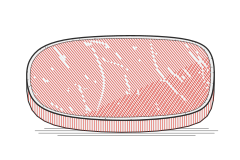
A fan-shaped muscle, well marbled
The serratus ventralis is a broad, fan-shaped muscle that connects the shoulder blade to the ribs and helps hold the front of the body in place. It lies underneath the blade, below the chuck eye, in the part of the chuck that American butchers call the under blade. Like the flat iron, it was traditionally ground or sold inside chuck roasts; the Denver steak is what results when the muscle is separated from its neighbours, trimmed of its heavy external fat and sliced into steaks.
In measurements of the chuck muscles, the serratus ventralis stood out for its high level of intramuscular fat. Its tenderness is moderate: more tender than most of the chuck, less than the loin. Its grain is coarse and changes direction across the muscle, which is why the steaks are best sliced thin across the grain after cooking.
The name has no geographic meaning. It was chosen by the US beef industry when the cut was promoted in the late 2000s, along with other new steaks from the chuck and round.
Out of the muscle studies of the 2000s
Around the turn of the 2000s, meat scientists at the University of Nebraska and the University of Florida, funded by the US beef checkoff, studied the muscles of the chuck and round one by one: their weight, fat, colour, connective tissue and tenderness. The aim was to find muscles inside cheap primals that could be sold as steaks. The most widely known result was the flat iron; the serratus ventralis was another muscle highlighted by the same profiling work.
On the carcass, the muscle runs along the outside of the first ribs under the blade. In IMPS terms it comes from the chuck, under blade (116G centre cut), which sits below the chuck eye roll (116D) where the chuck eye steak is cut. National systems draw the lines of the shoulder differently, and few have a dedicated name for the Denver cut.
In Argentina and Australia the muscle stays inside the larger shoulder cuts, the aguja and the chuck, and is not usually sold on its own.
Cooking it: high heat, never past medium
The Denver steak is a grilling steak. Its marbling makes it well suited to direct, high heat, over charcoal or wood or in a heavy pan, and it is usually cut 2–2.5 cm (¾–1 in) thick, so it cooks in a few minutes per side. Taken off at about 54 °C / 129 °F for medium-rare, it rises a few degrees while resting. Because of the connective tissue that runs through the muscle, it does not improve with cooking past medium, around 60 °C / 140 °F.
Slicing matters more than with a ribeye or striploin. After a rest of 5 minutes, the steak is cut into thin slices across the grain, following the changes of direction. Served this way, the slices are tender and juicy; cut thick or with the grain, the same steak can feel chewy.
The serratus ventralis is also used in Asian table grilling, sliced thin and cooked in seconds, and its fat content makes it a good candidate for marinating. Whole, the under blade can be braised like other chuck cuts, although that removes the reason for separating it as a steak.
Outer fat off, marbling throughout
Denver steaks are mostly sold in North America; elsewhere a butcher can separate the serratus ventralis from the chuck on request. A well-cut Denver steak has its outer fat removed, an even thickness and visible flecks of marbling throughout. Pieces with thick seams of fat or with the silverskin left on cook unevenly.
Because the muscle has a lot of intramuscular fat, the marbling grade of the carcass makes a large difference: from a well-marbled animal the steak can rival a chuck eye for flavour. Much of the meat on chuck short ribs is this same muscle, left on the bone.
Names around the world
12
The same muscle, named by language and by trade system.
| English | Denver steak |
| Tiếng Việt | Nạc vai |
| Español | Aguja |
| 한국어 | 목심 |
| 日本語 | チャックロール |
| Français | Basses côtes |
| Italiano | Reale |
| Русский | Чак ролл |
| 中文 | 上脑 |
All the cuts' names, country by country →
Trade and national systems
| System | Name | Reference |
|---|---|---|
| United States | Denver steak · Denver cut · under blade steak | IMPS 116G |
| Australia / NZ | Part of the chuck (under blade) | HAM |
| Argentina | Part of the aguja | IPCVA |
Frequently asked questions
What is a Denver steak?
A steak cut from the serratus ventralis, a marbled muscle from under the shoulder blade in the chuck. It was introduced in the United States in the late 2000s.
Is Denver steak a good cut?
It is well marbled and moderately tender. Grilled hot to medium-rare and sliced thin across the grain, it is juicy and flavourful; cooked past medium it becomes chewy.
Why is it called Denver steak?
The name is a marketing name chosen by the US beef industry; it does not refer to where the cut comes from.
Denver steak vs flat iron: what is the difference?
Both come from the chuck, but from different muscles: the Denver from the serratus ventralis under the blade, the flat iron from the infraspinatus on top of it. The flat iron is more tender; the Denver is more marbled.
Sources
3
- USDA Agricultural Marketing Service. Institutional Meat Purchase Specifications: Fresh Beef Series 100. Washington, DC, 2014. www.ams.usda.gov/sites/default/files/media/IMPS_100_Fresh_Beef%5B1%5D.pdf
- North American Meat Institute. The Meat Buyer's Guide, 8th ed. Washington, DC, 2014.
- Von Seggern, D. D.; Calkins, C. R.; Johnson, D. D.; Brickler, J. E.; Gwartney, B. L. "Muscle profiling: characterizing the muscles of the beef chuck and round." Meat Science 71, no. 1 (2005): 39–51.
Related