Main course · Standing rib, bone-in
Prime rib
Prime rib is a bone-in roast of the beef rib section, the same muscle that gives the ribeye steak, cooked whole in the oven, carved into thick slices and served with its juices (jus) and horseradish. It stands on its own rib bones as a rack and comes out pink from edge to centre; “prime” names the cut, not necessarily the USDA Prime grade.
At a glance
- Origin
- United States, from the British roast beef tradition
- Cut
- Bone-in rib roast, ribs 6–12
- Size
- 3 ribs, 3–3.5 kg / 6.5–7.5 lb; serves 6–8
- Oven
- 95–110 °C / 200–225 °F, then 260 °C / 500 °F to sear
- Time
- 1–3 days salting; 4–5 h roasting and resting
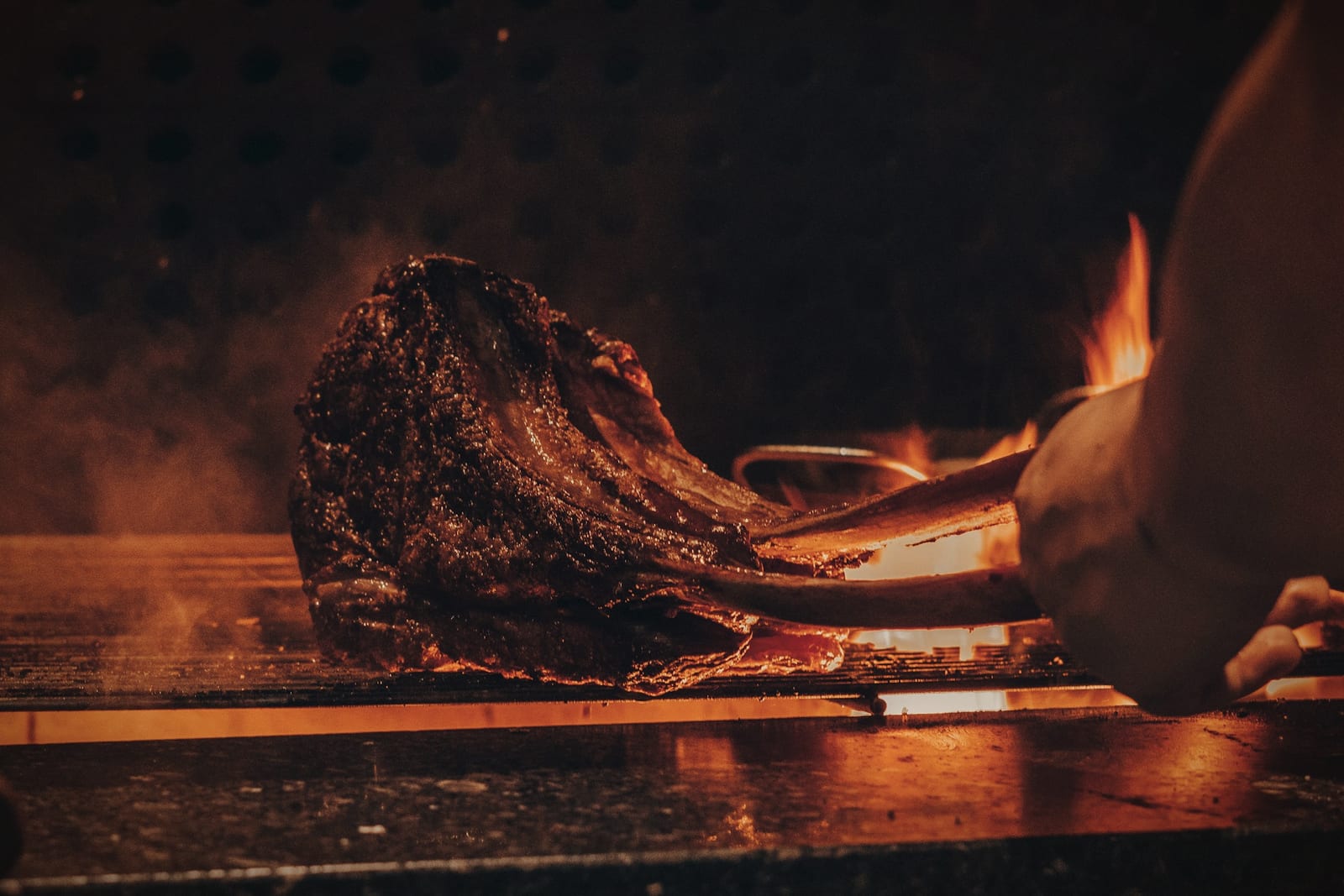
Ribs six to twelve, on the bone
Prime rib, or standing rib roast, is cut from the beef rib primal, which spans ribs 6 to 12 and contains the longissimus muscle of the ribeye together with the fatty cap (spinalis) that surrounds it. It "stands" on its rib bones in the roasting pan, which act as a natural rack. Cooked whole, the roast is pink from edge to centre and is carved at the table or on a carving board into slices 1.5–2.5 cm / ½–1 in thick.
In the United States the name does not guarantee the grade. "Prime" originally described the rib as a prime cut of the carcass; USDA Prime is a separate quality grade awarded to a small minority of graded beef. A rib roast labeled "prime rib" may be Choice or Select, and a roast that is truly USDA Prime should say so explicitly. See grading systems.
From England's roast to the carving cart
Prime rib descends from the British roast beef tradition, where a large rib of beef roasted before the fire was the centrepiece of Sunday and holiday meals, served with Yorkshire pudding and horseradish. In the United States the boneless or bone-in rib roast became a fixture of hotels, supper clubs and steakhouses in the 20th century, often carved to order from a heated cart, and a standard dish for Christmas and other celebrations.
The cut is defined in the USDA's Institutional Meat Purchase Specifications: the full rib primal is item 103, the oven-prepared rib with bones and cap fat trimmed for roasting is item 109, and the boneless ribeye roll, used for boneless roasts, is item 112.
Ingredients
| Ingredient | Amount | Note |
|---|---|---|
| Bone-in rib roast, 3 ribs | 3–3.5 kg / 6.5–7.5 lb | the loin end (ribs 10–12) is more uniform |
| Coarse salt | about 30 g / 3 tbsp | about 1 % of the weight |
| Black pepper | 12 g / 2 tbsp | coarsely ground |
| Garlic, thyme, rosemary | 4 cloves, a few sprigs | optional |
| Beef stock | 500 ml / 2 cups | for the jus |
| Dry red wine | 120 ml / ½ cup | optional, for the jus |
| Fresh horseradish root | 60 g / 2 oz | finely grated (or prepared horseradish) |
| Sour cream or crème fraîche | 240 g / 1 cup | for the horseradish sauce |
| Lemon juice | 1 tbsp / 15 ml | for the horseradish sauce |
Method
- One to three days ahead, salt the roast on all sides and refrigerate it uncovered on a rack. This dry-brining seasons the meat deeply and dries the surface for better browning. Optionally, cut the bones off and tie them back in place: they still protect the meat, and carving becomes easier.
- On the day, season with pepper (and garlic and herbs, if used). Heat the oven to 95–110 °C / 200–225 °F. Place the roast bone side down in a roasting pan, insert a probe thermometer into the centre of the thickest part.
- Roast until the centre reaches 52–54 °C / 126–130 °F for medium-rare, usually 3½–4½ hours for a 3-rib roast. The low heat cooks it evenly, with almost no grey band under the surface.
- Remove the roast, cover it loosely with foil and let it rest 30–60 minutes. Meanwhile, raise the oven to its maximum, 260–290 °C / 500–550 °F.
- Return the roast to the oven for 6–10 minutes, until the fat cap is deep brown and crisp. This final sear is the reverse sear; because the meat has already rested, it can be carved almost at once.
- For the jus, spoon off most of the fat from the roasting pan, deglaze it over heat with the wine, add the stock and reduce by about a third. Season and strain. For the sauce, mix the horseradish, sour cream, lemon juice and a pinch of salt.
- Cut the bones away, then slice the roast across the grain. Serve the bones separately or reserve them.
Temperatures
| Doneness | Remove from low oven | After rest and sear |
|---|---|---|
| Rare | 48–50 °C 118–122 °F | 50–53 °C 122–127 °F |
| Medium-rare | 52–54 °C 126–130 °F | 54–57 °C 130–135 °F |
| Medium | 57–58 °C 135–137 °F | 60–63 °C 140–145 °F |
| USDA safe minimum (whole cuts) | — | 63 °C 145 °F with a 3-minute rest |
High heat first, the classic way
The classic method is the reverse of the one above: a short blast at 230–260 °C / 450–500 °F to brown the surface, then a moderate oven at 150–165 °C / 300–325 °F until done. It is faster but leaves a wider band of grey, overcooked meat under the crust, and the roast continues to rise 3–5 °C / 5–10 °F while resting. Some cooks roast at a fixed low temperature and finish in a pan or on a grill; others cook the roast sous vide and sear it at the end. A boneless ribeye roll roasts the same way, slightly faster. Smoked prime rib is cooked in a barbecue pit at 107–121 °C / 225–250 °F. The British roast beef is often made from other cuts, such as topside or sirloin, and the leftover ribs are sold as beef back ribs.
Prime rib steak
A prime rib steak is one rib cut from the raw roast: a bone-in ribeye, usually 4–5 cm / 1½–2 in thick and 0.8–1.1 kg / 1¾–2½ lb. It is too thick to cook through in a pan before the outside burns, so it is cooked like a small roast. Salt it at least an hour ahead (or the day before). Bake it on a rack at 120 °C / 250 °F until the centre reads 49–50 °C / 120–122 °F, about 40–60 minutes, then sear it in a very hot cast-iron pan or over coals, 1–2 minutes a side plus the fat edge, to finish at 54–56 °C / 130–133 °F for medium-rare. Rest 5 minutes, cut the meat off the bone and slice it. Over a grill, use two zones: indirect side first, direct heat at the end. See reverse sear and the steak temperature chart.
End cut or centre cut
Prime rib is served in thick slices with its jus (the American steakhouse term for the unthickened pan juices, "au jus"), horseradish sauce, and usually baked or mashed potatoes, creamed spinach or Yorkshire pudding. Diners often choose the end cut, more done and crusted, or a centre cut, evenly pink. Leftovers are sliced thin for sandwiches, such as the French dip, served with jus for dipping.
Common mistakes. Roasting by time instead of with a thermometer. Using a high oven throughout, which produces a thick grey ring. Forgetting carryover cooking with the classic method and overshooting medium-rare. Carving too soon after a high-heat roast, which floods the board. Assuming "prime rib" on a menu means USDA Prime beef. Slicing too thin, which lets the pink meat lose heat and juice quickly.
Frequently asked questions
Is prime rib USDA Prime beef?
Not necessarily. 'Prime rib' names the cut, the rib roast; it may be graded Prime, Choice or Select. Truly USDA Prime beef is labeled as such.
What is the difference between prime rib and ribeye?
They come from the same rib section. Prime rib is the whole roast, usually bone-in, cooked and then sliced; a ribeye is a steak cut from it before cooking and grilled or pan-seared.
What temperature should prime rib be cooked to?
For medium-rare, remove it from a low oven at 52–54 °C / 126–130 °F; after resting and searing it finishes at about 54–57 °C / 130–135 °F.
How do you cook a prime rib steak?
Treat it as a small roast: salt it ahead, bake at 120 °C / 250 °F to 49–50 °C / 120–122 °F in the centre, then sear 1–2 minutes a side in a very hot pan for a final 54–56 °C / 130–133 °F, medium-rare. Rest 5 minutes before slicing.
How much prime rib per person?
About one rib for every two people, or 450–500 g / 16–18 oz of bone-in roast per person.
Sources
5
- USDA Agricultural Marketing Service. Institutional Meat Purchase Specifications: Fresh Beef Series 100. Washington, DC, 2014. www.ams.usda.gov/sites/default/files/media/IMPS_100_Fresh_Beef%5B1%5D.pdf
- USDA Agricultural Marketing Service. United States Standards for Grades of Carcass Beef. 2017. www.ams.usda.gov/grades-standards/carcass-beef-grades-and-standards
- USDA Food Safety and Inspection Service. Safe Minimum Internal Temperature Chart. 2023. www.fsis.usda.gov/food-safety/safe-food-handling-and-preparation/food-safety-basics/safe-temperature-chart
- McGee, Harold. On Food and Cooking: The Science and Lore of the Kitchen, rev. ed. New York: Scribner, 2004.
- López-Alt, J. Kenji. The Food Lab: Better Home Cooking Through Science. New York: W. W. Norton, 2015.
Related