Main course · Salt, pepper, oak
Texas brisket
Texas brisket is a whole beef brisket seasoned with salt and coarse black pepper and smoked 10–16 hours over oak at a low pit temperature, the central dish of Central Texas barbecue. The long smoke turns its collagen to gelatin; rub, fat and smoke dry into a dark crust, the bark.
At a glance
- Origin
- Central Texas, United States
- Cut
- Whole packer brisket: point and flat
- Pit
- 107–121 °C / 225–250 °F, post oak smoke
- Done
- Probe-tender, about 93–96 °C / 200–205 °F
- Time
- 10–16 h cooking, 1–4 h resting
- Serves
- 12–15 (about 3 kg / 6.5 lb cooked)
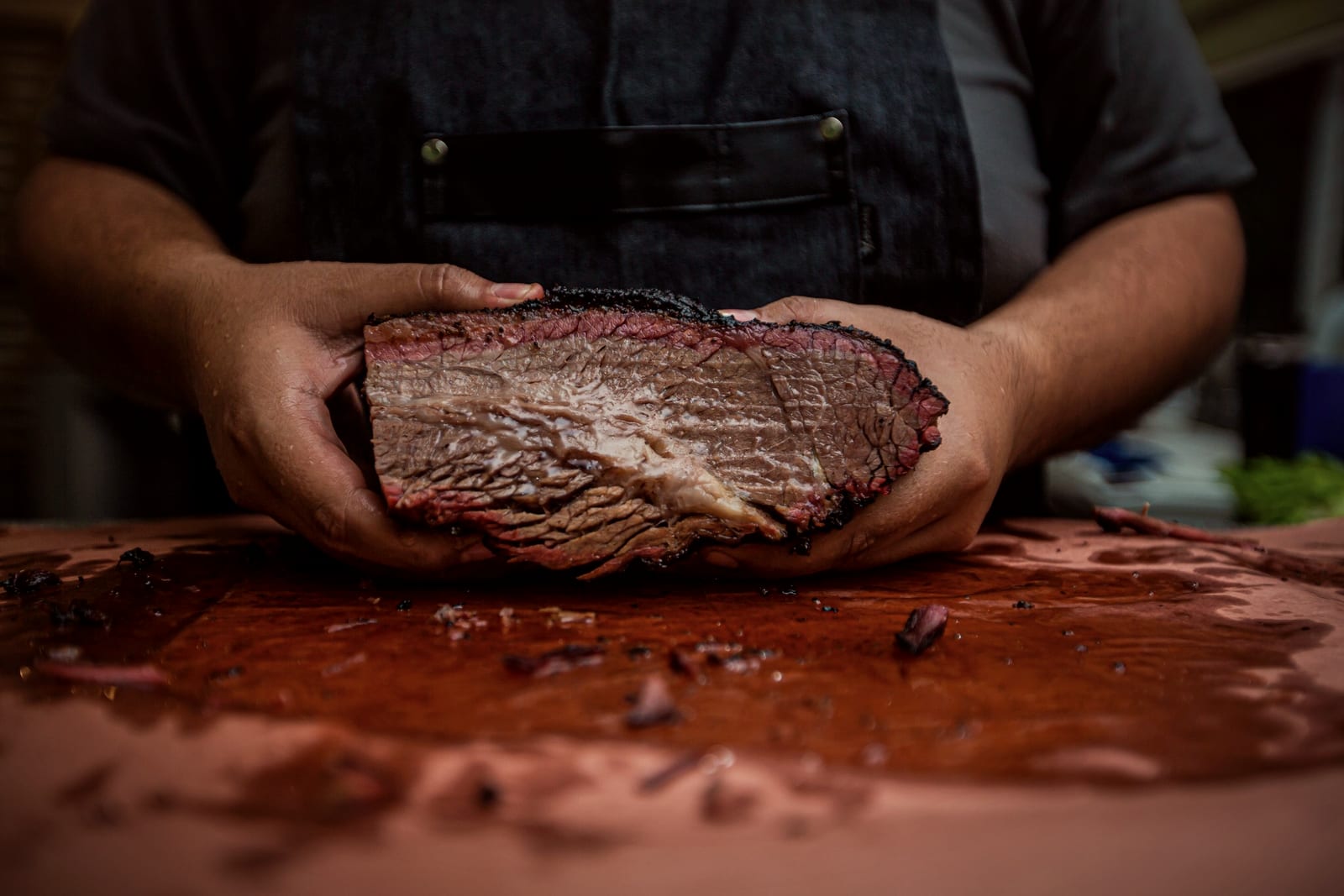
Flat, point and bark
Brisket is the pectoral muscle of the steer, a large, tough, heavily worked cut full of connective tissue. Cooked fast it is chewy; cooked slowly in smoke for most of a day it becomes tender enough to pull apart while still holding a slice. The Central Texas version uses the whole packer brisket, both of its muscles: the lean, flat flat and the thicker, fattier point, separated by a seam of fat. See brisket.
The seasoning is deliberately minimal, usually equal parts coarse salt and coarse black pepper. The flavor comes from the smoke, the rendered fat and the dark crust, called bark, that forms as the rub, fat and smoke dry on the surface over many hours.
German and Czech meat markets
Central Texas barbecue grew out of the meat markets opened by German and Czech immigrants in towns such as Lockhart, Luling, Elgin and Taylor in the late 19th and early 20th centuries. Butchers smoked unsold meat and sausage and sold it by weight on butcher paper, with bread or crackers, pickles and onions, a format that survives. Robb Walsh's Legends of Texas Barbecue Cookbook traces this tradition alongside the East Texas (African American), South Texas (barbacoa) and West Texas (direct-heat, "cowboy") styles.
Brisket was not originally the signature meat; shoulder clod and other cuts were common. It became dominant in the second half of the 20th century, a change often linked to the spread of boxed beef, which let markets buy briskets individually. Since the 2000s a new generation of pitmasters, described in Aaron Franklin and Jordan Mackay's Franklin Barbecue (2015), has made the salt-and-pepper, oak-smoked brisket internationally known.
Ingredients
| Ingredient | Amount | Note |
|---|---|---|
| Whole packer brisket | 5.5–7 kg / 12–15 lb untrimmed | point and flat together (IMPS 120); a flexible flat is a good sign |
| Coarse kosher salt | 60 g / about ½ cup | or about 1 % of the trimmed weight |
| Coarse black pepper | 60 g / about ¾ cup | "butcher's grind" or 16 mesh |
| Post oak (or other oak) splits | 10–15 kg / 22–33 lb | seasoned, dry wood |
| Unwaxed butcher paper | 1 roll, 45 cm / 18 in wide | for wrapping |
| Rendered beef fat (tallow) | 100 g / ½ cup | optional, brushed on the paper |
Method
- Trim the cold brisket: remove the hard fat and silverskin, leave a fat cap of about 6 mm / ¼ in, thin the hard fat between point and flat, and round off thin edges that would burn.
- Mix the salt and pepper and season every side evenly. It can be done just before cooking or the night before.
- Light the smoker and stabilize the pit at 107–121 °C / 225–250 °F with a small, hot, clean-burning fire; the smoke should be thin and pale blue, not white and thick. Some cooks run hotter, up to 135 °C / 275 °F.
- Place the brisket in the cooking chamber, usually with the thicker point toward the firebox. Feed the fire with a split every 30–60 minutes and keep the lid closed.
- After 5–7 hours the bark is set and the internal temperature stalls around 65–74 °C / 150–165 °F. Wrap the brisket tightly in butcher paper (brushed with tallow if desired) and return it to the pit.
- Cook until the thickest part of the flat is probe-tender, meaning a thermometer slides in with almost no resistance, usually at 93–96 °C / 200–205 °F. Tenderness, not a number, decides.
- Rest the brisket in its paper for at least 1 hour, ideally 2–4 hours, in an insulated box or an oven held at 60–65 °C / 140–150 °F so it stays above safe holding temperature.
- Separate point and flat. Slice the flat across the grain about the thickness of a pencil; turn the point 90° (its grain runs another way) and slice it thicker or cut it into cubes.
The stall and the wrap
Several hours into the cook, the internal temperature of a brisket often stops rising for hours. This stall is evaporative cooling: moisture reaching the surface evaporates and absorbs heat as fast as the pit supplies it, much like sweat on skin. It ends when the surface dries enough or when evaporation is blocked.
Wrapping blocks it. Foil, popularized on the competition circuit as the "Texas crutch", is the most effective but steams the bark soft; unwaxed butcher paper slows evaporation while letting some vapor escape, so the crust stays firmer. Meanwhile, as Harold McGee explains, collagen dissolves into gelatin only slowly and only after long exposure to temperatures around 70 °C / 160 °F and above, which is why time in the pit matters more than speed.
Chopped, burnt ends, barbacoa
Within Texas, East Texas brisket is often chopped and sauced and served on a bun; South Texas has barbacoa of beef head, traditionally cooked in a pit; and some West Texas cooks grill over mesquite coals rather than smoking with indirect heat. Kansas City turns the fatty point into burnt ends, cubes returned to the smoker with sauce. Offset smokers burning wood are the classic pit; pellet grills, kamado cookers and electric smokers reach similar results with less control of the fire. Braised brisket in Jewish cooking and corned beef are different dishes made from the same cut.
By weight, on butcher paper
Central Texas brisket is sold by weight and served on butcher paper with white bread or saltine crackers, dill pickles, raw onion and, in some places, pinto beans and potato salad. Sauce, if any, comes on the side; many traditional markets offered none. Customers usually choose between lean (from the flat) and moist or fatty (from the point).
Common mistakes. Over-trimming, which leaves the flat dry. Thick, white, acrid smoke from a smothered fire. Pulling the brisket at a target temperature without checking tenderness. Skipping the rest, which spills juice on the board. Slicing with the grain, which makes even a tender brisket stringy. Slicing the whole brisket in advance: it dries within minutes once cut.
Frequently asked questions
What temperature is brisket done?
Usually when the flat reaches about 93–96 °C / 200–205 °F and a probe slides in with almost no resistance. Tenderness is the real test; the number is a guide.
How long does it take to smoke a brisket?
At 107–121 °C / 225–250 °F a whole packer brisket typically takes 10–16 hours, plus 1–4 hours of resting.
Why does brisket stall?
Evaporating surface moisture cools the meat as fast as the pit heats it. Wrapping in butcher paper or foil shortens the stall.
What is the difference between the point and the flat?
The flat is the leaner, thinner muscle, sliced for 'lean' brisket; the point sits on top of it, has more fat and marbling, and is served as 'moist' brisket or burnt ends.
Sources
4
- McGee, Harold. On Food and Cooking: The Science and Lore of the Kitchen, rev. ed. New York: Scribner, 2004.
- USDA Agricultural Marketing Service. Institutional Meat Purchase Specifications: Fresh Beef Series 100. Washington, DC, 2014. www.ams.usda.gov/sites/default/files/media/IMPS_100_Fresh_Beef%5B1%5D.pdf
- Franklin, Aaron; Mackay, Jordan. Franklin Barbecue: A Meat-Smoking Manifesto. Berkeley: Ten Speed Press, 2015.
- Walsh, Robb. Legends of Texas Barbecue Cookbook: Recipes and Recollections from the Pitmasters. San Francisco: Chronicle Books, 2002.
Related