Street food · From Andean ch'arki
Beef jerky
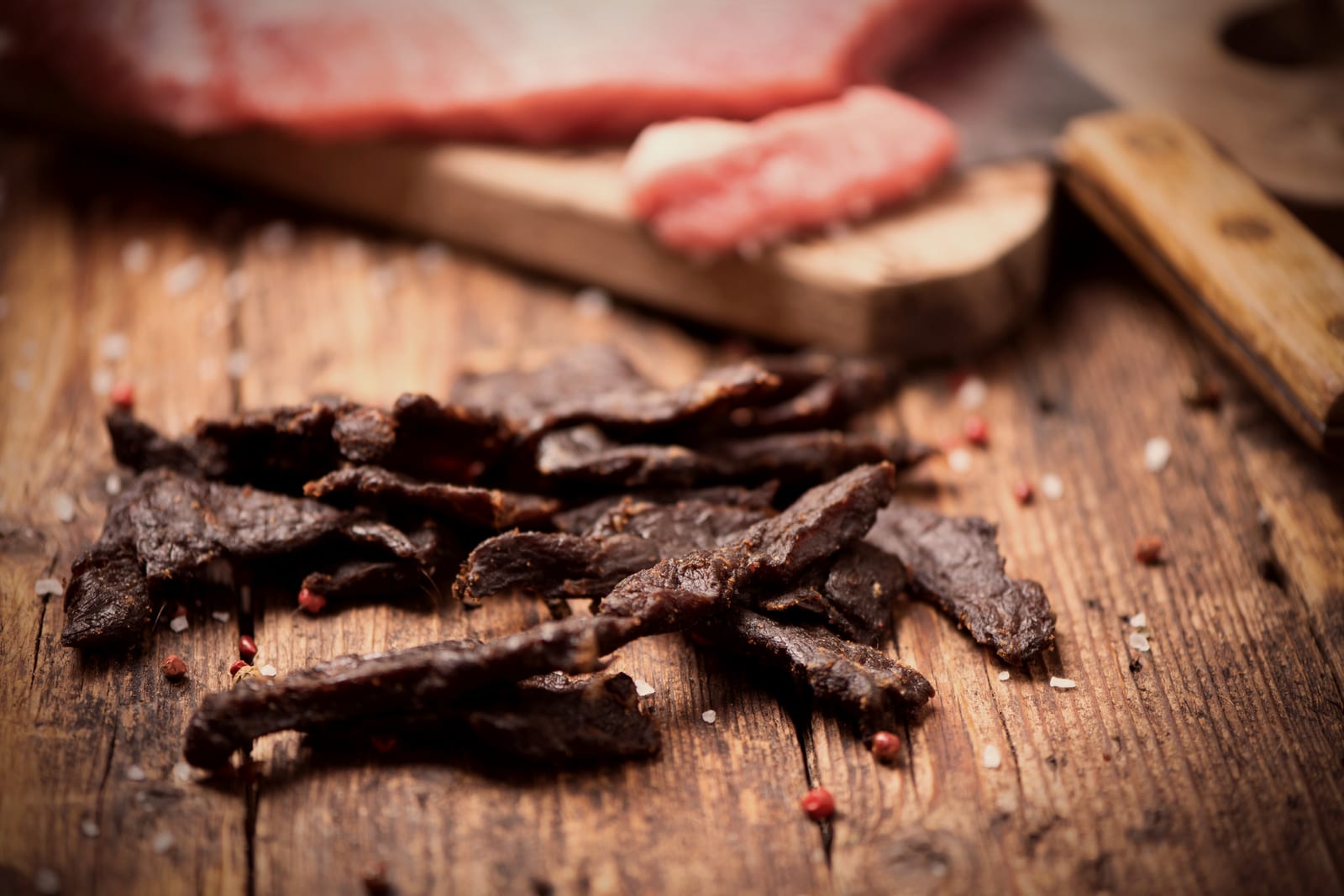
Beef jerky is lean beef cut into thin strips, seasoned or marinated, and dried until leathery and shelf-stable; its name comes from the Quechua ch'arki. Drying takes its water activity to about 0.80, below the 0.91 most bacteria need.
At a glance
- Origin
- Andes (ch'arki); North America
- Type
- Dried, marinated lean beef
- Cuts
- Eye of round, top round (topside), flank
- Safety step
- Heat to 71 °C / 160 °F, then dry at 54–60 °C / 130–140 °F
- Yield
- About 1 kg raw gives 350–400 g / 12–14 oz
Water out, fat off
Jerky is meat preserved by removing water. Thin, lean strips are salted or marinated, then dried with low, moving heat until most of their moisture is gone. What keeps it is not the temperature of the drying but the result: a low water activity (aw), the measure of how much water in a food is free for microbes to use. Most bacteria cannot grow below about 0.91, and jerky made well sits around 0.80 or lower, which is why it can be stored without refrigeration.
Fat does not dry; it turns rancid. That is why jerky uses the leanest cuts — eye of round, top round (topside in British and Australian butchery) and sometimes flank — trimmed of every visible piece of fat and sinew. Ground meat can also be pressed into strips, a style common in commercial products.
Ch'arki, charqui, jerky
Drying meat in sun, wind and cold is among the oldest food techniques. In the Andes, the Inca and earlier peoples made ch'arki from llama and alpaca, salted, pounded thin and dried at high altitude, where the air is cold and dry. Spanish colonists recorded it as charqui; in Brazil and the Southern Cone it became charque, made from beef. English took the word as jerky ("jerked beef") by the 18th century, according to the Oxford English Dictionary.
In North America, Indigenous peoples dried bison and venison, and pemmican — dried meat pounded with fat and berries — fed fur traders. Jerky became a provision of soldiers, cowboys and travellers, and in the 20th century a packaged snack. Today the United States is the largest market for commercial beef jerky.
Ingredients
| Ingredient | Amount | Note |
|---|---|---|
| Eye of round or top round | 1 kg / 2.2 lb | trimmed of all fat; partly frozen for slicing |
| Soy sauce | 120 ml / ½ cup | provides most of the salt |
| Worcestershire sauce | 60 ml / ¼ cup | |
| Brown sugar | 25 g / 2 tbsp | optional; more for a sweet style |
| Black pepper | 6 g / 2 tsp | coarsely ground |
| Garlic powder | 4 g / 1 tsp | |
| Onion powder | 4 g / 1 tsp | |
| Smoked paprika or chili flakes | 2–4 g / ½–1 tsp | to taste |
| Curing salt no. 1 (6.25 % nitrite) | 2.5 g / ½ tsp | optional; colour and extra safety |
Method
- Freeze the trimmed meat for 1–2 hours until firm. Slice 5 mm / ¼ in thick; across the grain gives a tender chew, with the grain a tougher, stringier one.
- Mix the marinade, add the strips, and refrigerate 6 to 24 hours, turning once. Always marinate in the refrigerator.
- Heat the meat to a safe temperature before drying: simmer the strips in the marinade, or bake them, until they reach 71 °C / 160 °F. This is the step the USDA Food Safety and Inspection Service recommends, because a dehydrator alone may never get the meat hot enough to kill Salmonella and E. coli O157:H7.
- Drain and pat dry. Lay the strips on dehydrator racks or oven racks without touching, so air can circulate.
- Dry at 54–60 °C / 130–140 °F for 4 to 8 hours (an oven with the door slightly open works at its lowest setting). Turn the strips halfway.
- Test by bending a cooled strip: it should crack but not snap, with no moist spots inside. Blot any surface fat.
- Cool completely, then store airtight. It keeps about 1–2 months at room temperature if well dried, longer in the refrigerator or freezer.
Charqui, khô bò and bakkwa
Andean charqui. Salted and sun-dried without marinade, often from llama or alpaca; it is rehydrated and cooked in stews such as Peru's olluquito con charqui. Brazil's charque and carne seca are heavily salted beef, related to carne de sol.
Vietnamese khô bò. Beef seasoned with sugar, fish sauce, chili, lemongrass and five-spice, dried and often shredded (khô bò sợi). It is sweeter and softer than American jerky, and served with green papaya salad or as a snack with beer.
Chinese rougan (肉干) and bakkwa. Niurou gan (牛肉干) is beef cooked in soy and spices, then dried. Bakkwa (肉干 in Hokkien), usually pork, is sweetened and grilled into thin sheets.
Related. South African biltong is air-dried with vinegar, without heat, and cut thicker.
A trail snack: 9–10 g protein an ounce
Jerky is eaten as it is, as a high-protein snack on trails and road trips. A 28 g / 1 oz portion supplies roughly 9–10 g of protein, along with considerable sodium. Shredded jerky is also added to salads, rice dishes and, in the Andes, to stews.
Common mistakes: leaving fat on (rancid flavour within weeks), cutting strips unevenly (some stay wet while others burn), skipping the pre-heat step, and storing jerky that still bends without cracking.
Frequently asked questions
Is homemade beef jerky safe?
Yes, if the meat is heated to 71 °C / 160 °F before or during drying and then dried at 54–60 °C / 130–140 °F until it cracks when bent. Dehydrating alone at low temperature may not kill pathogens.
What is the best cut for beef jerky?
The leanest ones: eye of round and top round are the most used, flank is also common. Fat does not dry and goes rancid.
How long does beef jerky last?
Well-dried homemade jerky keeps about 1–2 months in an airtight container at room temperature, and longer in the refrigerator or freezer.
What is the difference between jerky and biltong?
Jerky is thin, usually marinated in a sweet or savoury sauce and dried with heat; biltong is cut thicker, cured with vinegar, salt and coriander and air-dried without heat.
Sources
5
- McGee, Harold. On Food and Cooking: The Science and Lore of the Kitchen, rev. ed. New York: Scribner, 2004.
- Toldrá, Fidel (ed.). Lawrie's Meat Science, 8th ed. Duxford: Woodhead, 2017.
- USDA Food Safety and Inspection Service. Jerky and Food Safety. Washington, DC.
- National Center for Home Food Preservation, University of Georgia. Jerky. Athens, GA. nchfp.uga.edu/how/dry/jerky
- Oxford English Dictionary, s.v. "jerky". Oxford University Press.
Related