Street food · Dried without heat
Biltong
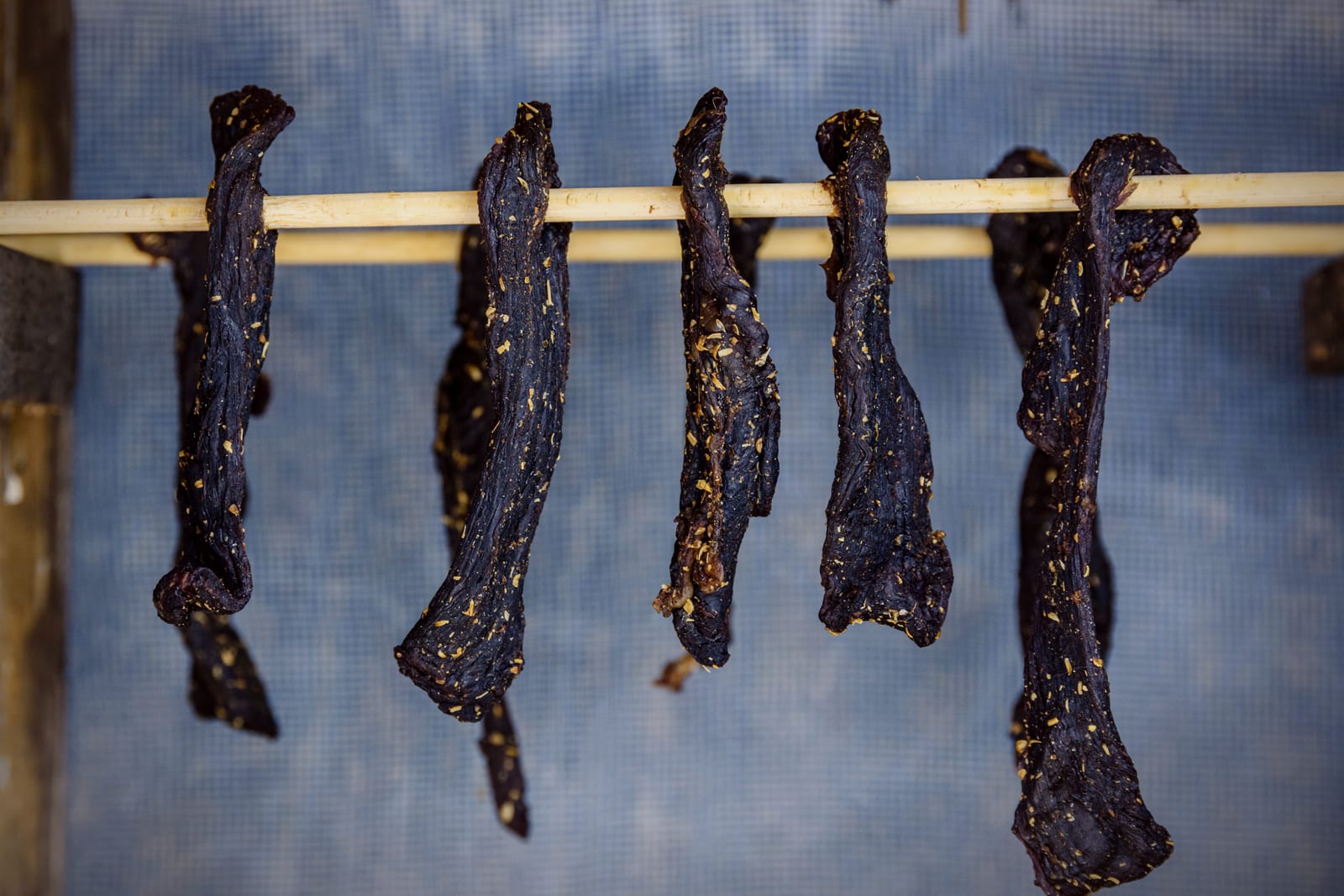
Biltong is a South African cured meat: thick strips of beef seasoned with vinegar, salt, coriander and black pepper and air-dried without heat for several days. The strips lose about half their weight and dry to a dark crust.
At a glance
- Origin
- South Africa (Cape Colony, 17th–19th c.)
- Type
- Vinegar-cured, air-dried beef
- Cuts
- Silverside, topside, rump
- Drying
- 3–7 days, no heat, moving air
- Weight loss
- About 50–60 %
Salt, vinegar and moving air
Biltong is beef preserved by salt, acid and drying. Long strips of lean muscle, often 2–3 cm / about 1 in thick, are soaked briefly in vinegar, coated with coarse salt, toasted coriander seed and black pepper, then hung in cool, moving air until they lose roughly half their weight. The outside dries to a dark crust while the centre can be left from moist and red ("wet") to fully dry and crumbly, according to taste.
It is sold everywhere in South Africa and in neighbouring Namibia, Zimbabwe and Botswana, in butcher shops, supermarkets and petrol stations, either as whole sticks or sliced (gesnyde). Beef is the most common meat, but game such as kudu, springbok, eland and ostrich is also made into biltong.
From the Cape to the Great Trek
The word is Afrikaans, from Dutch bil ("rump" or "buttock") and tong ("tongue" or "strip"). Indigenous Khoikhoi people of southern Africa already dried strips of game meat; Dutch settlers at the Cape from the 17th century added vinegar, saltpetre and spices from the spice trade of the Dutch East India Company, such as coriander, pepper and cloves.
Biltong became a staple of the Voortrekkers, the Afrikaner families who migrated inland from the Cape in the 1830s and 1840s (the Great Trek). Drying meat in the dry winter air of the interior gave them food that kept for months on the wagon. The tradition of making biltong at home in winter, when the air is cool and insects are few, continues in South Africa.
Ingredients
| Ingredient | Amount | Note |
|---|---|---|
| Silverside or topside | 2 kg / 4.4 lb | cut with the grain into strips 2–3 cm / ¾–1 in thick |
| Brown or apple cider vinegar | 250 ml / 1 cup | malt vinegar is also traditional |
| Coarse salt | 40 g / 1.4 oz (2 % of the meat) | non-iodised |
| Whole coriander seed | 20 g / 3 tbsp | toasted, coarsely crushed |
| Black pepper | 10 g / 1 tbsp | coarsely ground |
| Brown sugar | 10 g / 2½ tsp | optional, balances the vinegar |
| Bicarbonate of soda | a pinch | optional; some recipes add it to the vinegar |
| Worcestershire sauce, chili flakes | to taste | common modern additions |
Method
- Trim off the thick fat and silver skin. Cut the meat with the grain into long strips 2–3 cm / ¾–1 in thick and 4–5 cm / 1½–2 in wide.
- Mix the salt, crushed coriander, pepper and sugar. Dip or brush the strips in vinegar, then press the spice mix onto all sides.
- Layer the strips in a non-reactive dish, sprinkle with a little more vinegar, cover and refrigerate for 12 to 24 hours, turning once.
- Dip each strip briefly in a mix of vinegar and water (1:1) to remove excess salt, pat dry, and hang with hooks or string so that no strip touches another.
- Dry in moving air at room temperature, ideally 15–25 °C / 59–77 °F with low humidity. A simple "biltong box" with a low-watt light bulb and a small fan is common; it should only warm the air slightly, not cook the meat.
- Dry for 3 to 7 days depending on thickness, humidity and preference. Check daily: the surface should be dry and firm, with no white, green or furry mould.
- Slice thin across the grain to serve. Store in a paper bag for a few days, or vacuum-pack and refrigerate or freeze for longer.
Droëwors, game and wet biltong
Droëwors. Afrikaans for "dry sausage": a thin beef sausage seasoned with coriander, cloves and vinegar, made with a little fat and air-dried like biltong. It is usually sold alongside it.
Chilli bites, snapsticks and wet biltong. Thin sticks dried quickly, small spiced pieces with chili, and thick biltong left soft and red in the centre are all common shop styles.
Game biltong. Kudu, springbok, eland and ostrich give a leaner, darker biltong. Game is often frozen before curing as a precaution against parasites.
Biltong versus jerky. American beef jerky is cut thin, often marinated in a sweet or soy-based sauce and dried with heat in hours; biltong is thicker, cured with vinegar and salt, and dried without heat over days. Jerky is usually eaten whole; biltong is sliced from the stick.
Hurdles instead of heat
Because biltong is not cooked, its safety rests on a series of barriers that together prevent pathogens from growing, an approach food scientists call hurdle technology. Vinegar lowers the pH at the surface, salt lowers water activity, and drying lowers it further; coriander and pepper add a small antimicrobial effect. Studies of commercial South African biltong have found Salmonella, Listeria monocytogenes, Staphylococcus aureus and E. coli on some products, usually linked to raw-meat contamination or poor hygiene, so the barriers must all be used.
Practical rules: start with fresh, cold meat; keep it refrigerated during curing; use enough salt and vinegar; dry in clean, moving air; and discard strips with mould other than a faint white bloom. People at higher risk — pregnant women, young children, elderly and immunocompromised people — are advised by health authorities to avoid uncooked cured meats.
Frequently asked questions
What is the difference between biltong and jerky?
Biltong is cut thicker, cured with vinegar, salt and coriander and air-dried without heat for days; jerky is thin, usually marinated in a sweeter sauce and dried with heat in hours.
What cut of beef is used for biltong?
Silverside and topside, lean muscles from the hind leg, are the most common; rump and eye of round are also used.
Is biltong raw?
It is not cooked, but it is cured: vinegar, salt and drying preserve it. Its safety depends on fresh meat, enough salt and acid, and clean drying conditions.
How long does biltong last?
Fully dried biltong keeps a week or two in a paper bag at room temperature; vacuum-packed in the refrigerator it lasts a few weeks, and frozen several months. Wet biltong should be eaten within a few days.
Sources
4
- Toldrá, Fidel (ed.). Lawrie's Meat Science, 8th ed. Duxford: Woodhead, 2017.
- McGee, Harold. On Food and Cooking: The Science and Lore of the Kitchen, rev. ed. New York: Scribner, 2004.
- Jones, M.; Arnaud, E.; Gouws, P.; Hoffman, L. C. "Processing of South African biltong — a review." South African Journal of Animal Science 47, no. 6 (2017): 743–757.
- Leistner, Lothar. "Basic aspects of food preservation by hurdle technology." International Journal of Food Microbiology 55 (2000): 181–186.
Related