Main course · Brisket in brine
Corned beef
Corned beef is beef brisket cured for about a week in a brine of salt and sodium nitrite, then simmered for hours until tender enough to slice thinly across the grain. The nitrite keeps it pink right through; the name comes from the coarse 'corns' of salt once used to preserve it.
At a glance
- Origin
- Ireland (salt beef trade); United States (modern dish)
- Cut
- Brisket, usually the flat
- Cure
- Brine with salt and sodium nitrite, 5–7 days at 1–4 °C / 34–39 °F
- Cooking
- Simmered 3–3½ h at 85–90 °C / 185–195 °F
- Serves
- 8 (2.5 kg / 5.5 lb raw brisket)
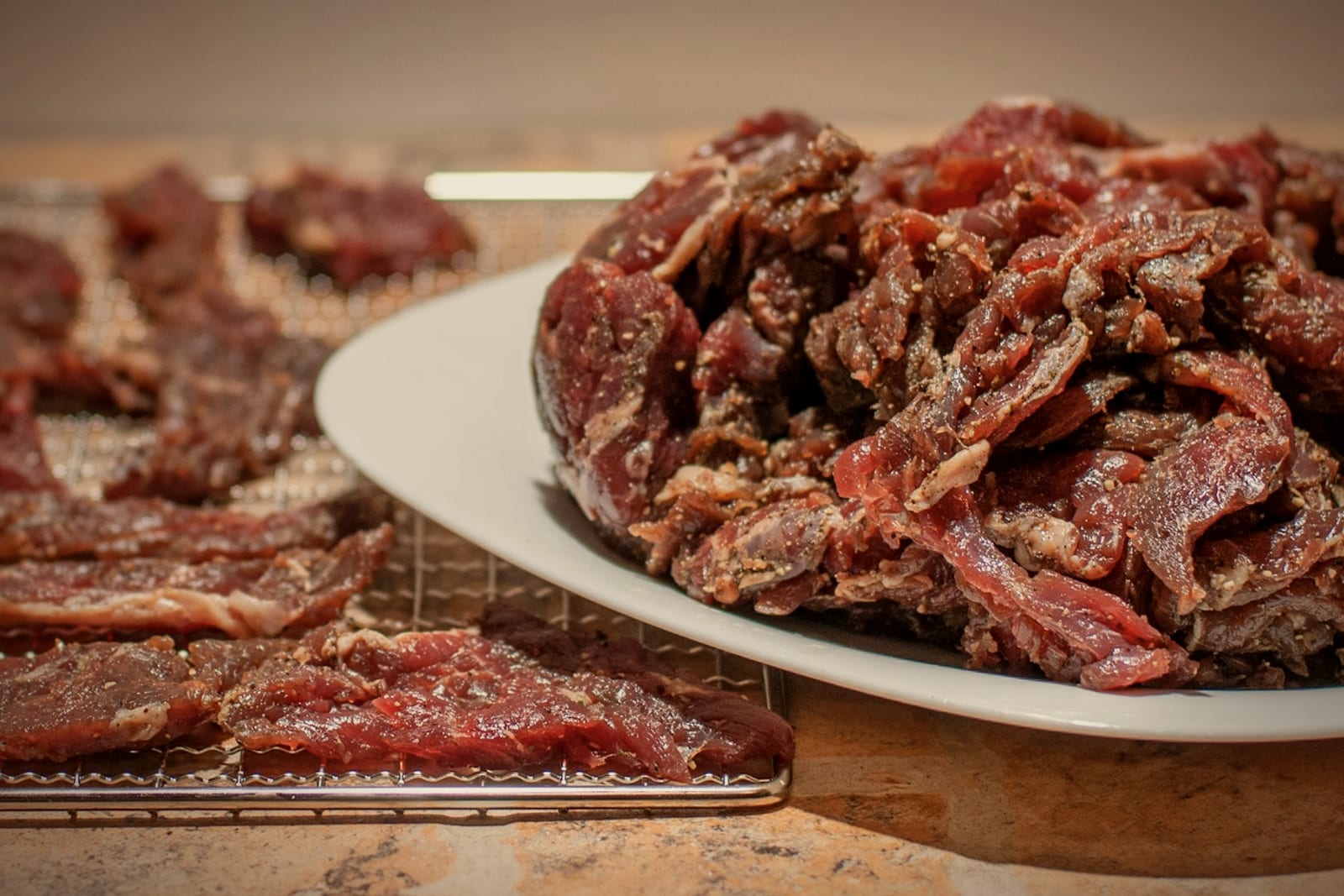
Brisket, brine and a little nitrite
Corned beef is a wet-cured cut, almost always brisket. The meat sits submerged in a brine of salt, sugar, spices and a small, measured amount of sodium nitrite for about a week, then is rinsed and simmered for several hours. The result is salty, pink right through, and tender enough to slice thinly across the grain. Without nitrite the same process gives grey, pot-roast-coloured meat, sometimes sold as grey corned beef in New England.
In English, corn originally meant any small grain or particle, and 'corned' meant preserved with coarse grains of salt. The word is recorded for salted beef from the 17th century, long before nitrite was understood. The same family of cured briskets includes pastrami, which is cured like corned beef but then spiced, smoked and steamed. For the chemistry of the cure, see curing.
From Cork's barrels to New York
In the 17th and 18th centuries Ireland was one of the main producers of salted beef in the Atlantic world. The English Cattle Acts of the 1660s barred live Irish cattle from English markets, so the beef was slaughtered, packed in salt and shipped in barrels instead. Cork became the centre of the trade, supplying the British navy, merchant fleets, and the plantations of the Caribbean and North America. Máirtín Mac Con Iomaire and Pádraic Óg Gallagher, in their culinary history of Irish corned beef, show that most of this beef was exported and that ordinary Irish people rarely ate it; at home, salted pork and bacon were far more common.
The dish now linked with Ireland took shape in the United States. Irish immigrants in late 19th-century cities such as New York bought cured brisket from Jewish butchers, whose corned beef was cheaper than the bacon joint they had known at home. Boiled with cabbage and potatoes, it became the Irish-American meal of St Patrick's Day, 17 March, and spread from there to Ireland's tourist menus. In Ireland itself the traditional festive equivalent is more often bacon and cabbage.
Ingredients
| Ingredient | Amount | Note |
|---|---|---|
| Beef brisket | 2.5 kg / 5.5 lb | the flat; trimmed to 6 mm / ¼ in of fat |
| Water | 4 L / 1 US gal | for the brine |
| Coarse salt | 200 g / 7 oz | not iodised |
| Curing salt #1 (Prague powder #1) | 20 g / 0.7 oz | 6.25 % sodium nitrite; weigh it on a scale |
| Sugar | 100 g / 3.5 oz | white or brown |
| Pickling spice | 30 g / 1 oz | mustard seed, coriander, black pepper, bay, allspice, clove, chili |
| Garlic | 4 cloves, 15 g / ½ oz | crushed |
| Potatoes | 1 kg / 2.2 lb | waxy, halved |
| Carrots | 500 g / 1.1 lb | in large pieces |
| Green cabbage | 1 head, about 1 kg / 2.2 lb | in wedges |
Method
- Heat 1 L / 1 qt of the water with the salt, sugar and half the pickling spice until dissolved. Add the remaining cold water, the garlic and the curing salt, stir, and chill the brine below 4 °C / 40 °F.
- Put the brisket in a non-reactive container, pour the brine over it and weigh it down so it stays fully submerged. With these proportions the ingoing nitrite stays under the US limit of 200 ppm for immersion-cured beef.
- Refrigerate at 1–4 °C / 34–39 °F for 5–7 days, turning the meat every day. A flat about 5 cm / 2 in thick needs 5 days; thicker pieces need longer, or can be injected with about 10 % of their weight in brine so the centre cures evenly.
- Remove the brisket, rinse it, and soak it for 1 hour in fresh cold water if a milder result is wanted. Discard the brine.
- Cover the meat with fresh cold water by 5 cm / 2 in, add the remaining spice, bring to a boil, skim, and reduce to a bare simmer of 85–90 °C / 185–195 °F.
- Simmer for 3–3½ hours, until a fork or probe slides in easily, usually at an internal 90–95 °C / 195–203 °F. Add the potatoes and carrots for the last 35 minutes and the cabbage for the last 15.
- Rest the meat in its liquid for 15 minutes, then slice it across the grain, about 5 mm / ¼ in thick.
Hash, salt beef and the tin
Corned beef hash. Leftover corned beef is diced, fried with potatoes and onion until crisp, and often topped with a fried egg; it is a classic American diner breakfast and a British and Irish standby.
Salt beef. In Britain, especially in the Jewish delis and bagel shops of East London, the same cured brisket is called salt beef and served hot in rye bread or a bagel with mustard. Montreal smoked meat is a related but different product: dry-cured, heavily spiced and smoked, closer to pastrami.
Canned corned beef. A separate product with the same name: cooked, finely broken beef pressed into tins with salt and nitrite. It grew from the meat-extract and canning plants of the Río de la Plata, notably the works at Fray Bentos, Uruguay, now a UNESCO World Heritage site, and supplied armies in both world wars. Brazil and Argentina are major producers today, and tinned corned beef is a staple in places such as the Philippines, the Pacific Islands, West Africa and the Caribbean.
Across the grain, or in a Reuben
Served hot, it is sliced across the grain with the vegetables it cooked with, plus mustard or horseradish; in Irish-American homes a parsley or mustard white sauce is common. Served cold or reheated, it goes into the Reuben sandwich (corned beef, Swiss cheese, sauerkraut and Russian dressing on rye) and into hash.
Safety. Curing salt contains a toxic concentration of nitrite and is dyed pink so it is not mistaken for table salt; it is weighed, never added by eye. The USDA's minimum safe internal temperature for whole cuts of beef is 63 °C / 145 °F with a 3-minute rest, though corned beef is cooked far beyond that for tenderness.
Frequently asked questions
Why is it called corned beef?
'Corn' once meant any small grain, including the coarse grains of salt used to preserve the meat. Nothing to do with maize.
Why is corned beef pink?
Sodium nitrite in the cure binds to the meat's myoglobin and forms a stable pink pigment that survives cooking. Without nitrite, corned beef turns grey.
Is corned beef really Irish?
Ireland was a major exporter of salted beef in the 17th and 18th centuries, but corned beef and cabbage as a St Patrick's Day dish is an Irish-American tradition.
What is the difference between corned beef and pastrami?
Both start as cured beef. Corned beef is simmered; pastrami is rubbed with coriander and black pepper, smoked and then steamed.
Sources
5
- McGee, Harold. On Food and Cooking: The Science and Lore of the Kitchen, rev. ed. New York: Scribner, 2004.
- USDA Food Safety and Inspection Service. Safe Minimum Internal Temperature Chart. 2023. www.fsis.usda.gov/food-safety/safe-food-handling-and-preparation/food-safety-basics/safe-temperature-chart
- Mac Con Iomaire, Máirtín; Óg Gallagher, Pádraic. "Irish Corned Beef: A Culinary History." Journal of Culinary Science & Technology 9, no. 1 (2011).
- United States. Code of Federal Regulations, Title 9, §424.21 — Use of food ingredients and sources of radiation (nitrite and nitrate limits in cured meat products).
- Ruhlman, Michael; Polcyn, Brian. Charcuterie: The Craft of Salting, Smoking, and Curing. New York: W. W. Norton, 2005.
Related