Sauce · Bologna, beef and milk
Ragù alla bolognese
Ragù alla bolognese is a meat sauce from Bologna made by slowly simmering minced beef and pancetta with a soffritto of onion, carrot and celery, wine, a little tomato and, traditionally, milk. Two hours or more make it thick, glossy and dark; in Bologna it dresses egg tagliatelle, whose porous surface holds it, not spaghetti.
At a glance
- Origin
- Bologna, Emilia-Romagna
- Reference text
- Accademia Italiana della Cucina, 1982; revised 2023
- Meat
- Coarsely minced beef and fresh pancetta
- Simmer
- At least 2 h, barely bubbling
- Pasta
- Fresh egg tagliatelle; lasagne
- Time
- 40 min active, about 3½ h total
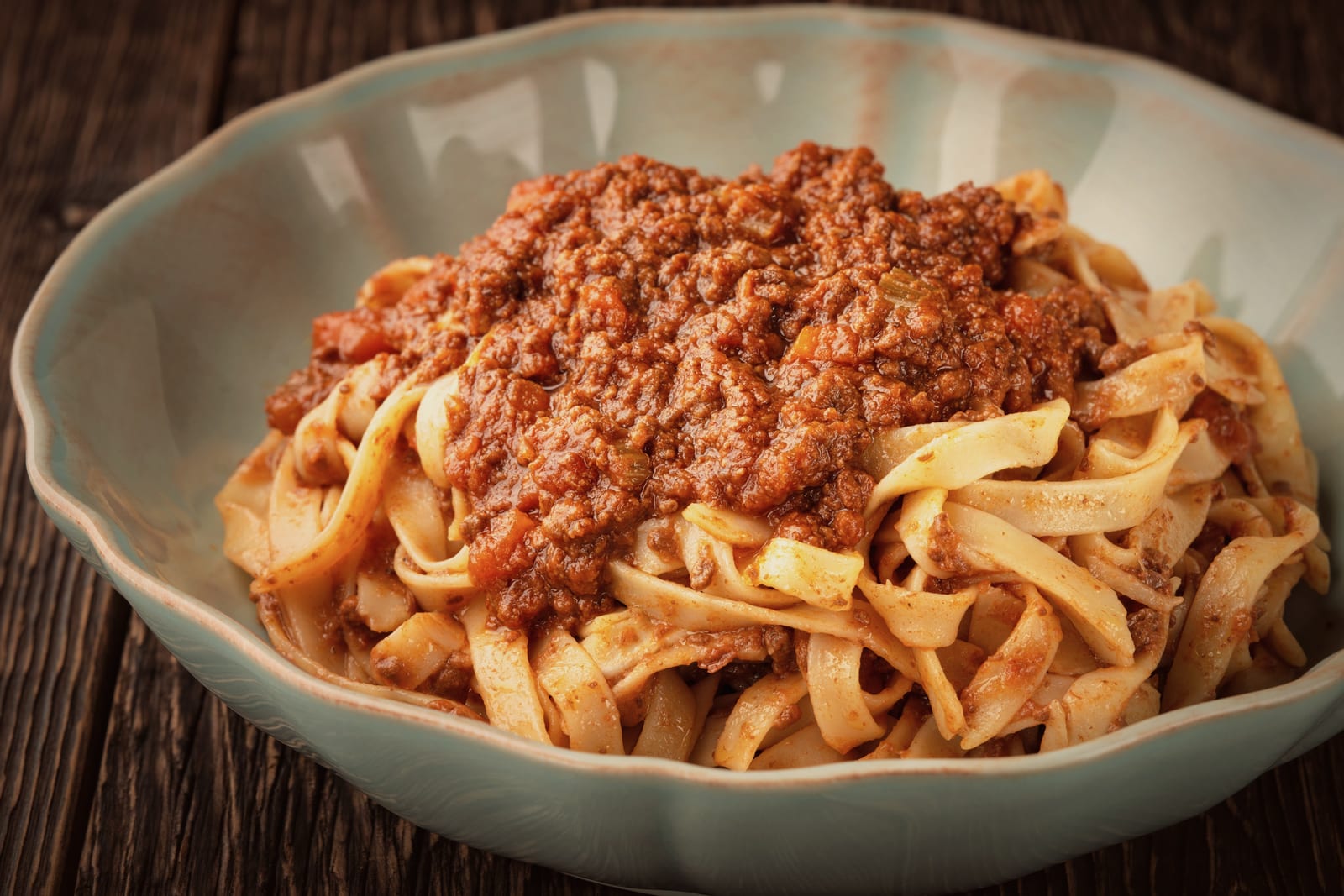
Meat first, tomato to season
Ragù alla bolognese is a meat sauce in which the meat, not the tomato, is the main ingredient: the tomato is used in small amounts, as a concentrate or a few spoonfuls of passata, to color and season. The meat is browned, moistened with wine, then cooked slowly for two hours or more until it is tender and the sauce is thick, glossy and dark.
Outside Italy the dish is widely known as "spaghetti bolognese", a combination that is not part of Bologna's tradition. In the city, ragù dresses fresh egg pasta, above all tagliatelle, whose wide, porous surface holds the sauce; it is also the filling of lasagne verdi alla bolognese, layered with béchamel and Parmigiano Reggiano.
Artusi in 1891, the Accademia in 1982
The word ragù comes from the French ragoût. Meat sauces for pasta are documented in Emilia from the 18th and 19th centuries. Pellegrino Artusi's La scienza in cucina e l'arte di mangiar bene (1891) includes maccheroni alla bolognese, dressed with a sauce of lean veal, pancetta, butter, onion and carrot, without tomato, and with optional additions such as dried mushrooms, chicken livers or a little cream.
On 17 October 1982 the Bologna delegation of the Accademia Italiana della Cucina deposited its "classic" recipe with the Bologna Chamber of Commerce, to set a reference against the many versions sold under the name. It called for beef cartella (which the Accademia's 2023 note describes as the diaphragm), pancetta, carrot, celery, onion, tomato passata or concentrate, white wine, whole milk, broth and optional cream. On 20 April 2023 the Accademia deposited a revised text: according to the Chamber of Commerce's announcement, it accepts coarsely minced beef from the butcher's counter in place of the hard-to-find cartella, fresh pancetta, red or white wine, and treats the milk as optional. The 2023 text excludes garlic, other herbs and spices, veal, smoked pancetta and flour; the long simmer is the same.
Ingredients
| Ingredient | Amount | Note |
|---|---|---|
| Beef, coarsely minced | 500 g / 1.1 lb | from a fatty cut: cartella, flank, skirt or chuck |
| Pancetta | 200 g / 7 oz | fresh or rolled, finely chopped |
| Onion | 60 g / 2 oz | very finely chopped |
| Carrot | 80 g / 3 oz | very finely chopped |
| Celery | 80 g / 3 oz | very finely chopped |
| Olive oil or butter | 3 tbsp / 45 ml | |
| Dry white or red wine | 150 ml / ⅔ cup | |
| Tomato passata | 100 g / 3½ oz | or 30 g / 1 oz double concentrate |
| Whole milk | 150 ml / ⅔ cup | traditional; optional in the 2023 text |
| Meat broth | about 500 ml / 2 cups | hot, added little by little |
| Salt, black pepper | to taste | |
| Fresh egg tagliatelle | 600 g / 1.3 lb | to serve 6 |
Method
- In a heavy, wide pan, melt the pancetta gently in the oil or butter over medium-low heat, about 5 minutes, without letting it crisp.
- Add the onion, carrot and celery (the soffritto) and cook slowly until soft and translucent, 8–10 minutes.
- Raise the heat, add the beef and break it up with a wooden spoon. Cook, stirring, until the liquid it releases has evaporated and the meat begins to sizzle and color, 10–15 minutes.
- Pour in the wine and let it evaporate almost completely, scraping the bottom of the pan.
- Stir in the passata or the concentrate diluted in a ladle of broth. Lower the heat to the minimum, partly cover and simmer for at least 2 hours, with the surface barely bubbling. Add hot broth a ladle at a time whenever the sauce looks dry.
- About 30 minutes before the end, add the milk a little at a time; it softens the acidity of wine and tomato and rounds the sauce. Season with salt and pepper.
- The ragù is ready when it is thick and the fat glistens on the surface. Cook the tagliatelle in salted water, drain while still slightly firm and toss with the ragù in the pan, with a little cooking water if needed. Serve with grated Parmigiano Reggiano.
Pork, livers and the Naples ragù
Within Emilia, family recipes add pork or a mixture of beef and pork, chicken livers, or a spoonful of cream at the end; the Accademia lists veal, smoked bacon, garlic and flour among the ingredients that do not belong. Ragù napoletano, the other great Italian ragù, works differently: large pieces of beef and pork, often rolled braciole, are cooked for many hours in a generous quantity of tomato and red wine. The sauce dresses pasta as a first course, and the meat is served afterwards as a second course.
Many cuisines have minced-meat sauces of their own: the Greek kima served with pasta, the British cottage pie filling, and salsa boloñesa as it is made across Latin America, usually with more tomato than the Bolognese reference. For other slow beef dishes, see ossobuco and beef stew; for minced beef as a cut, see ground beef.
Tagliatelle, not spaghetti
In Bologna, tagliatelle al ragù is served as a first course (primo), with grated Parmigiano Reggiano. Ragù also fills lasagne and can dress short pasta such as rigatoni or garganelli; it keeps for 3–4 days refrigerated and freezes well. Common mistakes: adding too much tomato, which turns ragù into a tomato sauce with meat; skipping the browning, so the meat boils grey; simmering too briefly; adding garlic or dried herbs, which are not part of the Bolognese recipe; and serving it on long, thin dried pasta, which the sauce slides off.
Frequently asked questions
Is spaghetti bolognese authentic?
Not in Bologna: there, ragù is served with fresh egg tagliatelle or used in lasagne. Spaghetti bolognese developed abroad.
Why is milk added to bolognese sauce?
Milk softens the acidity of the wine and tomato and makes the sauce rounder. It is in the 1982 reference recipe; the 2023 revision makes it optional.
How much tomato goes in ragù alla bolognese?
Little: a few tablespoons of passata or a spoonful of concentrate for the whole pan. The meat is the main ingredient.
How long should ragù simmer?
At least 2 hours at a bare simmer; many cooks go to 3 hours or more for a deeper flavor.
What meat is used in the official bolognese recipe?
The 1982 text calls for beef cartella (the diaphragm) with pancetta; the 2023 revision accepts coarsely minced beef in its place.
Sources
6
- Larousse Gastronomique, rev. ed. London: Hamlyn, 2009.
- McGee, Harold. On Food and Cooking: The Science and Lore of the Kitchen, rev. ed. New York: Scribner, 2004.
- Artusi, Pellegrino. La scienza in cucina e l'arte di mangiar bene. Florence, 1891.
- Accademia Italiana della Cucina, Delegazione di Bologna. Ricetta classica del ragù alla bolognese, deposited with the Camera di Commercio di Bologna, 17 October 1982.
- LaPresse. "Cambia la ricetta del ragù bolognese: eccola." 20 April 2023. www.lapresse.it/cronaca/2023/04/20/cambia-la-ricetta-del-ragu-bolognese-eccola
- Camera di Commercio di Bologna; Accademia Italiana della Cucina. Deposito della rinnovata ricetta del vero ragù alla bolognese (press release). Bologna, 20 April 2023. www.bo.camcom.gov.it/sites/default/files/comunicazione/comunicati/2023/comunicato%20stampa%20deposito%20rinnovata%20ricetta%20vero%20Rag%C3%B9%20alla%20bolognese%2020%20aprile%202023.pdf
Related