Main course · From Sweden to Vietnam
Meatballs
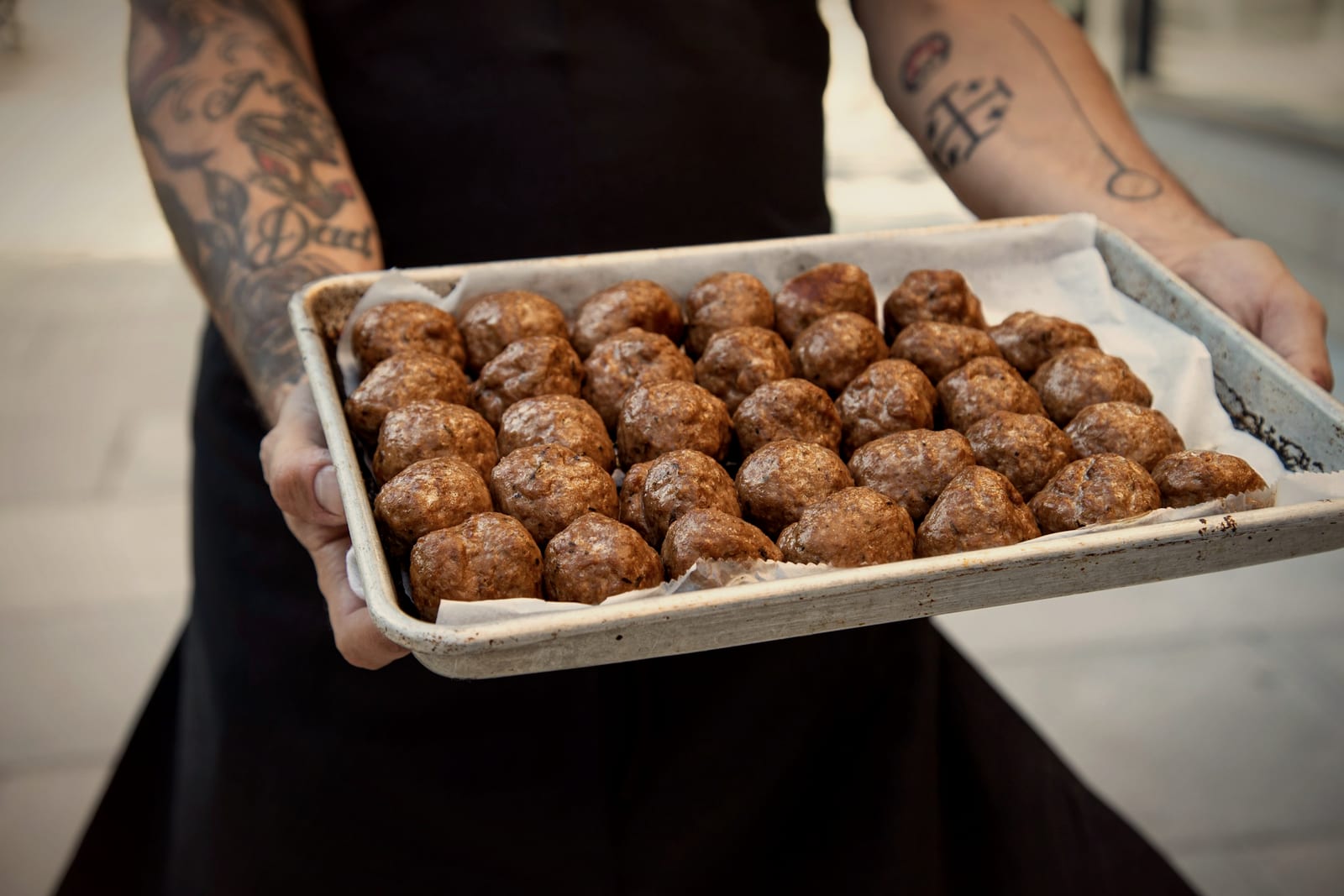
Meatballs are small balls of minced meat bound with egg, bread or starch and seasoned, then fried, simmered, baked or poached, from Swedish köttbullar and Spanish albóndigas to kofta and Vietnamese bò viên. The binder holds moisture: without it the proteins shrink as they set and the ball turns dense.
At a glance
- Found in
- Most cuisines that eat minced meat
- Meat
- Ground beef, 15–20 % fat
- Safe inside
- 71 °C / 160 °F (USDA)
- Size
- About 30 g / 1 oz each
- Serves
- 6 (about 30 meatballs)
- Time
- 35 min active, 1 h total
Why a binder keeps them tender
A meatball is minced meat shaped into a ball, usually 2–5 cm / ¾–2 in across. Most recipes add a binder, such as egg, breadcrumbs soaked in milk or water (a panade), rice or starch, which holds moisture and keeps the texture tender. Without it, minced meat cooked in a ball tightens and becomes dense, because the proteins shrink as they set.
Beef is the most common meat in many traditions, alone or mixed with pork, veal or lamb. A fat content of 15–20 % gives juicy meatballs; very lean mince makes them dry. Because mincing spreads surface bacteria through the meat, ground beef must be cooked through: the USDA's safe minimum internal temperature is 71 °C / 160 °F.
Al-bunduqa, kufta and Charles XII
Shaping minced meat into balls is very old and appears independently in many places. Recipes for seasoned minced-meat balls appear in medieval Arabic cookbooks, and the Spanish word albóndiga is usually traced to the Arabic al-bunduqa, "hazelnut" or small ball. The kofta family, from the Persian kufta, "pounded", spread from Persia and the Arab world to Turkey, the Balkans and South Asia.
The Swedish köttbullar are often said to have been brought from the Ottoman Empire by King Charles XII in the early 18th century; the story is popular but historians consider the evidence thin. In Italy, polpette are generally eaten as a second course, without pasta; spaghetti and meatballs is an Italian-American dish that took shape in the United States in the early 20th century.
Ingredients
| Ingredient | Amount | Note |
|---|---|---|
| Ground beef | 900 g / 2 lb | 15–20 % fat; or half beef, half pork |
| Fresh breadcrumbs | 60 g / 2 oz | crustless white bread, torn |
| Milk | 120 ml / ½ cup | to soak the bread |
| Eggs | 2 | |
| Onion | 1 small, about 100 g / 3½ oz | grated or very finely chopped |
| Garlic | 2 cloves | grated; optional |
| Parsley | 15 g / ½ oz | finely chopped |
| Grated hard cheese | 40 g / 1½ oz | optional (Parmigiano or similar) |
| Salt | 12 g / ⅖ oz | about 2 tsp fine salt |
| Black pepper | to taste | |
| Oil | 3 tbsp / 45 ml | for browning |
| Tomato sauce or beef stock | 800 ml / 3⅓ cups | for simmering |
Method
- Soak the breadcrumbs in the milk for 5 minutes, then mash them into a paste (the panade).
- In a large bowl, combine the panade with the eggs, onion, garlic, parsley, cheese, salt and pepper. Add the beef and mix with your hands just until even; overmixing makes meatballs springy and tight.
- Fry a teaspoon of the mixture to check the seasoning and adjust. With wet hands, shape balls of about 30 g / 1 oz (about 3.5 cm / 1½ in). Chill for 15 minutes if the mixture is soft.
- Heat the oil in a wide pan over medium-high heat and brown the meatballs in batches, turning them, 4–5 minutes per batch. They do not need to be cooked through at this stage.
- Pour off excess fat, add the tomato sauce or stock and bring to a simmer. Return the meatballs, cover and cook gently for 15–20 minutes.
- Check one of the largest meatballs with a thermometer: it must reach 71 °C / 160 °F at the center. Serve in the sauce.
Köttbullar, polpette, kofta, bò viên
Köttbullar (Sweden) are small, made of beef or beef and pork with breadcrumbs and cream, fried in butter and served with a cream gravy, lingonberry jam, mashed or boiled potatoes and often pickled cucumber. Polpette (Italy) vary by region and are fried, baked or simmered in tomato sauce and eaten as a second course; the larger, sauce-covered meatballs of spaghetti and meatballs belong to Italian-American cooking. Albóndigas (Spain) are simmered in a sauce of saffron and almonds or tomato; in Mexico, albóndigas are often served in a broth with vegetables and may contain rice.
Kofta and köfte (Middle East, Turkey, South Asia) use beef or lamb with onion, herbs and spices, and are grilled on skewers, fried or cooked in curry. Bò viên (Vietnam) are springy beef balls of Chinese origin, made by pounding or blending lean beef to a smooth paste with fish sauce, starch and pepper, then poaching it; they are eaten in phở and noodle soups. The Chinese lion's head (shīzi tóu), large meatballs braised or steamed with cabbage, is made with pork, not beef.
In their sauce, cooked to 71 °C
Meatballs are served in their sauce with pasta, rice, potatoes or bread, in soups, in sandwiches, or alone as a snack or tapa. They freeze well after cooking. Common mistakes: using very lean mince, which makes them dry; skipping the binder; mixing too long; making them of uneven size, so some overcook while others are underdone; and judging doneness by color, which is not a reliable indicator for ground beef. A thermometer reading of 71 °C / 160 °F is the safe test.
Frequently asked questions
What temperature should beef meatballs be cooked to?
71 °C / 160 °F at the center, the USDA's safe minimum for ground beef. Color is not a reliable sign of doneness.
Why are my meatballs tough?
Usually because the meat is too lean, there is no panade of soaked bread, or the mixture has been mixed too long. Mix only until combined.
Do Italians eat spaghetti and meatballs?
Not as a traditional dish: in Italy, polpette are usually a second course without pasta. Spaghetti and meatballs developed among Italian Americans.
What are Swedish meatballs served with?
Traditionally with a cream gravy, lingonberry jam, potatoes and often pickled cucumber.
What is bò viên?
Vietnamese beef balls made from a smooth, pounded beef paste, poached until springy and eaten in phở and other noodle soups.
Sources
4
- USDA Food Safety and Inspection Service. Safe Minimum Internal Temperature Chart. 2023. www.fsis.usda.gov/food-safety/safe-food-handling-and-preparation/food-safety-basics/safe-temperature-chart
- McGee, Harold. On Food and Cooking: The Science and Lore of the Kitchen, rev. ed. New York: Scribner, 2004.
- Davidson, Alan. The Oxford Companion to Food. Oxford: Oxford University Press, 1999.
- Smith, Andrew F. (ed.). The Oxford Companion to American Food and Drink. New York: Oxford University Press, 2007.
Related